
Ciutat de les Arts i les Ciencies and the white futurism of Valencia
Published on 08/21/2026 at 22:59 | Editorial responsibility: Rafael Müller, Editor-in-Chief AD HOC NEWS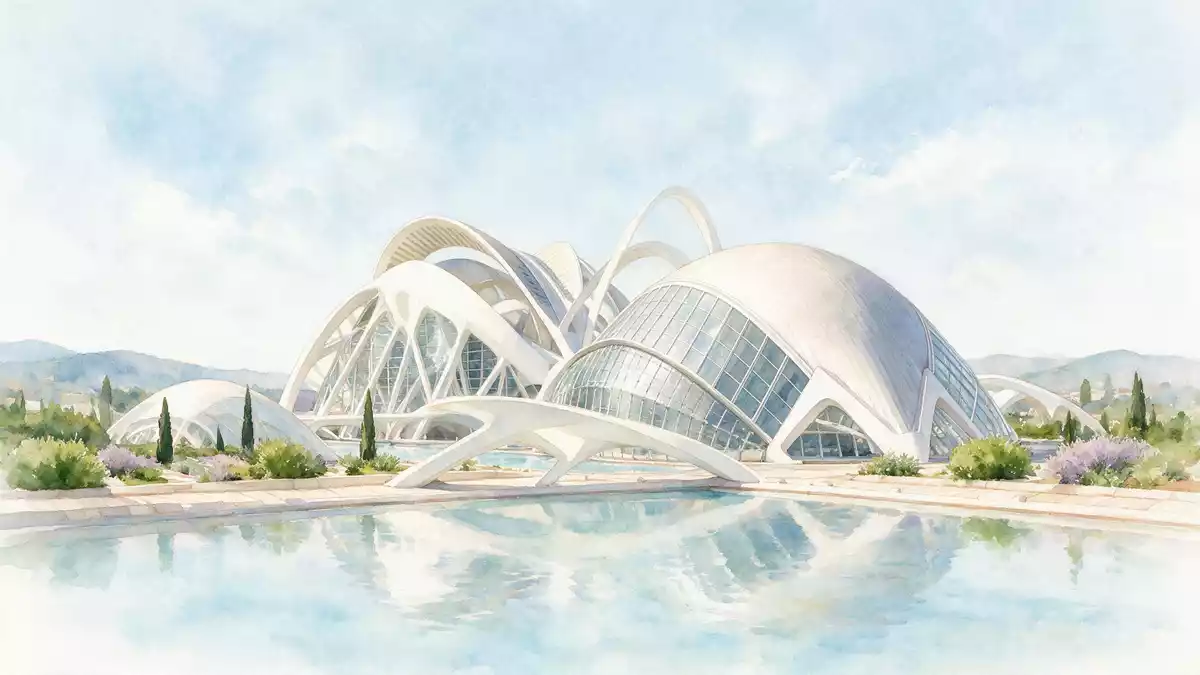
Ciutat de les Arts i les Ciencies in Valencia is a vast cultural and scientific complex laid out along the former bed of the Turia river, known for its white neo?futurist architecture reflected in long pools of water. Conceived in the 1990s and opened in phases from 1998 onwards, it brings together exhibition halls, gardens and performance spaces in one continuous sculptural landscape.
White concrete and a neo?futurist river of architecture
Ciutat de les Arts i les Ciencies was commissioned by the Generalitat Valenciana as a cultural and scientific complex occupying a large stretch of the diverted Turia riverbed on the southern side of Valencia’s historic centre.complex devoted to scientific and cultural dissemination The overall project took shape between the early 1990s and the 2000s, with construction beginning in 1996 and the first building, L’Hemisfèric, inaugurated in April 1998.construction in July 1996 and inauguration in April 1998 The main architect of the ensemble is the Valencia?born engineer and architect Santiago Calatrava, joined by the Spanish?Mexican architect Félix Candela for the Oceanogràfic aquarium, whose thin?shell concrete roofs are among the most distinctive structures on the site.Calatrava as director with collaborations of Félix Candela
The complex extends over a linear axis of roughly two kilometres, with buildings, promenades and planted areas arranged parallel to long sheets of water that echo the memory of the river.axis of just under two kilometres that was formerly the bed of the River Turia Across the site, white concrete and steel are used in expressive structural forms, contrasted with glass façades and the blue of the water basins. The architecture belongs to a neo?futurist and structural expressionist language, where exposed supports, sweeping curves and cantilevered elements define the spaces as much as their internal layouts.neo?Futurist and Structural Expressionist, 350,000+ sq m complex
L’Hemisferic, the Science Museum and the Umbracle
Approaching from the city side, many visitors encounter first L’Hemisferic, a cinema and planetarium whose form suggests a giant eye, set within a shallow expanse of water that mirrors its white structure and glass surfaces.L’Hemisfèric IMAX cinema and planetarium shaped like a giant eye Inside, the building houses an IMAX cinema and digital projection spaces arranged beneath a large dome, while externally its elongated profile anchors one end of the complex. Behind it stands the Museu de les Ciències, the science museum, with a long, ribbed structure running parallel to the water, containing several levels of interactive exhibition galleries.
Beside these buildings rises the Umbracle, a landscaped walkway and garden constructed over a parking structure, where a sequence of tall white arches frames planting and open air paths.Umbracle as landscaped vantage point and car park This elevated promenade offers views across the complex, taking in the science museum to one side and the long pools and bridges to the other. Together, L’Hemisferic, the Museu de les Ciències and the Umbracle form a cluster where scientific exhibition, cinematic projection and landscaped public space sit within a continuous composition of white structural forms.
Oceanografic and Palau de les Arts Reina Sofia
Further along the axis from the science museum, the Oceanogràfic occupies a group of pavilions and water bodies dedicated to marine environments, with Candela’s concrete roofs forming sculptural, petal?like shells over the main buildings.Oceanogràfic roofs by Félix Candela Within this part of Ciutat de les Arts i les Ciencies, aquaria and outdoor pools are arranged to present different oceanic regions, while the surrounding architecture continues the language of white surfaces contrasted with water and sky. The Oceanogràfic is widely described as the largest aquarium in Europe, and its integration into the broader complex underscores the site’s focus on scientific and environmental themes.Oceanogràfic as the largest aquarium in Europe
At the far end of the ensemble rises the Palau de les Arts Reina Sofia, the opera house and performing arts centre whose layered, curving forms and projecting decks have become one of the most recognisable images of Valencia.Palau de les Arts Reina Sofia opened in 2005 Inside, it contains opera and concert halls stacked within its sculptural envelope, while outside terraces, ramps and viewing platforms connect the building with the water and gardens below. Alongside the Palau stands the Ágora, a later addition that creates an enclosed space for major events and houses the CaixaForum cultural centre, continuing the theme of large?scale public venues expressed through exposed structural forms.Palau de les Arts and Ágora with CaixaForum
Visiting Ciutat de les Arts i les Ciencies: what travellers from Western Europe should know
- Ciutat de les Arts i les Ciencies lies in the former Turia riverbed south?east of Valencia’s historic centre and is reached by city bus routes and roads such as Av del Professor López Piñero.
- The complex is extensive and largely open?air, with long promenades beside water basins and several flights of steps and ramps connecting gardens, bridges and building entrances.
- The official language in Valencia is Spanish, with Valencian also used locally, and the currency across Spain is the euro.
- Other sights near Ciutat de les Arts i les Ciencies include the remaining landscaped sections of the Turia gardens and the Port of Valencia area towards the sea.
Searching for Ciutat de les Arts i les Ciencies on social platforms
These links open searches for Ciutat de les Arts i les Ciencies on each platform.
Frequently asked questions about Ciutat de les Arts i les Ciencies
Where is Ciutat de les Arts i les Ciencies located?
Ciutat de les Arts i les Ciencies stands in Valencia, Spain, along the former course of the Turia river in the south?eastern part of the city.
What can visitors expect on a visit to Ciutat de les Arts i les Ciencies?
Visitors encounter a sequence of museums, gardens, cinemas and performance spaces set among water basins and promenades, all framed by expressive white concrete and glass architecture.
What makes Ciutat de les Arts i les Ciencies distinctive among urban complexes?
The complex combines neo?futurist architecture by Santiago Calatrava and Félix Candela with a linear riverside layout, integrating science, marine life and opera within one continuous designed landscape.


