
Ciutat de les Arts i les Ciencies, a futuristic riverbed landscape in Valencia
Published on 08/29/2026 at 14:51 | Editorial responsibility: Rafael Müller, Editor-in-Chief AD HOC NEWS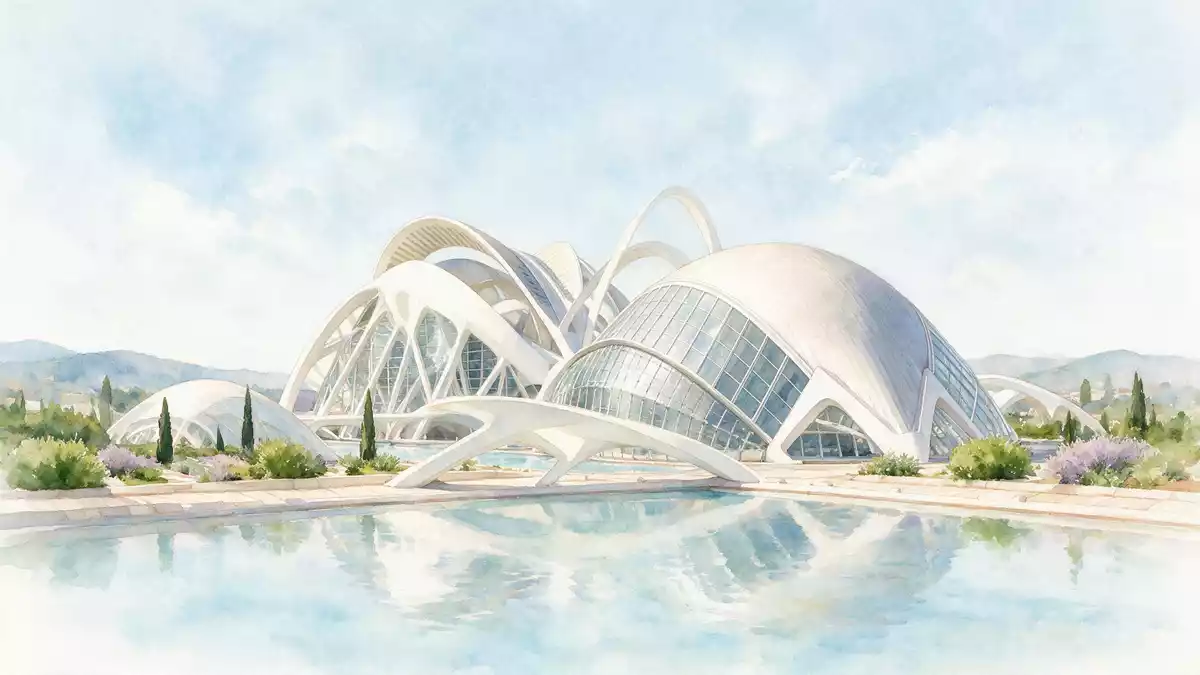
Ciutat de les Arts i les Ciencies in Valencia is a vast cultural and architectural complex where gleaming white structures, water and gardens fill the old bed of the Turia river in Spain’s Comunitat Valenciana.City of Arts and Sciences The ensemble took shape in the late twentieth century under Valencian architect Santiago Calatrava, with contributions from Mexican-Spanish architect Félix Candela, and extends for almost two kilometres along this reclaimed corridor.
A riverbed transformed into a linear cultural landscape
The most striking aspect of Ciutat de les Arts i les Ciencies is its setting: the complex runs along the former course of the Turia, a river whose diverted channel left a long, level strip cutting across Valencia towards the sea.old course of the Túria river Here the architecture lines a sequence of shallow water surfaces, planted edges and broad promenades that form an elongated park of concrete, glass and vegetation.
The complex occupies an area reported at around 350,000 m², a scale that becomes tangible as visitors walk between the buildings and see them receding along the riverbed.covers an approximate area of 350,000 m2 On one side lies the Autopista del Saler, on the other residential neighbourhoods, while the old river channel itself has been reshaped into terraces and basins where the reflective water surfaces mirror the white structures.
Futuristic architecture by Santiago Calatrava and Félix Candela
Ciutat de les Arts i les Ciencies is closely associated with Santiago Calatrava, whose expressive concrete and steel forms define much of the complex.Santiago Calatrava Félix Candela designed some of the thin-shell concrete elements, bringing his experience with daring curved structures into the composition.Félix Candela The result is a series of buildings that share a palette of white concrete, glass and steel, while each keeps a distinct profile.
The Hemisfèric, opened as the first element in 1998, is a cinematic and planetarium space whose structure rises beside a broad water surface.Hemisfèric Nearby stands the Museu de les Ciències, a long building with exposed structural ribs and extensive glazing that houses interactive science exhibitions.science museum Towards the seaward end rises the Palau de les Arts Reina Sofia, a sculptural opera house whose layered concrete forms shelter performance halls and terraces.
Water, gardens and the ensemble of attractions
Beyond the individual buildings, Ciutat de les Arts i les Ciencies works as an ensemble of attractions set in a landscape of water and planting. L’Umbracle forms a raised gardened walkway with regional and tropical species framed by large structural arches, offering views across the complex and towards Valencia’s skyline.L’Umbracle viewpoint with gardens Below and around it, paved areas link the cultural spaces in a sequence that encourages long strolls alongside the water surfaces.
The complex brings together institutions dedicated to different aspects of science and culture. Oceanogràfic is described as the largest aquarium in Europe, with marine environments representing seas and oceans from various parts of the world.largest aquarium in Europe The Àgora, a high-roofed events space, completes the sequence, providing a flexible setting for exhibitions and gatherings at the far end of the riverbed composition.L’Àgora multifunctional space
Visiting Ciutat de les Arts i les Ciencies: what travellers from Western Europe should know
- Ciutat de les Arts i les Ciencies lies in the Quatre Carreres district of Valencia along the former Turia riverbed, close to Avenida Professor López Piñero and the Autopista del Saler.
- The terrain within the complex is largely level, with broad paved promenades and bridges that cross the water surfaces; reaching some vantage points involves staircases and ramps inside the buildings.
- Valencia is reached by rail and air from Western Europe, with the complex situated between the historic city centre and the port along the Jardí del Túria corridor.
- The official language is Spanish and the regional language Valencian, and the currency is the euro.
- Entry requirements depend on your nationality; UK travellers can check the FCDO travel advice at gov.uk/foreign-travel-advice, Irish travellers the Department of Foreign Affairs at ireland.ie.
Searching for Ciutat de les Arts i les Ciencies on social platforms
These links open searches for Ciutat de les Arts i les Ciencies on each platform.
Frequently asked questions about Ciutat de les Arts i les Ciencies
Where is Ciutat de les Arts i les Ciencies located?
Ciutat de les Arts i les Ciencies is in Valencia, Spain, occupying a long stretch of the former Turia riverbed near Avenida Professor López Piñero in the Quatre Carreres district.
What can visitors expect during a visit?
Visitors encounter a sequence of futuristic buildings, extensive water surfaces, gardens and promenades, housing attractions such as a science museum, planetarium, aquarium, opera house and event spaces.
What makes Ciutat de les Arts i les Ciencies distinctive compared with other urban complexes?
Its combination of large-scale expressive architecture by Santiago Calatrava and Félix Candela, its linear riverbed setting, and the integration of cultural, scientific and marine institutions into a single designed landscape give it a distinctive character.


