
Ciudad Amurallada de Cartagena and its stone embrace of the Caribbean
Published on 09/08/2026 at 21:14 | Editorial responsibility: Rafael Müller, Editor-in-Chief AD HOC NEWS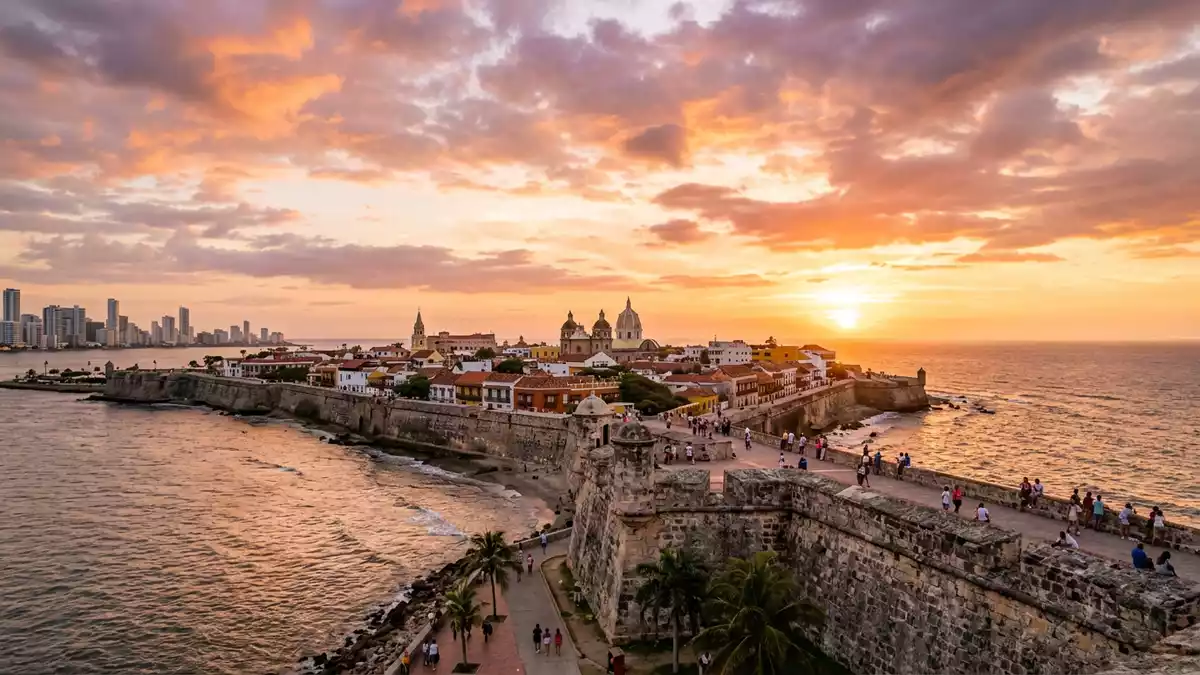
Ciudad Amurallada de Cartagena is the historic walled core of Cartagena de Indias on Colombia’s Caribbean coast, enclosed by thick coral-stone fortifications that still ring its streets. Within these walls, a compact grid of colonial houses, churches and plazas preserves the atmosphere of a Spanish port city from the sixteenth to eighteenth centuries.
Stone walls built for a Caribbean stronghold
The defining feature of Ciudad Amurallada de Cartagena is its continuous defensive wall system, raised in response to repeated attacks on this Spanish colonial harbour. Construction of the fortifications began in 1586 and continued into the eighteenth century, creating a belt of masonry around the town that took more than two centuries to complete.Construction began in 1586 Large stretches of the walls were built using coral stone quarried nearby, a material that gives their surfaces a pale, rough texture in strong tropical light.Coral-stone walls along the sea
Walking along the ramparts reveals a sequence of bastions and curtain walls facing the Caribbean, with cannon positions oriented towards the open water where enemy ships once approached. The fortifications form part of a wider defensive ensemble of Cartagena de Indias recognised by UNESCO in 1984 as “Puerto, Fortaleza y Conjunto Monumental de Cartagena de Indias”, confirming the city’s status as a World Heritage site.UNESCO World Heritage inscription in 1984 Sections of the masonry open towards the modern skyline of Bocagrande, setting the low colonial fabric of the old town against later towers beyond the harbour.
A compact colonial city within the walls
Inside Ciudad Amurallada de Cartagena, the urban fabric is a tightly knit arrangement of streets and squares typical of a Spanish colonial port. Narrow roadways link plazas such as Santo Domingo and San Pedro Claver, where stone churches face rows of houses whose upper floors carry overhanging balconies.Plazas Santo Domingo and San Pedro Claver Many facades are painted in strong colours, and timber balcony fronts frame views along the streets.
Among the civic buildings inside the walls are the Cathedral of Cartagena and former religious houses converted into hotels and cultural venues, alongside institutions such as the Palace of the Inquisition and museums dedicated to regional heritage. The historic centre, officially designated as the “Centro Histórico” of Cartagena de Indias, was declared a national monument of Colombia in 1959, reinforcing the protected status of the streets and buildings enclosed by the defensive ring.Centro Histórico designation and layout Houses with interior courtyards, arcaded walkways and thick masonry walls retain traces of the climate-conscious building techniques of the early colonial period.
Ciudad Amurallada de Cartagena in its wider urban and maritime setting
Ciudad Amurallada de Cartagena occupies a promontory on the north-western edge of Cartagena de Indias, bordered by the Caribbean Sea and by harbour waters that once brought fleets from Spain and other parts of the Americas.Location on the Caribbean coast The walled city forms the historic core of a much larger urban area that now includes districts such as Bocagrande with high-rise developments along the shoreline, and Getsemaní with streets beyond the old ramparts.
The defensive walls of Cartagena de Indias, including Ciudad Amurallada de Cartagena, extend for approximately 11 km when all stretches and bastions are taken into account, with several kilometres accessible on foot as a continuous elevated path above the streets.Approximate 11 km defensive system From certain points, the ramparts look out towards the curve of the coastline and the approaches to the bay, underlining the strategic position that led the Spanish Crown to invest heavily in fortifying Cartagena between the sixteenth and eighteenth centuries.Sixteenth to eighteenth-century fortifications
Visiting Ciudad Amurallada de Cartagena: what travellers from Western Europe should know
- Ciudad Amurallada de Cartagena forms the historic centre of Cartagena de Indias on Colombia’s Caribbean coast, reached from Rafael Núñez International Airport by road connections into the Centro Histórico.
- The walled city is largely level, but access to the ramparts involves stairways up to the top of the masonry, and some sections follow the coastline with low parapets.
- The historic centre lies close to neighbourhoods such as Bocagrande and Getsemaní, so walking routes can link colonial streets with the seafront and adjacent districts in a single outing.
- The official language is Spanish and the currency is the Colombian peso.
- Entry requirements depend on your nationality; UK travellers can check the FCDO travel advice at gov.uk/foreign-travel-advice, Irish travellers the Department of Foreign Affairs at ireland.ie.
Searching for Ciudad Amurallada de Cartagena on social platforms
These links open searches for Ciudad Amurallada de Cartagena on each platform.
Frequently asked questions about Ciudad Amurallada de Cartagena
Where is Ciudad Amurallada de Cartagena located?
Ciudad Amurallada de Cartagena is the historic walled centre of Cartagena de Indias on Colombia’s Caribbean coast, set on a promontory beside the harbour.
What should visitors expect inside the walled city?
Visitors encounter narrow colonial streets, plazas with churches and civic buildings, colourful houses with balconies, and extensive stone ramparts that can be explored on foot.
What makes Ciudad Amurallada de Cartagena distinctive among historic centres?
Its combination of long coral-stone sea walls, a compact Spanish colonial street grid, and formal recognition as a UNESCO World Heritage site gives the old town a marked defensive and architectural character.


