
Citadel of Qaitbay and Alexandria’s fortress on the sea
Published on 09/23/2026 at 18:41 | Editorial responsibility: Rafael Müller, Editor-in-Chief AD HOC NEWS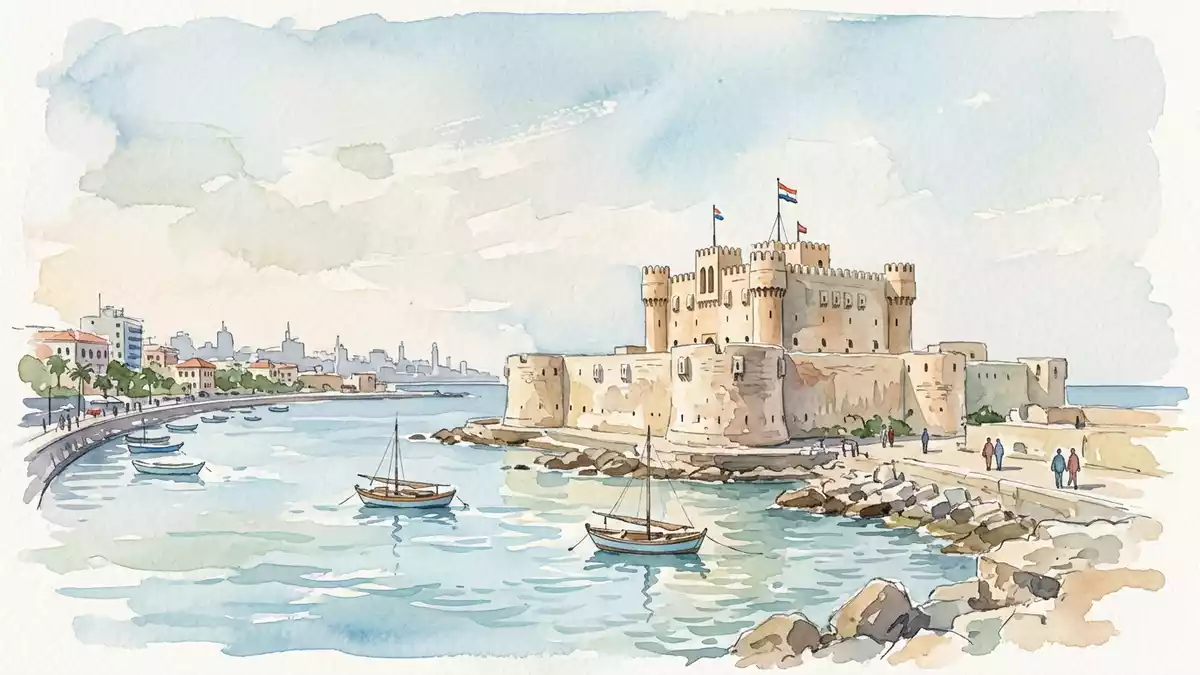
Citadel of Qaitbay occupies the eastern edge of Pharos Island at the entrance to Alexandria’s Eastern Harbour. Its limestone walls, corner towers and broad sea-facing position create a fortress whose identity remains tied to Alexandria’s ancient lighthouse.
Citadel of Qaitbay on the site of Pharos
The citadel was built between 1477 and 1479 during the rule of the Mamluk sultan al-Ashraf Abu al-Nasr Qaitbay. The Egyptian monument record places its construction over the ruins of Alexandria’s Lighthouse, the Pharos associated with the ancient city’s maritime history. The monument record identifies the fortress as a limestone structure surrounded by defensive walls.
The lighthouse dated from 279 BC and occupied the same important harbour entrance. Earthquake damage affected the ancient structure, and its remains were demolished in 1375. Stones from the lighthouse remained in the area and were used in the construction of the Mamluk citadel. The relationship between the two monuments gives the fortress a layered place in Alexandria’s history, with a medieval stronghold occupying ground associated with the ancient Mediterranean world.
A Mamluk fortress in limestone
Citadel of Qaitbay covers approximately 17,550 square metres. An outer wall encloses the building, while an inner wall surrounds the courtyard. The outer defences include towers and sea-facing passages, and the inner spaces contain rooms associated with barracks, storage and military equipment.
The main tower is a square, three-storey building with sides measuring 30 metres and a height of 17 metres. Circular towers occupy its corners, while projecting balconies and narrow openings form part of its defensive design. The upper edges carry arched battlements, and the entrance bears Qaitbay’s emblem. The main tower contains a mosque, chambers and a great hall linked with the sultan.
Courtyards, harbour views and changing rulers
The entrance opens towards the courtyard, where the main tower forms the dominant building. Rooms within the surrounding walls served different military functions, including accommodation, provisions and weapons storage. A water tank stood near the tower for soldiers and horses.
The citadel underwent repairs under Sultan Qansuh al-Ghuri in 1501. Ottoman forces used it after taking Egypt in 1517, and Muhammad Ali Pasha renewed parts of the fortress during the nineteenth century. Damage followed the British bombardment of Alexandria in 1882. Restoration campaigns in the twentieth and twenty-first centuries returned the building to its role as a preserved historic monument.
Visiting Citadel of Qaitbay: what travellers from Western Europe should know
- Citadel of Qaitbay stands on the eastern edge of Pharos Island, beside Alexandria’s Eastern Harbour. The Corniche reaches the harbour area, and taxis provide road transport across Alexandria.
- The approach crosses a harbour-side setting and leads into a fortified complex of walls, courtyards and stairs. The main tower has three storeys, with internal passages and rooms.
- Alexandria’s official language is Arabic, and the currency is the Egyptian pound.
- The Mediterranean lies directly beside the fortress, with the sea-facing outer wall forming part of the visible setting.
Searching for Citadel of Qaitbay on social platforms
These links open searches for Citadel of Qaitbay on each platform.
Frequently asked questions about Citadel of Qaitbay
Where is Citadel of Qaitbay?
Citadel of Qaitbay stands on the eastern edge of Pharos Island in Alexandria, at the entrance to the city’s Eastern Harbour.
What can visitors expect inside?
The complex contains limestone walls, a courtyard, defensive rooms, a mosque and a three-storey main tower with internal passages.
What makes the fortress distinctive?
Its distinctive setting links a fifteenth-century Mamluk fortress with the site and surviving stone associated with Alexandria’s ancient lighthouse.


