
Citadel of Qaitbay, Alexandria’s stone guardian of the sea
Published on 09/16/2026 at 12:45 | Editorial responsibility: Rafael Müller, Editor-in-Chief AD HOC NEWS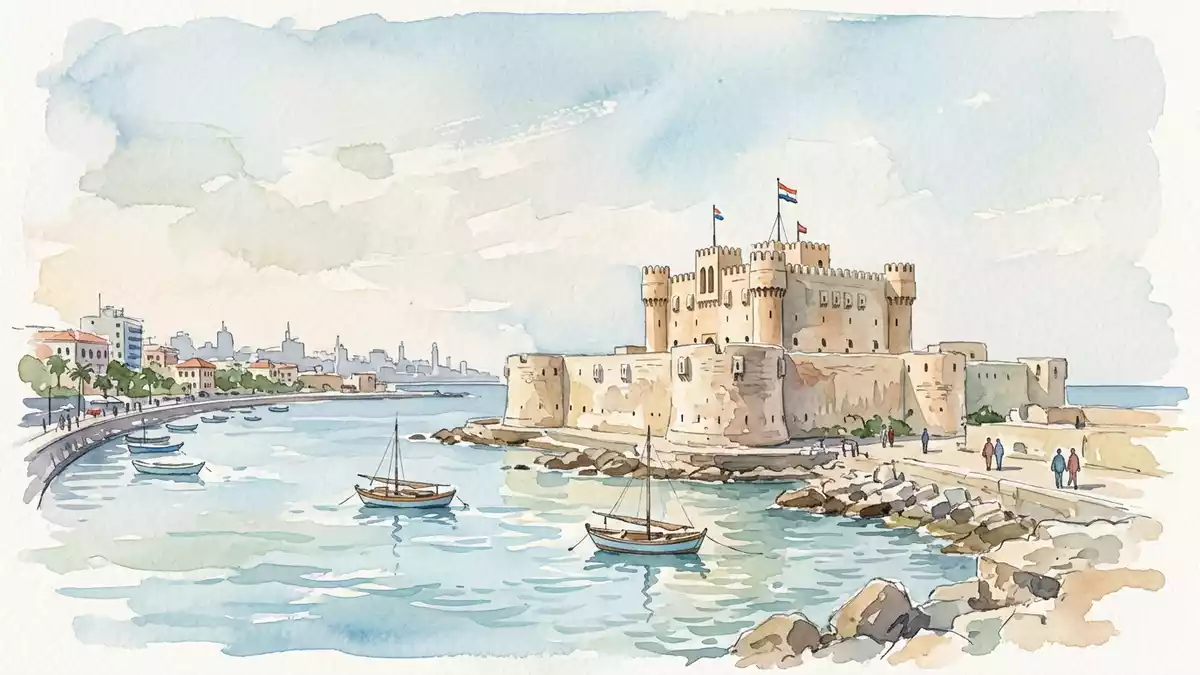
Citadel of Qaitbay rises at the seaward edge of Alexandria’s Eastern Harbour, a compact stone fortress that marks the site where the ancient Lighthouse of Alexandria once stood. Built in the late fifteenth century under the Circassian Mamluk sultan Al?Ashraf Sayf al?Din Qaitbay, it fuses medieval military engineering with a charged sense of place above the Mediterranean.
From Mamluk stronghold to harbour landmark
The Citadel of Qaitbay is a fifteenth?century defensive fortress on the Mediterranean coast, constructed on Pharos Island at the entrance to Alexandria’s main harbour.defensive fortress on the Mediterranean The Mamluk sultan Al?Ashraf Sayf al?Din Qaitbay ordered the stronghold between 1477 and 1479, adding a major stone bastion to the city’s system of coastal fortifications.built between 882 and 884 AH
Qaitbay’s fortress stands on the ruins of the ancient Lighthouse of Alexandria, the Pharos that classical authors counted among the Seven Wonders of the Ancient World.over the ruins of Alexandria’s Lighthouse Earthquakes in the medieval centuries reduced the lighthouse to rubble, and its surviving foundations provided a ready platform for late Mamluk military architecture.built on the Lighthouse of Alexandria site The citadel’s position at the harbour mouth gives it a clear line of sight over the shipping channel and along the Corniche.
Stone, geometry and the plan of the citadel
The fortress occupies an area of roughly 17,550 m² (about 4.3 acres), defined by outer walls that form an almost square enclosure around the central keep.spanned an area of approximately 17550 m2 The construction is predominantly limestone, a material widely used in Alexandria’s historic architecture, laid in thick courses that give the outer faces a blunt, robust profile towards sea and land.massive masonry and compact geometry
Within the enclosure, the plan centres on a multi?storey keep surrounded by courtyards and defensive galleries. The internal circulation uses staircases and corridors embedded in the thickness of the walls, connecting guardrooms, roof terraces and vantage points over the harbour. Arrow slits and gun ports punctuate the walls, marking the transition from earlier fortification techniques to the artillery age in the late Mamluk period.late Mamluk fortress
Layers of history above the Pharos foundations
The foundations beneath Citadel of Qaitbay reach back to the third century BCE, when the original Pharos lighthouse rose under the Ptolemaic ruler Ptolemy II Philadelphus as a marker for mariners approaching Alexandria.Pharos of Alexandria built between 280 and 247 BCE Earthquakes in 956, 1303 and 1323 CE progressively damaged the tower, leaving a broken structure that later builders could reuse.damaged by earthquakes in 956, 1303, and 1323 CE
When Qaitbay commissioned the fortress in 1477, stone from the collapsed Pharos was incorporated into the new walls, tying medieval defences physically to the earlier wonder.stone from the collapsed Pharos was reused In the centuries after Qaitbay’s reign, Ottoman forces integrated the citadel into their naval system, and later damage from nineteenth?century bombardment led to restoration work that shaped the fortress in its present form.heavily damaged during the British bombardment
Visiting Citadel of Qaitbay: what travellers from Western Europe should know
- Citadel of Qaitbay stands on Pharos Island at the western end of Alexandria’s Eastern Harbour, reached along the Corniche by road and local transport.
- The fortress interior includes staircases, terraces and roof walks; several routes involve climbing narrow stone steps and moving through enclosed passages within the walls.
- The site lies directly beside the Mediterranean, with exposed ramparts where strong sea winds and spray can affect the experience on the outer platforms.
- The official language is Arabic and the currency is the Egyptian pound.
- Entry requirements depend on your nationality; UK travellers can check the FCDO travel advice at gov.uk/foreign-travel-advice, Irish travellers the Department of Foreign Affairs at ireland.ie.
Searching for Citadel of Qaitbay on social platforms
These links open searches for Citadel of Qaitbay on each platform.
Frequently asked questions about Citadel of Qaitbay
Where is Citadel of Qaitbay located in Alexandria?
Citadel of Qaitbay stands on Pharos Island at the western tip of Alexandria’s Eastern Harbour, on the Mediterranean coast of Egypt.
What should visitors expect inside the fortress?
Visitors encounter thick limestone walls, a central keep with several levels, courtyards, staircases within the masonry and open terraces overlooking the harbour and sea.
What makes Citadel of Qaitbay distinctive among Alexandria’s landmarks?
The fortress combines late fifteenth?century Mamluk military design with the historic foundations of the Pharos lighthouse, linking medieval Alexandria directly to its ancient maritime past.


