
Cinque Terre’s terraced cliffs and five painted villages
Published on 09/07/2026 at 09:27 | Editorial responsibility: Rafael Müller, Editor-in-Chief AD HOC NEWS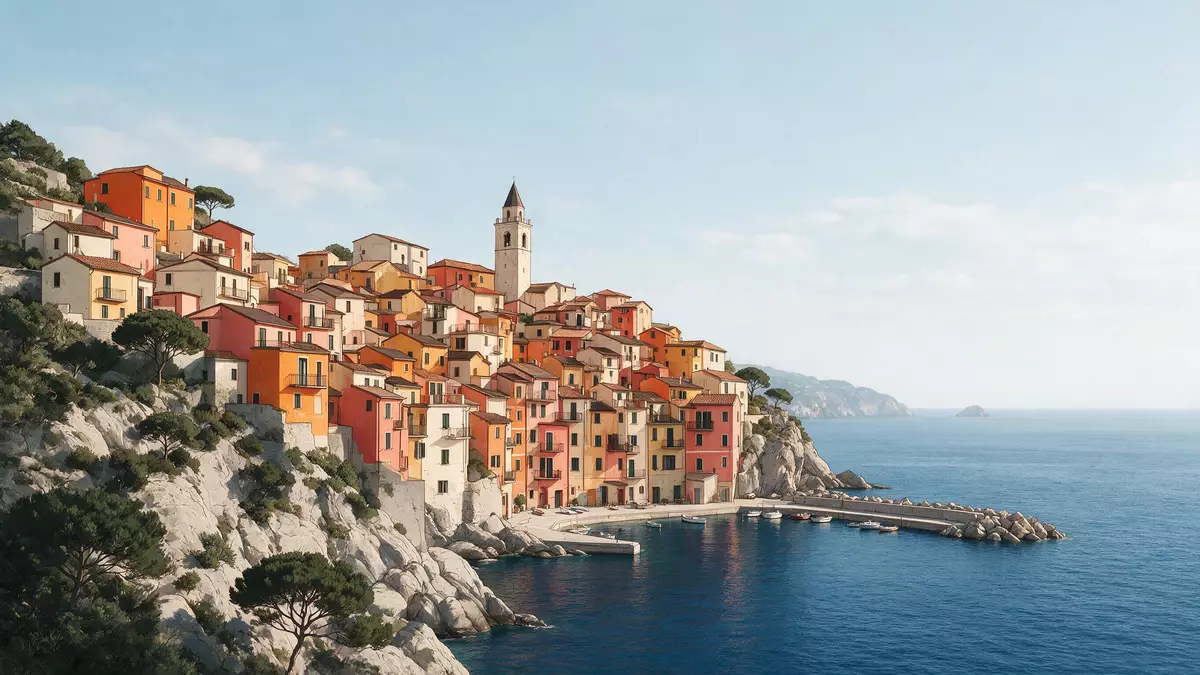
Cinque Terre on the Ligurian coast in north-west Italy compresses five fishing villages, steep terraces and a narrow railway line into a thin strip between mountains and sea. The coastline and its settlements form part of a cultural landscape that is recognised as a UNESCO World Heritage Site, tying the everyday fabric of the villages to the stone-walled slopes above them.
Five villages on a narrow Ligurian ledge
Cinque Terre takes its name from the “five lands”, a sequence of villages that cling to the eastern Ligurian coast in La Spezia province between Levanto and La Spezia. From west to east the line runs through Monterosso al Mare, Vernazza, Corniglia, Manarola and Riomaggiore, each facing the Ligurian Sea and backed by steep hills cut into terraces for vines and olives.The coastal area lies within Liguria and forms part of the wider site that also includes Portovenere and the small islands of Palmaria, Tino and Tinetto.The World Heritage listing covers the territory between Punta Mesco and Punta Persico
The villages sit inside Cinque Terre National Park, which is described as the smallest national park in Italy by area yet one of the most densely populated, because the settlements and their terraces fall within its boundaries.The park’s territory includes Riomaggiore, Vernazza and Monterosso al Mare The combination of maritime villages, agricultural terraces and protected land gives the area a layered identity as both inhabited landscape and conservation area.
A cultural landscape of terraces, paths and dry stone walls
The spine of Cinque Terre is the band of terraces that climb from the railway and the villages up the slopes, supported by dry stone walls built without mortar. Over centuries these narrow strips of cultivated land have been used primarily for vines and olive trees, creating a stepped pattern that runs for kilometres along the coast.The World Heritage description highlights terraces developed for vine and olive growing The walls and paths together form a kind of open-air infrastructure, linking small plots, hamlets and shrines across the slopes.
This intricate landscape of cultivation and settlement underpinned the decision in 1997 to inscribe Portovenere, Cinque Terre and the islands of Palmaria, Tino and Tinetto on the UNESCO World Heritage List as a cultural site.The inscription records the site under reference number 826 The designation emphasises how human-made terraces, small ports and hillside paths together form a coherent whole rather than separate attractions, with agriculture and fishing woven into the built fabric.
Railway tunnels, coastal paths and compact harbours
Access between the five villages has long been constrained by the steep terrain, and this remains part of the character of Cinque Terre. A regional railway line runs along the coast, largely in tunnels behind the villages, linking Monterosso al Mare, Vernazza, Corniglia, Manarola and Riomaggiore in sequence and connecting them with La Spezia and other Ligurian towns.The line serves the villages as part of a wider coastal route Platforms and station buildings sit close to the sea in several of the settlements, so trains and boats share the same narrow corridor of land.
Beyond the tracks, coastal paths and stepped lanes thread between houses, vineyards and chapels, sometimes running along the cliff edge and sometimes cutting inland through cultivated land.The official tourism information describes the five towns as hillside villages on a rugged coastline Small harbours provide sheltered water for fishing boats, and in several villages short promenades or breakwaters create public space close to the sea where the land had room for little more than a cluster of houses and a slipway.
Visiting Cinque Terre: what travellers from Western Europe should know
- Cinque Terre lies on the Ligurian coast of north-west Italy in the province of La Spezia, between the towns of Levanto and La Spezia, and is served by regional trains on the coastal line that connects through both.
- The terrain is steep throughout the villages and their surroundings, with stepped lanes, narrow alleys and paths that climb through terraced hillsides, so many routes involve long stairways rather than level pavements.
- The five villages stand within Cinque Terre National Park and along a protected marine area on the Ligurian Sea, so stretches of coastline around the settlements consist of rocky coves and headlands rather than broad sandy beaches.
- The official language is Italian and the currency is the euro, and place names in the area use Italian spellings such as Monterosso al Mare and Riomaggiore.
- Entry requirements depend on your nationality; UK travellers can check the FCDO travel advice at gov.uk/foreign-travel-advice, Irish travellers the Department of Foreign Affairs at ireland.ie.
Searching for Cinque Terre on social platforms
These links open searches for Cinque Terre on each platform.
Frequently asked questions about Cinque Terre
Where is Cinque Terre?
Cinque Terre is a stretch of Ligurian coastline in north-west Italy, in the province of La Spezia, facing the Ligurian Sea and backed by steep hills.
What should travellers expect on a visit?
Travellers encounter compact fishing villages with painted houses, a railway and paths squeezed between sea and terraces, and a landscape protected as both national park and cultural heritage site.
What makes Cinque Terre distinctive among coastal regions?
The combination of five closely spaced villages, dry stone terraces for vines and olives, and a continuous strip of protected land and sea gives Cinque Terre its particular character.


