
Church of the Holy Sepulchre as a layered shrine of stone and light
Published on 08/26/2026 at 16:39 | Editorial responsibility: Rafael Müller, Editor-in-Chief AD HOC NEWS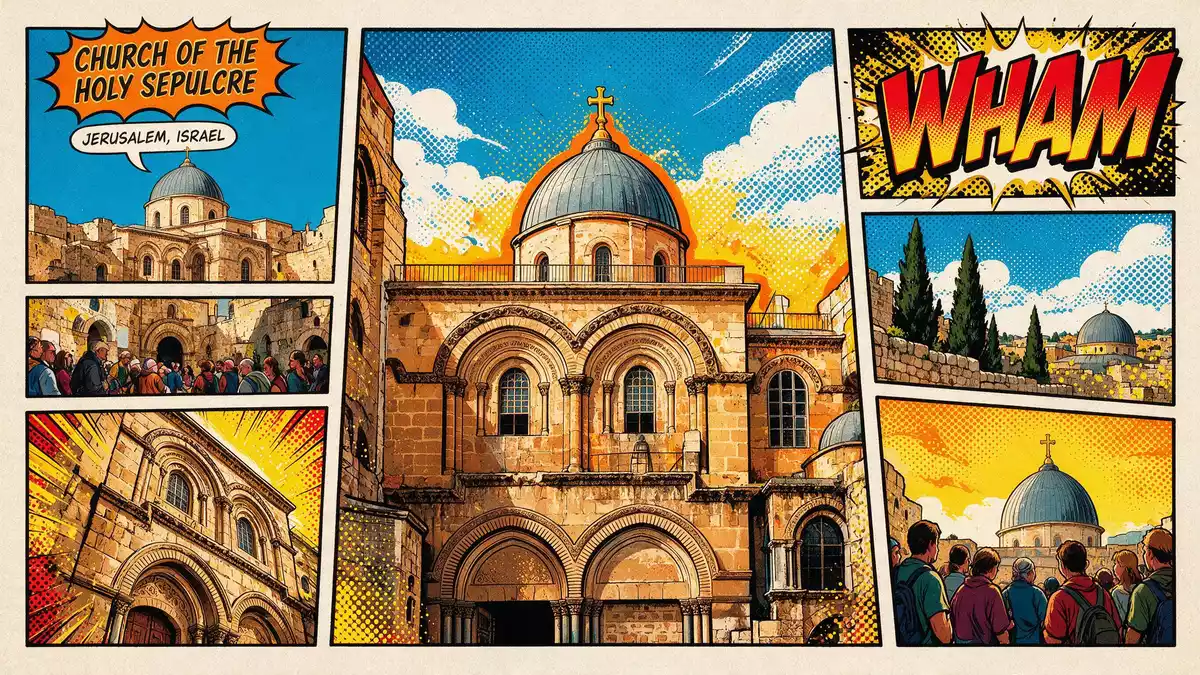
The Church of the Holy Sepulchre in Jerusalem compresses the places associated with the crucifixion and burial of Jesus into a single stone complex, layered with centuries of rebuilding. Visitors step into a space where a fourth-century imperial foundation, medieval crusader masonry and later restorations still frame the rock of Golgotha and the shrine over the tomb.
From Constantine’s complex to a crusader church
The story of the Church of the Holy Sepulchre begins under Emperor Constantine the Great in the fourth century, when a vast Christian complex was laid out in the north-west quarter of Jerusalem’s Old City. This early layout, consecrated in 335, combined a basilica known as the Martyrium with an open courtyard and a rotunda called the Anastasis, which enclosed the site venerated as the tomb of Christ.The original Constantinian complex brought together the traditional locations of the crucifixion and burial within a single ceremonial sequence of spaces.
This first church suffered major damage in 614 when Persian forces burned parts of Jerusalem, and it was later destroyed around 1009 on the orders of the Fatimid caliph al-Hakim bi-Amr Allah.A subsequent rebuilding under the Byzantine emperor Constantine IX Monomachos in 1048 restored key elements, though on a reduced scale compared with Constantine’s original scheme. The decisive reshaping came in the twelfth century, when crusader builders created a Romanesque church that unified the main holy sites under one roof and established much of the plan recognised today.Twelfth-century crusader reconstruction integrated the rotunda, a new choir and enclosed chapels into a single, continuous structure.
An interior that gathers Golgotha and the tomb
Stepping through the church’s south-facing entrance, visitors find themselves in an interior where different eras of stonework converge around the focal points of Christian devotion. The rock of Golgotha, the site identified with the crucifixion, rises within a chapel near the front of the church, its exposed surface framed by richly decorated altars and dense iconography.Descriptive accounts of the building emphasise how the church encloses both the outcrop of Calvary and the tomb, bringing what were once outdoor sites into a covered, architectural setting.
Beyond Golgotha, the space opens towards the Anastasis rotunda, where a broad dome rises over the Edicule, the small constructed shrine that marks the tomb. The rotunda is supported by massive piers and arcades, their heavy masonry belonging largely to the crusader period, and the Edicule stands at the centre as a distinct structure surrounded by circulating space.Architectural studies describe the combination of the rotunda over the tomb and the adjoining basilican spaces as a defining feature of the church, with later additions fitting around this core. The result is an interior where chapels, stairways and galleries cluster around the central axis linking Golgotha and the grave.
Layers of custody and World Heritage status
The Church of the Holy Sepulchre functions not only as a building but as a shared sanctuary for several Christian communities, including the Greek Orthodox Patriarchate, the Armenian Apostolic Patriarchate and the Franciscan Custody of the Holy Land. Their rights and responsibilities are regulated by the so-called Status Quo, a nineteenth-century arrangement that fixed patterns of use and maintenance, and remains a defining feature of the church’s daily life.Historical outlines of the church’s administration emphasise how this shared custody reflects the building’s importance to different traditions.
The church stands within the Old City of Jerusalem, an area inscribed on the UNESCO World Heritage List in 1981 as the “Old City of Jerusalem and its Walls”.UNESCO decisions on the Old City of Jerusalem and its Walls confirm this status and note that the site is also on the List of World Heritage in Danger. As a result, the Church of the Holy Sepulchre forms part of a larger protected urban fabric, with its domes, bell tower and clustered roofs contributing to the skyline of the Christian Quarter and its interior serving as a focus for pilgrims from across the world.
Visiting Church of the Holy Sepulchre: what travellers from Western Europe should know
- The Church of the Holy Sepulchre stands in the Christian Quarter of Jerusalem’s Old City, west of the Haram esh-Sharif, and is reached on foot through the Old City’s narrow streets.
- The approach involves uneven paving and short flights of stone steps around the church, and the interior includes stairways and confined chapels that may be crowded.
- Jerusalem lies in Israel, where the official language is Hebrew and the currency is the Israeli shekel.
- Entry requirements depend on your nationality; UK travellers can check the FCDO travel advice at gov.uk/foreign-travel-advice, Irish travellers the Department of Foreign Affairs at ireland.ie.
Searching for Church of the Holy Sepulchre on social platforms
These links open searches for Church of the Holy Sepulchre on each platform.
Frequently asked questions about Church of the Holy Sepulchre
Where is the Church of the Holy Sepulchre located?
The Church of the Holy Sepulchre stands in the Christian Quarter of Jerusalem’s Old City, within the area designated by UNESCO as the Old City of Jerusalem and its Walls.
What should visitors expect inside the church?
Visitors encounter an intricate interior of chapels, stairways and galleries arranged around Golgotha and the rotunda over the tomb, with stone surfaces bearing traces of different building phases.
What makes the Church of the Holy Sepulchre distinctive among Christian sites?
The church encloses the traditional sites of both the crucifixion and the burial of Jesus within one complex, shaped by fourth-century imperial foundations and twelfth-century crusader reconstruction.


