
Church of the Holy Sepulchre and the layered stones of faith
Published on 09/15/2026 at 18:07 | Editorial responsibility: Rafael Müller, Editor-in-Chief AD HOC NEWS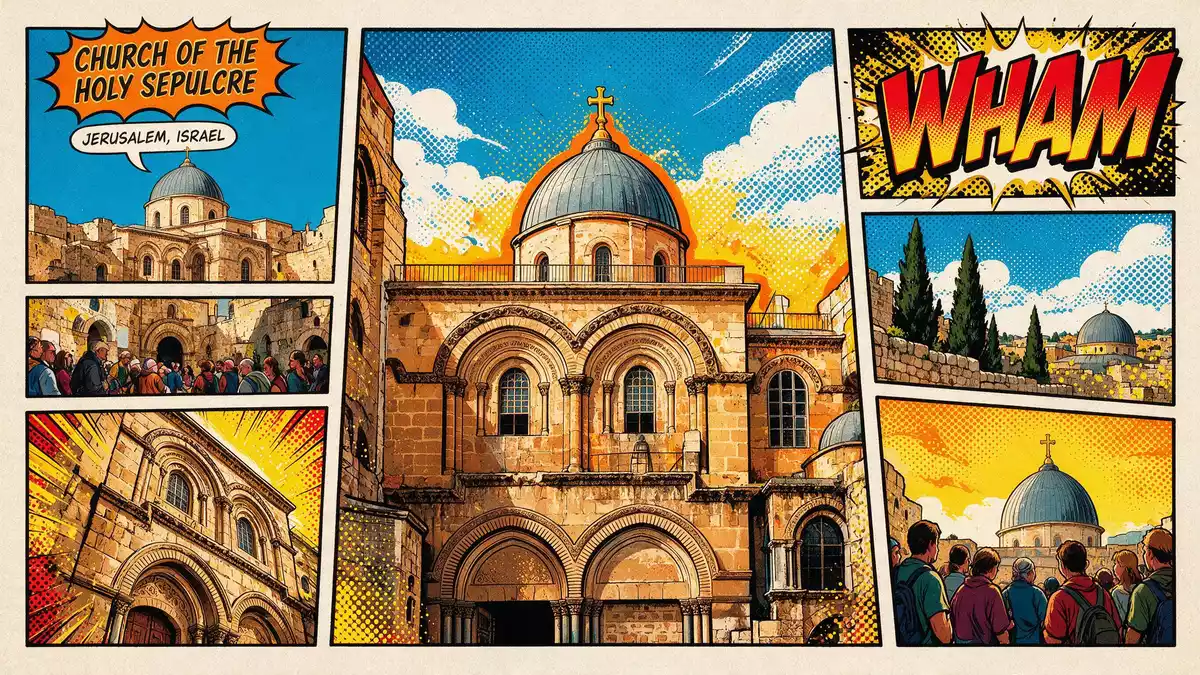
Church of the Holy Sepulchre in Jerusalem is a compact world of stone where the sites associated with Jesus’ crucifixion and tomb are enclosed in a single, intricate complex. Emerging from Christian building under Emperor Constantine in the fourth century and reshaped by Crusader architects in the twelfth century, it combines chapels, rotunda and basilica in a dense architectural palimpsest that visitors read in walls, domes and worn thresholds.
From Constantine’s basilica to a Crusader stone labyrinth
The origins of Church of the Holy Sepulchre lie in the reign of Constantine the Great, the first Christian emperor of Rome, who ordered a monumental church to enclose the traditional sites of Golgotha and the tomb of Christ in the early fourth century CE.Constantine the Great first built a church on the site This Constantinian complex combined an entrance atrium, a great basilica known as the Martyrium and, beyond it, a rotunda called the Anastasis housing the rock-cut tomb under a dome.a great basilica and a rotunda called the Anastasis
Conflict and religious change repeatedly damaged this early church. Persian forces burned major parts of the complex in 614, after which Abbot Modestus oversaw restorations in the early seventh century.burned by the Persians in 614, restored by Modestus In 1009 the Fatimid caliph al-Hakim bi-Amr Allah ordered the church’s destruction, and a reduced building was rebuilt under Byzantine emperor Constantine IX Monomachos by 1048.rebuilt by Constantine IX Monomachos and completed in 1048 The First Crusade brought another transformation: after Latin forces captured Jerusalem in 1099, Crusader builders unified separate chapels and structures and by the middle of the twelfth century created much of the Romanesque stone volume that visitors walk through today.Crusaders undertook major renovations and expansions
Rotunda, Golgotha and the Edicule under shared roofs
Church of the Holy Sepulchre lies in the north-west quarter of Jerusalem’s Old City, where narrow streets open into a forecourt before the main entrance façade.lies in the northwest quarter of the Old City of Jerusalem Inside, the building reads as three intertwined worlds: the rotunda over the tomb, the cluster of chapels around Golgotha and the longitudinal spaces of the former basilica. The rotunda, still known by the Greek name Anastasis, forms a broad circular hall beneath a dome, at whose centre stands the Edicule, a masonry shrine enclosing the rock-cut tomb associated with Christ’s burial.an edicule has enclosed the rock-cut tomb and the current structure dates from 1810
The Edicule visitors see dates largely from 1810, when it was rebuilt in an Ottoman Baroque style following fire damage earlier in the nineteenth century.the Edicule was rebuilt and the current structure dates from 1810 East of the rotunda, Crusader builders gave the complex a Romanesque character, with heavy stone vaults, carved capitals and an ambulatory that wraps around key chapels.the church was extensively rebuilt and expanded with Romanesque elements Within this stone maze, visitors encounter raised chapels marking the traditional site of Golgotha, stone pavements associated with the preparation of the body, and side altars cared for by different Christian communities under a long-established Status Quo arrangement.chapels and altars tailored to various Christian denominations under the Status Quo
Shared guardianship and enduring pilgrimage
Church of the Holy Sepulchre has been a focus of Christian pilgrimage since at least the fourth century, as it brings together the sites venerated as Golgotha and the tomb in one complex.an important pilgrimage destination since at least the 4th century Over centuries, responsibility for different parts of the church settled between several Christian traditions, including Greek Orthodox, Roman Catholic (Latin), Armenian Apostolic and others, each with defined chapels, liturgical times and maintenance duties.various Christian denominations under the Status Quo arrangement formalized in 1852 The Status Quo arrangement, established in the nineteenth century, stabilised this division of space, so that the same stones carry several distinct liturgical lives.
For travellers, this complex guardianship is visible in details rather than explanations: lamps of different styles, language variations in inscriptions, and clergy moving along well-practised routes between altars. World Monuments Fund and other organisations have supported conservation programmes, focusing on the stone fabric and the Edicule, whose recent scientific investigation confirmed that parts of the underlying tomb formation date back to early Roman times.World Monuments Fund documentation on the Edicule and tomb The result is not a museum but a living church where archaeological layers and liturgy share the same constrained interior.
Visiting Church of the Holy Sepulchre: what travellers from Western Europe should know
- Church of the Holy Sepulchre stands in the Christian Quarter of the Old City of Jerusalem, reached on foot through the surrounding lanes from the city’s historic gates.
- Inside, movement between chapels and the rotunda involves stone stairways, uneven pavements and narrow passages that can require steady footing and attention to low arches.
- The official languages of wider Israel are Hebrew and Arabic, and the currency is the Israeli shekel.
- Entry requirements depend on your nationality; UK travellers can check the FCDO travel advice at gov.uk/foreign-travel-advice, Irish travellers the Department of Foreign Affairs at ireland.ie.
Searching for Church of the Holy Sepulchre on social platforms
These links open searches for Church of the Holy Sepulchre on each platform.
Frequently asked questions about Church of the Holy Sepulchre
Where is Church of the Holy Sepulchre located in Jerusalem?
Church of the Holy Sepulchre stands in the Christian Quarter of the Old City of Jerusalem, in the north-western sector of the walled historic centre.
What should visitors expect inside Church of the Holy Sepulchre?
Visitors encounter an interconnected complex of chapels, the domed rotunda with the Edicule over the tomb, stairways and stone pavements marking sites linked with the Passion account.
What makes Church of the Holy Sepulchre distinctive among Christian sites?
The church gathers Golgotha, the tomb of Christ and multiple Christian traditions under one roof, combining fourth-century foundations, Crusader Romanesque architecture and the nineteenth-century Edicule.


