
Church of the Holy Sepulchre and Jerusalem’s layered shrine
Published on 09/16/2026 at 13:21 | Editorial responsibility: Rafael Müller, Editor-in-Chief AD HOC NEWS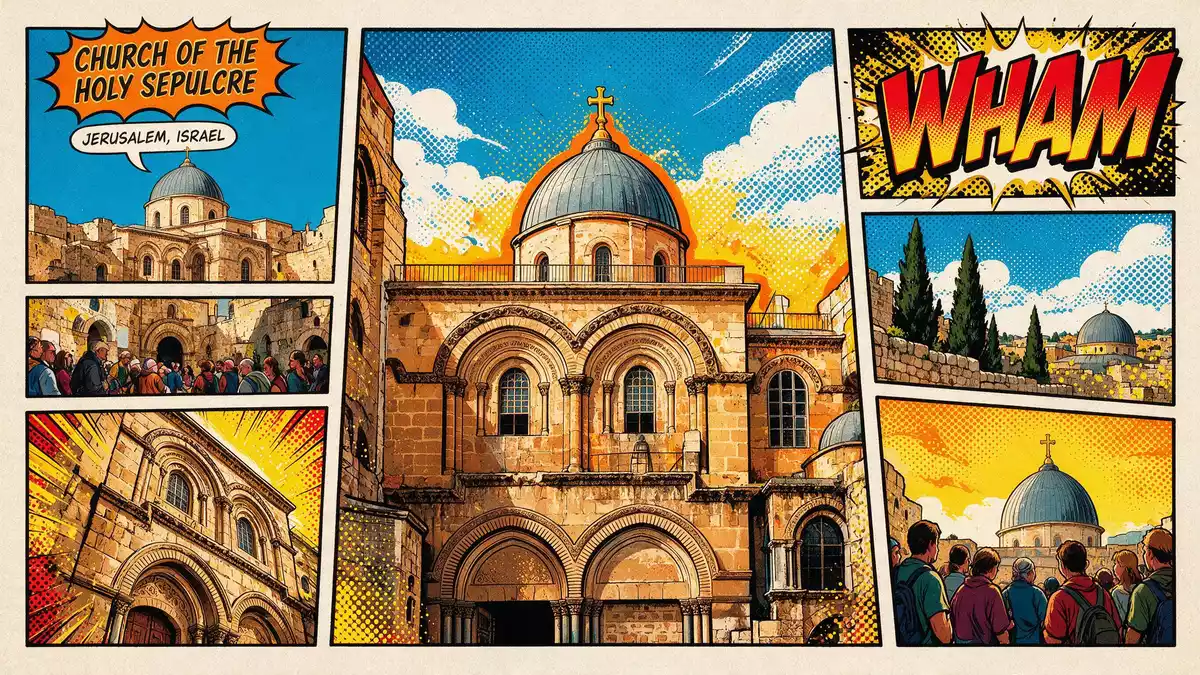
Church of the Holy Sepulchre in Jerusalem is a layered sacred complex whose surviving fabric brings together the rotunda, chapels and the Tomb of Christ. Its core history reaches back to Constantine the Great and the fourth century.
Constantine’s church and the Crusader rebuild
The church’s origins lie in the early fourth century, when Constantine the Great ordered a Christian shrine on this site. The first building was associated with the reign of Constantine and with the tradition of Jesus’s burial and resurrection. Constantine the Great The present arrangement reflects later rebuilding after heavy damage and renewed work in the eleventh and twelfth centuries.
The church is linked to the old city of Jerusalem, and its interior brings several sacred places into a single building. The UNESCO listing for the Old City of Jerusalem and its Walls names the Resurrection rotunda in the Church of the Holy Sepulchre and identifies Christ’s tomb there. Resurrection rotunda The result is a dense plan of domes, chapels and passages rather than one broad church hall.
The rotunda, aedicule and chapels
Inside the church, the rotunda forms the central space. In its middle stands the Aedicule, the small shrine enclosing the Tomb of Christ. A Christian shrine of this kind gives the building its most recognisable internal focus, but the eye also meets walls, columns and side chapels in close succession.
The interior includes eastern chapels and spaces associated with Golgotha and the burial tradition. A scholarly overview in the Oxford Reference entry describes the Crusader church as the structure that established much of the present plan, while the later Ottoman period added another layer to the fabric. Crusader church The building therefore reads less like a single monument than a cluster of sacred chambers joined under one roof.
A building shaped by repeated rebuilding
The church’s visible form belongs to several periods at once. An early fourth-century foundation under Constantine the Great, Crusader rebuilding in the twelfth century and later repairs all remain part of the structure visitors meet today. fourth century The mixture of Roman, Byzantine, Crusader and later elements gives the place an unusually stratified appearance.
The whole complex is tied to Jerusalem’s Old City, where narrow streets bring it into a tight urban setting. The church is built of heavy masonry, with domes, arches and smaller sacred enclosures distributed across the interior. Its strongest impression comes from that accumulation of forms rather than from a single façade.
Visiting Church of the Holy Sepulchre: what travellers from Western Europe should know
- Church of the Holy Sepulchre stands in the Christian Quarter of the Old City of Jerusalem. The main approach is through the surrounding streets of the Old City.
- The interior includes uneven flooring, steps and tightly arranged chapels. The spaces are compact and closely connected.
- The church brings together different Christian communities, and several rites share its sanctuaries. That shared custody is visible in the partitioned interior.
- The most closely associated places are the rotunda, the Aedicule and Golgotha. These names help orientation inside the complex.
Searching for Church of the Holy Sepulchre on social platforms
These links open searches for Church of the Holy Sepulchre on each platform.
Frequently asked questions about Church of the Holy Sepulchre
Where is Church of the Holy Sepulchre?
It stands in the Christian Quarter of the Old City of Jerusalem. The church is part of a dense historic quarter of streets and sanctuaries.
What should a visit include?
The rotunda, the Aedicule and Golgotha are the main spaces linked to the site’s identity. The interior is compact and arranged through chapels, passages and shared sacred areas.
What makes it distinctive?
The building unites early Christian origins, Crusader rebuilding and later layers in one structure. That combination of the rotunda, the Aedicule and multiple chapels gives it its particular character.


