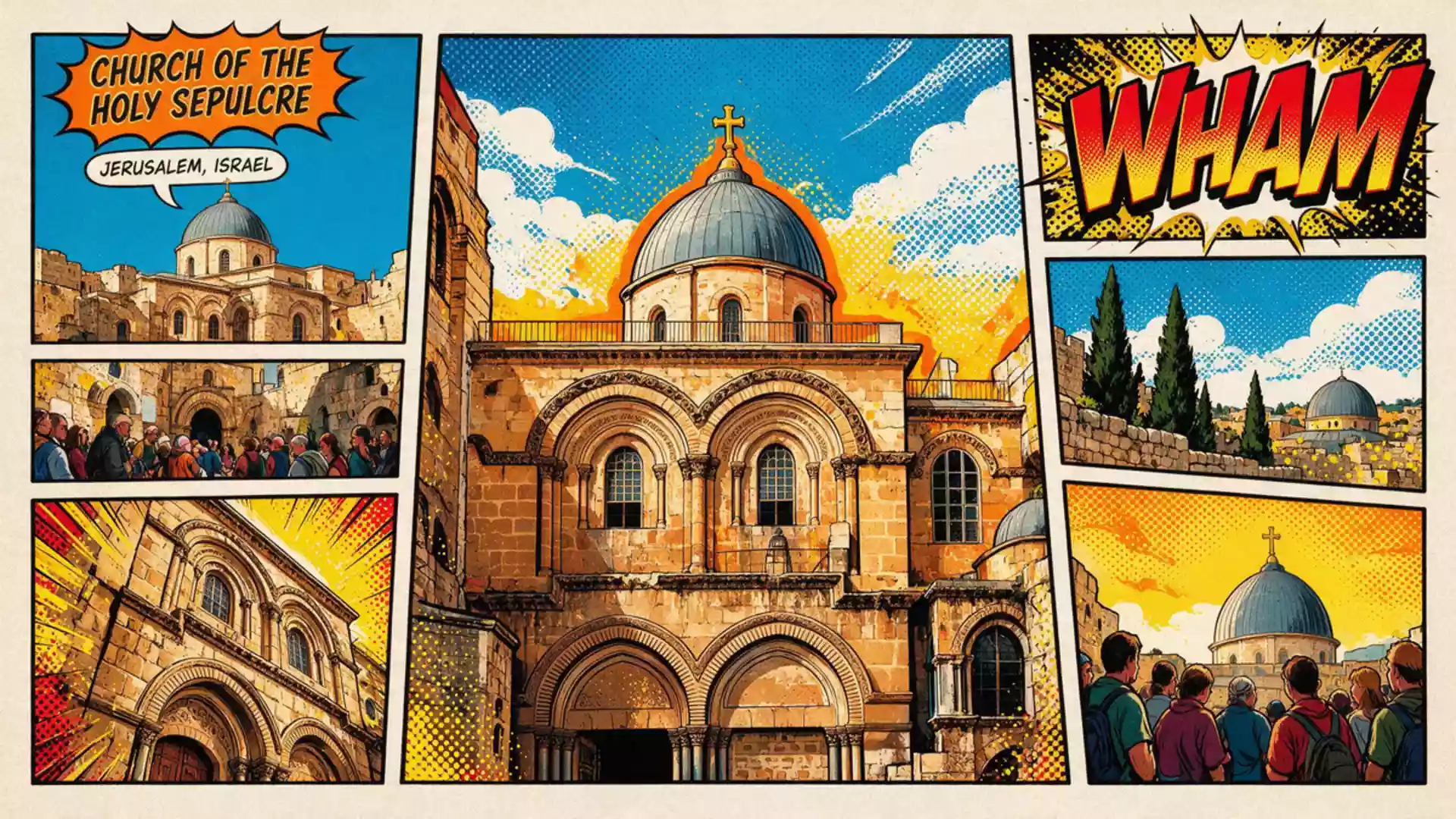
Church of the Holy Sepulchre and its layered sacred architecture
Published on 09/14/2026 at 19:50 | Editorial responsibility: Rafael Müller, Editor-in-Chief AD HOC NEWS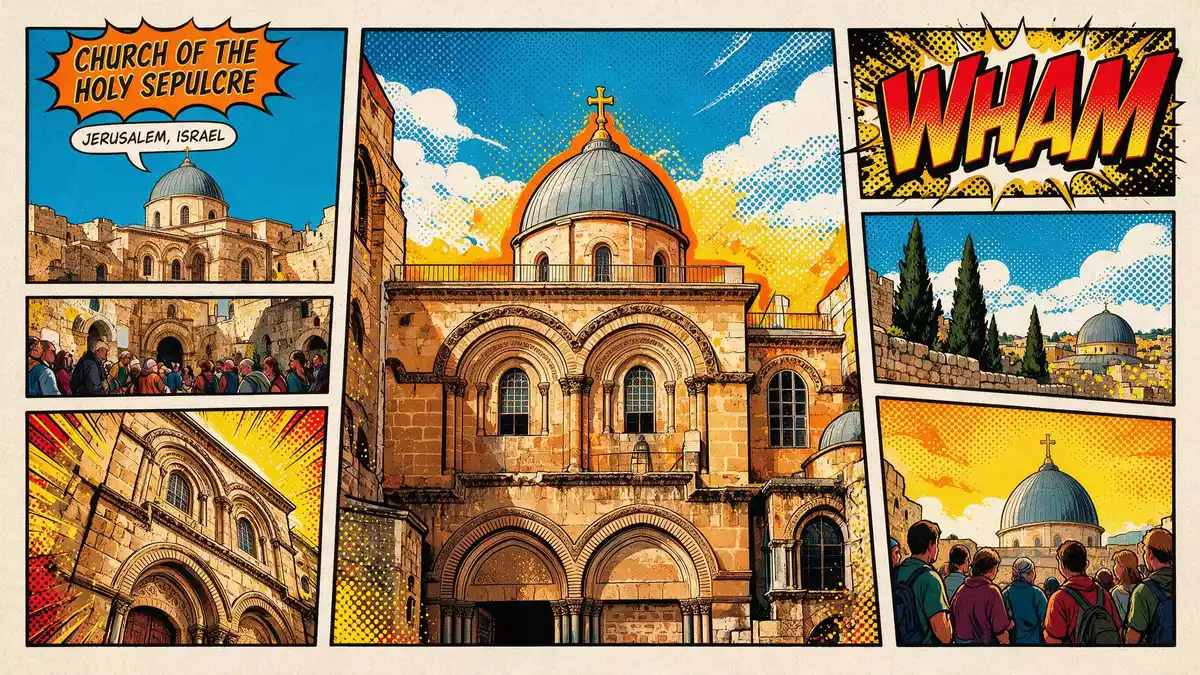
The Church of the Holy Sepulchre in Jerusalem is a compact stone complex where the traditional sites of Golgotha and Christ’s tomb sit within a single, multi-layered interior shaped over many centuries of rebuilding. Founded in the fourth century under Emperor Constantine the Great, it has been reconstructed repeatedly after invasions, fires and earthquakes, leaving a dense sequence of architectural periods visible in one enclosed space.
From Constantine’s basilica to a Crusader stone envelope
The origins of the Church of the Holy Sepulchre lie in the reign of Constantine the Great, whose builders established a large Christian complex here in the fourth century, combining a basilica with a rotunda over the tomb of Christ.Constantine first built a church This early ensemble enclosed the quarry rock associated with Golgotha and the tomb, integrating them into a monumental setting for Christian worship in what became the Christian Quarter of Jerusalem’s Old City.its history began in the fourth century
The Constantinian fabric did not survive intact. It was burned during the Persian invasion of 614 and later destroyed on the orders of the Fatimid caliph al-Hakim around 1009, prompting Byzantine rebuilding campaigns before a broader transformation in the twelfth century.the church was burned and destroyed After the First Crusade and the capture of Jerusalem in 1099, Crusader patrons undertook extensive reconstruction, enclosing Golgotha, the tomb and other chapels under a single masonry envelope and giving the complex much of its present Romanesque appearance.Crusaders undertook major renovations
The rotunda, the Edicule and surrounding chapels
Within the church, the rotunda over Christ’s tomb remains one of its defining spaces, a circular volume capped by a dome and focused on the Edicule, the small shrine protecting the rock-cut burial place at its centre.a gold-domed rotunda covered the edicule The structure seen today descends from this early arrangement but has been rebuilt several times; the current Edicule dates from the early nineteenth century, when an Ottoman Baroque design by a Greek architect replaced its fire-damaged predecessor.the current edicule dates from 1810
Radiating around the rotunda and main basilica are chapels and altars associated with different Christian traditions, reflecting the long-standing Status Quo arrangement that governs use of the building.chapels and altars tailored to denominations The area identified with Golgotha is now enclosed within its own chapel complex, raised above the level of the main floor, while the Stone of Anointing and other focal points line the axis between the principal entrance and the rotunda.Rotunda, Golgotha chapel and Stone of Anointing For visitors, the effect is that of moving through a compressed assemblage of spaces where distinct liturgical zones abut one another inside a single stone shell.
A building shaped by damage, repair and shared custody
Little visible fabric from the original Constantinian church survives above ground, because centuries of damage and rebuilding have left later masonry dominant in the elevations and vaults.little remains of the original Byzantine structure Much of the external architecture recognisable from outside dates to Crusader work in the twelfth century, which introduced Romanesque elements such as heavy arches and sculpted portals and reconfigured the plan to unify previously separate structures.visible external architecture dates to the Crusader period
Later centuries added further layers. Repairs and alterations under Mamluk and Ottoman rule introduced new chapels and decorative details, while nineteenth-century interventions reshaped damaged parts of the rotunda and Edicule after a major fire, leaving the present church largely a product of those nineteenth-century restorations together with twelfth-century structural work.the present church dates mainly from 1810 The result is a single complex where Constantinian foundations, Crusader stonework and Ottoman Baroque forms coexist, mirroring the shared custody of the site by several Christian communities and the long, eventful history of Jerusalem itself.
Visiting Church of the Holy Sepulchre: what travellers from Western Europe should know
- The Church of the Holy Sepulchre stands in the northwest quarter of Jerusalem’s Old City, within the Christian Quarter, reached on foot through narrow stone streets.
- The interior rises and descends across multiple levels, with staircases leading to chapels above and below the main floor; visits involve negotiating worn stone steps and uneven surfaces.
- The official language is Hebrew and the currency is the Israeli new shekel.
- Entry requirements depend on your nationality; UK travellers can check the FCDO travel advice at gov.uk/foreign-travel-advice, Irish travellers the Department of Foreign Affairs at ireland.ie.
Searching for Church of the Holy Sepulchre on social platforms
These links open searches for Church of the Holy Sepulchre on each platform.Frequently asked questions about Church of the Holy Sepulchre
Where is the Church of the Holy Sepulchre located in Jerusalem?
The Church of the Holy Sepulchre is situated in the northwest part of Jerusalem’s Old City, within the historic Christian Quarter.
What should visitors expect inside the Church of the Holy Sepulchre?
Visitors encounter an intricate interior of chapels, altars and staircases, with the rotunda over Christ’s tomb and the Golgotha area forming two central focal points.
What makes the Church of the Holy Sepulchre distinctive among Jerusalem’s sacred sites?
The church is distinctive for enclosing the traditional locations of Golgotha and Christ’s tomb within one shared, multi-period stone complex shaped by successive reconstructions.