
Church of the Holy Sepulchre and its layered sacred architecture
Published on 09/12/2026 at 20:11 | Editorial responsibility: Rafael Müller, Editor-in-Chief AD HOC NEWS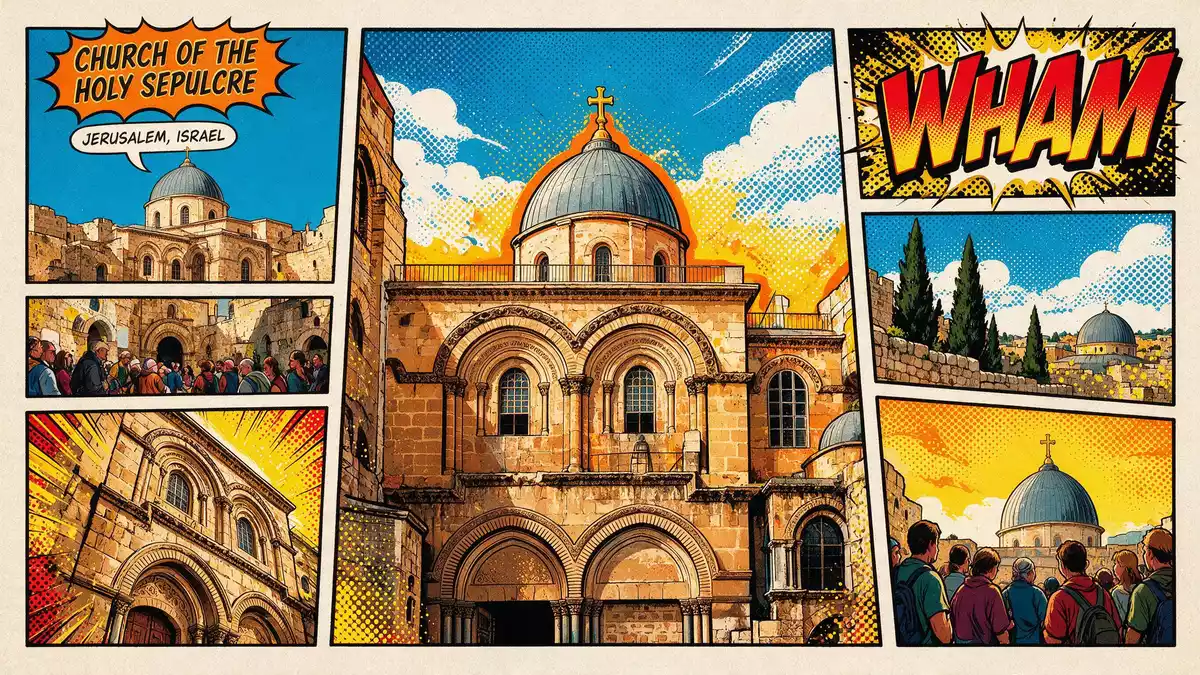
The Church of the Holy Sepulchre in Jerusalem is a layered Christian sanctuary, where the rock of Golgotha and the tomb of Christ sit within one dense architectural complex shaped over many centuries.church built on the traditional site of Jesus’ Crucifixion anchors the building’s identity as much as its stone walls and domes.
From Constantine’s basilica to a Crusader stone labyrinth
The origins of the Church of the Holy Sepulchre lie in the early fourth century, during the reign of Emperor Constantine the Great.origins date back to the early 4th century CE during the reign of Roman Emperor Constantine the Great Construction began in the 320s and the complex was consecrated in the 330s as a large Christian ensemble.
The Constantinian project combined a basilica known as the Martyrium with an open courtyard around Golgotha and a rotunda called the Anastasis, which encased the tomb of Christ in its own domed enclosure.basilica with an open atrium leading to a rotunda encasing the tomb This arrangement bound several distinct holy places into a single architectural sequence.
Rotunda, Edicule and the enclosed rock of Golgotha
At the heart of the Church of the Holy Sepulchre stands the rotunda, the Anastasis, enclosing the Edicule, a small building that surrounds the rock?cut tomb associated with the burial of Jesus.an edicule has enclosed and protected the rock-cut tomb The current Edicule dates from 1810 and was built in an Ottoman Baroque style, a compact structure containing two internal spaces.
A short distance away inside the same church complex lies the rocky outcrop identified as Golgotha, enclosed within a chapel and raised above the surrounding floor.two points of bare Jerusalem rock, the tomb and Golgotha The Crusader rebuilding in the twelfth century brought Golgotha, the tomb and additional chapels under one roof, turning the earlier sequence of courtyard and separate structures into a single stone labyrinth of altars, vaults and side chapels.Crusaders enclosed Golgotha, the tomb, and other holy sites under a single roof
A church shaped by destruction, repair and shared custody
The present form of the Church of the Holy Sepulchre reflects repeated cycles of damage and reconstruction. The Byzantine church was burned and looted by the Persians in 614 and later destroyed on orders of the Fatimid caliph al?Hakim in 1009.burned by the Persians in 614 and destroyed by al-Hakim about 1009 Emperor Constantine IX Monomachos oversaw rebuilding in the eleventh century, though much of the surviving stonework belongs to the twelfth?century Crusader campaign.
Crusader architects created a Romanesque shell that unified earlier structures, adding barrel vaults, a bell tower and a chancel east of the rotunda, while roofing the former open courtyard over Golgotha.Crusader era extensively rebuilt and expanded with Romanesque elements Later Mamluk and Ottoman interventions added further chapels and furnishings as different Christian communities settled into a delicate sharing arrangement often referred to as a Status Quo, visible today in the coexistence of multiple liturgical traditions within the same walls.Status Quo arrangement formalized in 1852
Visiting Church of the Holy Sepulchre: what travellers from Western Europe should know
- The Church of the Holy Sepulchre stands in the Christian Quarter of the Old City of Jerusalem, reached on foot through narrow streets that branch off the historic Cardo.
- Inside, movement between chapels involves steps, uneven stone floors and some confined staircases, particularly around the upper level near the Golgotha chapels.
- The church lies within the Old City walls near other major religious sites, so approaches often pass through bustling market lanes and tight passages.
- The official language is Hebrew and the currency is the Israeli shekel.
- Entry requirements depend on your nationality; UK travellers can check the FCDO travel advice at gov.uk/foreign-travel-advice, Irish travellers the Department of Foreign Affairs at ireland.ie.
Searching for Church of the Holy Sepulchre on social platforms
These links open searches for Church of the Holy Sepulchre on each platform.Frequently asked questions about Church of the Holy Sepulchre
Where is the Church of the Holy Sepulchre located in Jerusalem?
The Church of the Holy Sepulchre stands in the northwest part of the Old City of Jerusalem, within the Christian Quarter and inside the historic city walls.
What can visitors expect inside the Church of the Holy Sepulchre?
Visitors encounter a complex interior of stone chapels, the rotunda around the Edicule, and the enclosed rock of Golgotha, connected by staircases, arcades and vaulted passages.
What makes the Church of the Holy Sepulchre distinctive among Christian sites?
The Church of the Holy Sepulchre is distinctive because it gathers, within a single church, the traditional sites of both the Crucifixion at Golgotha and the tomb associated with the Resurrection of Christ.


