
Chua Tran Quoc, Hanoi’s pagoda on West Lake
Published on 09/16/2026 at 09:05 | Editorial responsibility: Rafael Müller, Editor-in-Chief AD HOC NEWS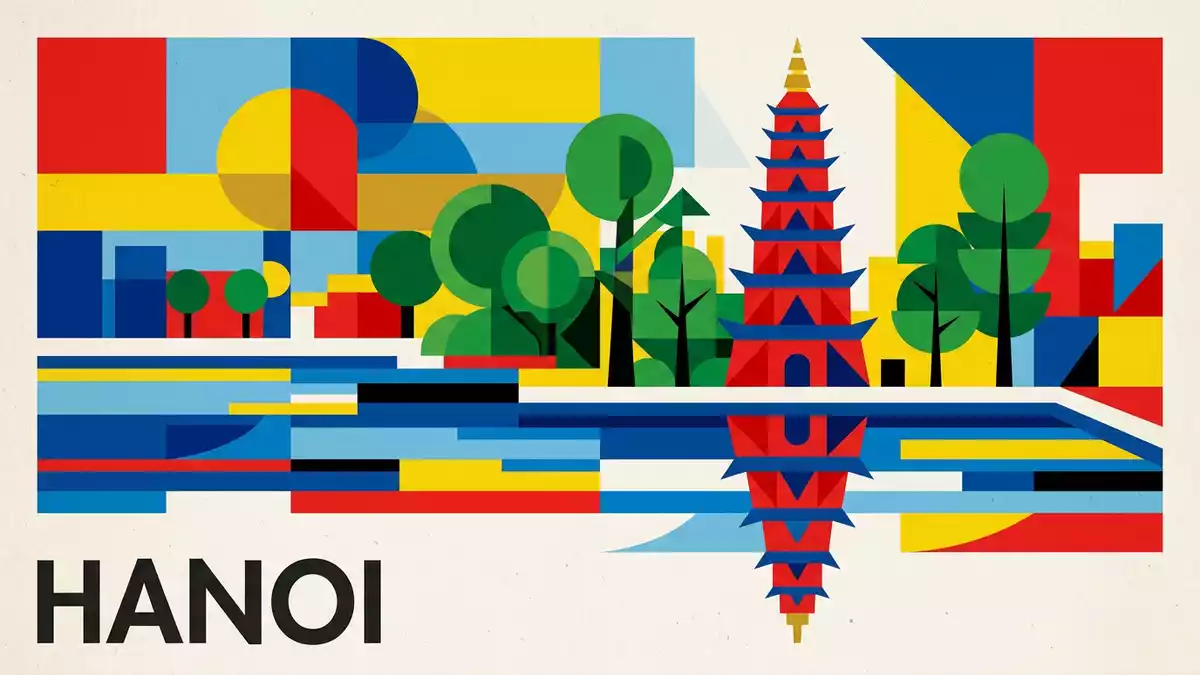
Chua Tran Quoc, known in English as Tran Quoc Pagoda, is a Buddhist temple on a small island in Hanoi’s West Lake that combines early imperial history with a distinctive lakeside setting. Rooted in the sixth century under Emperor Ly Nam De, it is widely recognised as the oldest surviving Buddhist temple in the Vietnamese capital.
A lakeside pagoda on Kim Ngu islet
Chua Tran Quoc stands on Kim Ngu islet, a compact piece of land surrounded by the broad waters of West Lake in Hanoi’s Tay Ho District. The island lies near the eastern shore of the lake, linked to Thanh Nien Road by a solid causeway that carries both pedestrians and vehicleson Kim Ngu islet. From Thanh Nien Road, which runs between West Lake and the smaller Truc Bach Lake, the approach brings water into view even before entering the pagoda precinct, reinforcing the sense that the temple is set within the lake rather than beside it.
The pagoda complex occupies much of the islet, with its towers and halls framed by lakeside trees and low boundary walls. The main gate faces Thanh Nien Road and opens into a courtyard that serves as the transition from the traffic of Tay Ho District to the quieter temple interiorlocated near the southeastern shore. The setting on West Lake also places Chua Tran Quoc within sight of other lakeside buildings and gardens, yet the separation by water gives the islet a distinct identity in the city’s fabric.
From Khai Quoc to Tran Quoc
The origins of Chua Tran Quoc reach back to the sixth century, when a Buddhist temple was established during the reign of Emperor Ly Nam De, in what is now regarded as the pre?Ly dynasty periodconstructed in 541 and completed in 545. The original foundation carried the name Khai Quoc, meaning “Found the Nation”, which reflected its role in early Vietnamese statehood and religious lifeoriginally named Khai Quoc. Over the centuries, as dynasties shifted and the capital’s urban structure changed, the temple acquired the name Tran Quoc, a title that evokes the idea of protecting or stabilising the country.
Historical accounts describe relocations of the temple from sites near the Red River to its current position on West Lake during the seventeenth century, when dams and causeways reshaped the city’s waterways. By the reign of Le Hy Tong in the late seventeenth and early eighteenth centuries, the name Tran Quoc Pagoda had taken hold, and the temple was integrated into the religious landscape of Thang Long, the historical name for Hanoiassumed its present name. Chua Tran Quoc has since been listed as a National Historical and Cultural Heritage site, underscoring its recognised status in Vietnam’s record of historic monumentslisted as a National Historical and Cultural Heritage.
Towers, halls and statues within the precinct
Within the modest area of Kim Ngu islet, Chua Tran Quoc contains a layered ensemble of towers, worship halls and gardens that reflects the long evolution of Vietnamese Buddhist architecture. A prominent multi?storey stupa rises near the lakeside, its tiers stacked vertically and punctuated by niches holding statues of the Buddha, forming a focal point visible from the shore of West Lakea multi-storey lotus tower. Around it stand smaller stupas and memorial structures dedicated to religious figures, arranged to create a dense cluster of brick and stone forms beside the water.
The main worship spaces follow a traditional layout aligned along an axis, with a front hall, an upper hall and an incense house forming three principal layers that together make up the pagoda’s corethree main layers. Inside these halls are wooden statues, altars and carved panels that illustrate Buddhist themes, some dating back several centuries. Renovations in 1815 expanded the complex to include additional buildings and a tower garden, creating a precinct whose area extends across several thousand square metres and includes courtyards, shrines and a lakeside walkwayrenovations in 1815.
Visiting Chua Tran Quoc: what travellers from Western Europe should know
- Chua Tran Quoc stands on Kim Ngu islet off the eastern side of West Lake, linked to Thanh Nien Road in Hanoi’s Tay Ho District by a causeway, with the main gate facing the road.
- The pagoda precinct includes outdoor courtyards, internal halls and tower gardens, with steps between levels and stone paving that can be uneven underfoot.
- West Lake surrounds the islet on all sides, so the immediate environment combines temple architecture with open water and occasional breezes across the lake surface.
- Hanoi is the capital of Vietnam, where the official language is Vietnamese and the currency is the Vietnamese dong.
- Entry requirements depend on your nationality; UK travellers can check the FCDO travel advice at gov.uk/foreign-travel-advice, Irish travellers the Department of Foreign Affairs at ireland.ie.
Searching for Chua Tran Quoc on social platforms
These links open searches for Chua Tran Quoc on each platform.
Frequently asked questions about Chua Tran Quoc
Where is Chua Tran Quoc located in Hanoi?
Chua Tran Quoc stands on Kim Ngu islet in West Lake, linked to Thanh Nien Road in Yen Phu Ward, Tay Ho District, north?west of central Hanoi.
What can visitors expect when entering the pagoda?
Visitors pass through the main gate into a courtyard that leads to worship halls, stupas and gardens, with statues, altars and tower clusters arranged within the precinct.
What makes Chua Tran Quoc distinctive among Hanoi’s temples?
Chua Tran Quoc combines sixth?century origins, a recognised status as Hanoi’s oldest Buddhist temple and a lakeside setting on a small islet surrounded by West Lake.


