
Chua Tran Quoc and its lakeside pagoda on Hanoi’s West Lake
Published on 09/10/2026 at 08:52 | Editorial responsibility: Rafael Müller, Editor-in-Chief AD HOC NEWS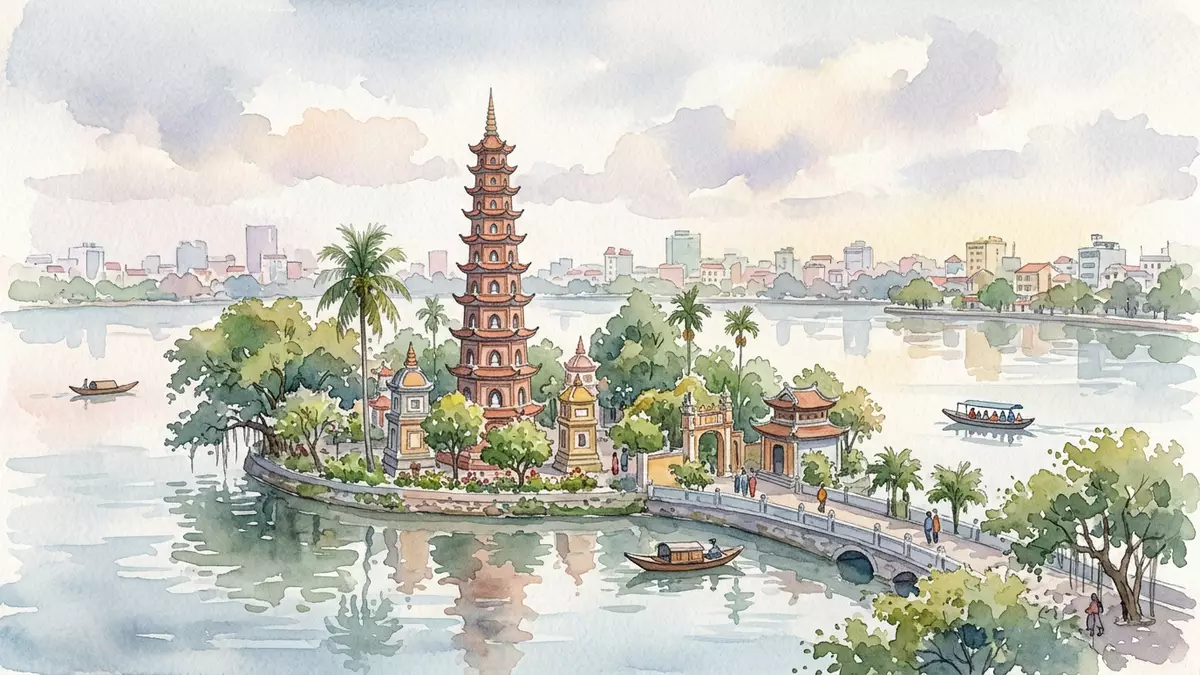
Chua Tran Quoc, known in English as Tran Quoc Pagoda, is a Buddhist temple on a small islet in Hanoi’s West Lake whose multi-tiered brick tower rises above the water and the line of Thanh Nien Road. It is widely recognised as the oldest Buddhist temple in Hanoi, with origins in the sixth century during the reign of King Ly Nam De in the early Ly dynasty.
A sixth-century pagoda on a lakeside islet
The story of Chua Tran Quoc reaches back to the sixth century, when the pagoda was first established under King Ly Nam De, who ruled in the years 541 to 547.built during the reign of King Ly Nam De In its earliest phase it bore the name Khai Quoc, meaning “Nation Founding”, a title that linked the temple closely to the formation of the early Vietnamese state.Originally named Khai Quoc Over the following centuries, rulers of later dynasties oversaw expansions and renovations, and the pagoda acquired its present name Tran Quoc during the Le dynasty in the seventeenth century.later King Le Hy Tong renamed it Tran Quoc
The pagoda stands on a compact islet off the eastern side of West Lake in Yen Phu Ward, Tay Ho District, a little north-west of Hanoi’s historic centre.located on a small island near the southeastern shore of West Lake A short bridge links the islet to Thanh Nien Road, the narrow strip of land between West Lake and neighbouring Truc Bach Lake, so water shapes every approach to the site.located in a small island of West Lake by Thanh Nien Road The pagoda’s status as the oldest Buddhist temple in the capital has long been recognised; it appears in national registers as a historical and cultural heritage site and has been associated with royal visits by rulers such as Emperor Minh Mang in the nineteenth century.the oldest pagoda in Hanoi listed as National Historical and Cultural Heritage
Brick towers, courtyards and shrines beside West Lake
The most striking feature of Chua Tran Quoc is the brick stupa that rises prominently above the islet, composed of multiple diminishing tiers that stack upwards into a slender tower. Each tier carries arched niches housing small Buddha statues, and the overall effect is a vertical rhythm of recesses and projections that catches the light from the lake. Around this principal tower stand other smaller stupas and memorial structures, which together form a recognisable silhouette when seen from the lakeshore.Located on a small island of West Lake, Tran Quoc is the oldest pagoda in Hanoi
Within the temple precinct, buildings follow the layout of a traditional Vietnamese Buddhist compound, with a front hall for reception, an incense hall and an upper sanctuary where principal images of the Buddha stand.The main architectural units of Tran Quoc pagoda includes the Front Hall, Incense Ward, Upper Edifice, Bell Tower Wood-framed halls with tiled roofs enclose courtyards planted with small trees and pots, giving the compact islet a layered sequence of spaces from gate to inner shrine. A bell tower, ancestral house and stelae house record the patronage and renovations that have sustained the pagoda through dynasties, while stone stelae stand as physical records of imperial attention to the site.Tran Quoc Pagoda has a history of about 1400 years
A religious landmark framed by Hanoi’s lakes
Chua Tran Quoc occupies a position between two of Hanoi’s best-known lakes, West Lake and Truc Bach Lake, and the route along Thanh Nien Road makes that geography clear as the water opens on both sides.seated on an island linked by a bridge to the causeway between West Lake and Truc Bach Lake From the causeway, the pagoda’s stupa and roofs form a focus point against the wide expanse of West Lake, and the islet’s small size means that shrines, trees and water all lie within close reach of one another. The location in Tay Ho District places the pagoda slightly away from the dense blocks of the Old Quarter, yet still within the urban fabric of the capital.about 3 km from the center of Hanoi
Over many centuries, Chua Tran Quoc has served as a religious site for Buddhist practice and as a place associated with courtly visits and learned monks.Tran Quoc had hosted famous Buddhist monks and received kings on Buddhist memorial days The pagoda’s long history means that its architecture carries elements from different periods, from early foundations named Khai Quoc to expansions under later emperors, and recent restorations have preserved these layers while maintaining its function as an active temple. The lakeside setting, with views across open water, makes the pagoda part of a broader landscape in which religious structures, promenades and urban neighbourhoods meet.
Visiting Chua Tran Quoc: what travellers from Western Europe should know
- Chua Tran Quoc stands on an islet off Thanh Nien Road in Tay Ho District, between West Lake and Truc Bach Lake in Hanoi, reached by a short bridge from the causeway.
- The temple precinct is compact but layered, with courtyards, shrines and halls connected by paved paths and steps, and the stupa tower rising above the surrounding trees and roofs.
- The lakeside approach along Thanh Nien Road brings views of West Lake and Truc Bach Lake, and the temple’s main gate is set directly facing the roadway.
- The official language is Vietnamese and the currency is the Vietnamese dong.
Searching for Chua Tran Quoc on social platforms
These links open searches for Chua Tran Quoc on each platform.
Frequently asked questions about Chua Tran Quoc
Where is Chua Tran Quoc located in Hanoi?
Chua Tran Quoc stands on a small islet off the shore of West Lake in Yen Phu Ward, Tay Ho District, linked to Thanh Nien Road between West Lake and Truc Bach Lake.
What can visitors expect when entering the pagoda precinct?
Visitors cross a short bridge from the lakeside causeway into a compact temple compound with a prominent brick stupa, courtyards, shrines and traditional halls arranged around paved paths and trees.
What makes Chua Tran Quoc distinctive among Hanoi’s religious sites?
Its combination of sixth-century origins, status as Hanoi’s oldest Buddhist temple, layered historic architecture and a prominent lakeside setting on West Lake makes Chua Tran Quoc a distinctive landmark in the Vietnamese capital.


