
Chocolate Hills, the limestone cones of Bohol
Published on 08/21/2026 at 14:30 | Editorial responsibility: Rafael Müller, Editor-in-Chief AD HOC NEWS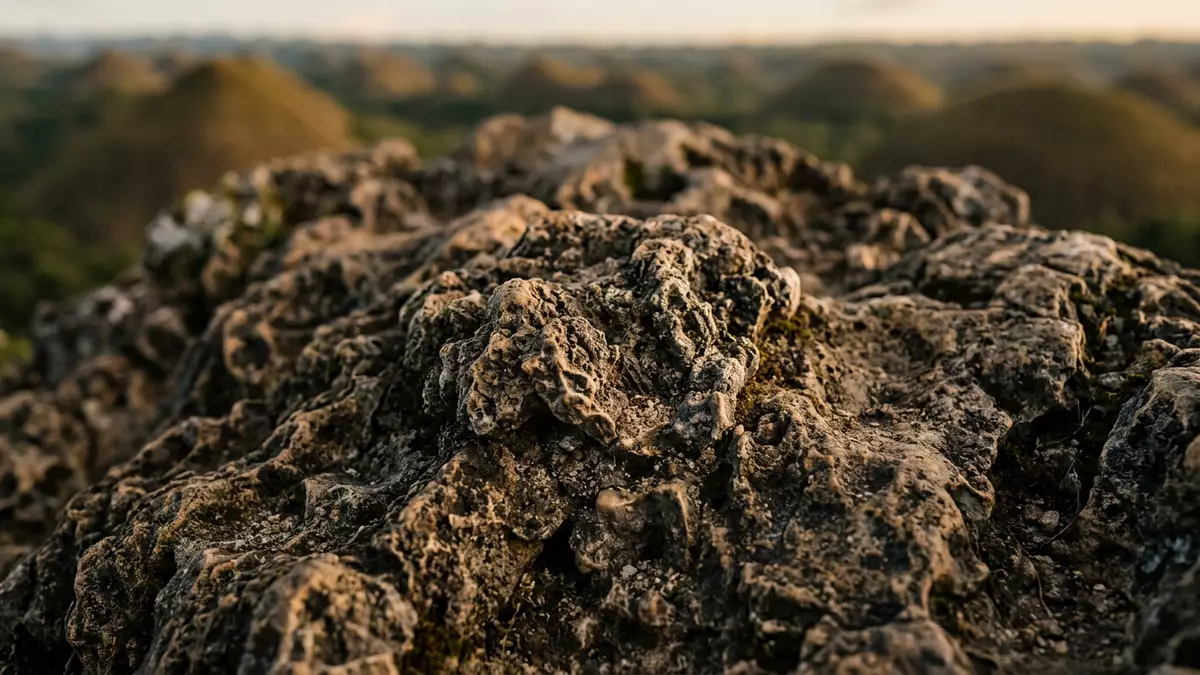
The Chocolate Hills form one of the most distinctive limestone landscapes in the Philippines, covering a broad area of central Bohol with hundreds of grass-covered cones of strikingly regular shape. Set within Bohol Province in the Visayas region, these hills are part of a wider tropical karst terrain that has developed over geological time from a marine limestone platform dating to the late Pliocene and early Pleistocene.
A landscape of conical limestone hills
The core of the Chocolate Hills is a field of smooth, conical hills rising from relatively flat plains, creating a repeated pattern of near-symmetrical mounds across the central part of the island.smooth, uniformly shaped conical isolated hills Each hill is formed from marine limestone, a rock built up from the remains of coral reefs and other shallow-water organisms that once occupied a warm sea covering what is now Bohol.platform of thick widespread buildup of coral reefs The limestone itself contains fossils of foraminifera, coral, molluscs and algae, underlining the marine origin of the material now visible in the hills.fossils of foraminifera, coral, molluscs, and algae
Across the area, the hills form a geomorphological pattern known as conical karst, in which isolated limestone mounds are separated by flatter plains that carry streams, springs and scattered caves.range of karst conical hills Elevations in the wider Chocolate Hills Natural Monument lie within a band between about 100 m and 500 m above sea level, giving the landscape gentle relief rather than extreme height.elevation ranges from 100 m to 500 m above sea level The grass cover that blankets the limestone softens the outline of each mound and ties the individual hills visually into a single, extensive landform.
From coral platform to National Geological Monument
Geologically, the Chocolate Hills trace their origin to a platform of coral limestone laid down in the late Pliocene and early Pleistocene, when this part of the Philippine archipelago lay beneath a shallow sea.late Pliocene to early Pleistocene epochs Over millions of years, tectonic movements lifted this marine platform above sea level and fractured the limestone. Rainwater, surface streams and groundwater then interacted with the soluble rock, gradually dissolving it and carving the present pattern of hills and intervening depressions.raised above the sea level and fractured
The broader terrain is an example of tropical karstification of a coral limestone platform, in which chemical weathering and erosion create mogotes and cockpit karst forms that can include caves, sinkholes and underground drainage.karstification in a tropical climate Recognition of this concentrated field of karst hills led to its designation as the Philippines’ third National Geological Monument in 1988, underlining its scientific and geomorphic significance within the country.declared the country's 3rd National Geological Monument on June 18, 1988 The same area appears on the UNESCO World Heritage Centre’s tentative list as the Chocolate Hills Natural Monument, marking it out as a candidate for future inscription.
Seasonal colour changes and viewing the hills
The name “Chocolate Hills” reflects a visual change that appears across the landscape in the dry season, when the grasses covering the limestone mounds turn a deep brown and give the impression of countless pieces of chocolate laid across the plains.grass-covered hills turn chocolate brown During wetter periods, the same hills appear green, with the vegetation softening the contrast between the cones and the surrounding lowlands. Whatever the season, the repetition of similar-sized hills, many with tapering tops and smooth flanks, forms a regular pattern that is rare among karst landscapes.limestone, grass-covered mounds
The most familiar views of the Chocolate Hills come from vantage points near the town of Carmen, one of several municipalities in which the hills are concentrated, along with Batuan and Sagbayan.located throughout the towns of Carmen, Batuan and Sagbayan From elevated platforms in this area, visitors can look out over hundreds of mounds and see how the cones extend across the landscape, separated by low-lying land with scattered trees and cultivated fields. Beyond designated viewpoints, the hills form part of an inhabited rural region in which roads weave between the limestone and local communities live alongside the geological formations.
Visiting Chocolate Hills: what travellers from Western Europe should know
- Chocolate Hills lie in Bohol Province in the central Visayas region of the Philippines, with well-known viewpoints close to the town of Carmen linked by local roads.
- The terrain consists of low limestone hills rising from plains, with access to viewpoints involving stairs or short uphill walks on paved or gravel surfaces.
- The wider area combines rural settlements, fields and patches of forest among the hills, so approaches pass through inhabited countryside rather than remote mountain terrain.
- The official language is Filipino alongside regional languages, and the currency is the Philippine peso.
- Entry requirements depend on your nationality; UK travellers can check the FCDO travel advice at gov.uk/foreign-travel-advice, Irish travellers the Department of Foreign Affairs at ireland.ie.
Searching for Chocolate Hills on social platforms
These links open searches for Chocolate Hills on each platform.
Frequently asked questions about Chocolate Hills
Where are the Chocolate Hills?
The Chocolate Hills are in Bohol Province in the central Visayas region of the Philippines, particularly around the municipalities of Carmen, Batuan and Sagbayan.
What should visitors expect when viewing the Chocolate Hills?
Visitors encounter a wide field of grass-covered limestone hills rising from plains, with formal viewpoints reached by short walks or staircases that offer panoramic views across the cones.
What makes the Chocolate Hills distinctive among limestone landscapes?
The Chocolate Hills are notable for their large number of similar-sized conical limestone mounds, seasonal colour change of the grass cover, and recognition as a National Geological Monument in the Philippines.


