
Chihkan Lou in Tainan: layered fort and temple complex
Published on 08/28/2026 at 09:23 | Editorial responsibility: Rafael Müller, Editor-in-Chief AD HOC NEWS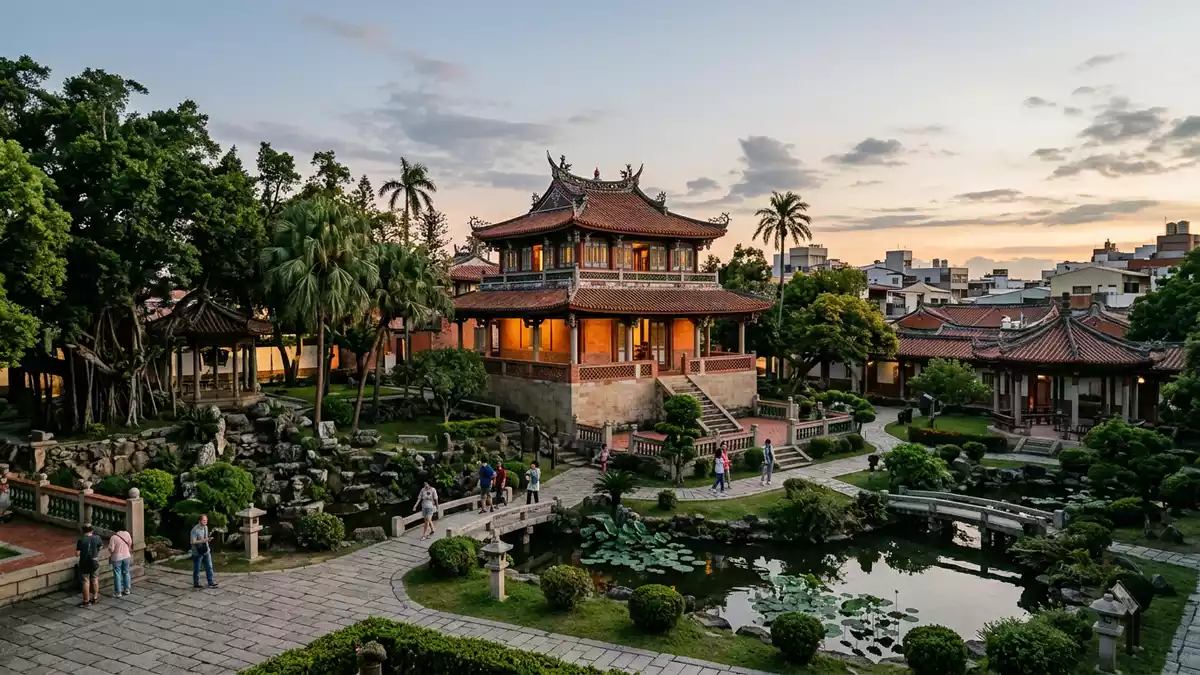
Chihkan Lou in Tainan is a historic complex where Chinese-style halls and courtyards rise on the platform of a seventeenth-century Dutch fortress built as Fort Provintia. Its present appearance reflects additions from the Qing and Japanese periods, while the site itself preserves traces of colonial rule and later temple culture in southern Taiwan.
From Fort Provintia to Chihkan Lou
The origins of Chihkan Lou lie in Fort Provintia, constructed by the Dutch in 1653 in what is now the West Central District of Tainan City.Fort Provintia was built by the Dutch in 1653 The name “Provintia” derives from a Dutch word associated with “eternity”, reflecting the European origin of the outpost.The name Provintia comes from a Dutch term for eternity Local Han communities used names such as Chihkan Tower, Fanzai Tower and Red Hair Tower for the same structure, tying it to both indigenous language and the presence of Europeans.
In 1661, Zheng Chenggong, known in Western sources as Koxinga, expelled the Dutch from Tainan and took control of Fort Provintia, renaming it Cheng Tian Fu as a government base.Koxinga expelled the Dutch in 1661 and renamed the fort Cheng Tian Fu Under Qing rule and later Japanese administration the complex changed use several times, including periods when Chihkan Tower served as an armory and later as a military hospital, yet the raised platform and surviving walls maintained the outline of the Dutch stronghold.Chihkan Tower was repurposed as an armory and later converted into a military hospital
Temple halls, courtyards and inscriptions
Earthquakes and typhoons in the nineteenth century left much of the original Dutch fort in ruins, and new Chinese temples were built on the platform, creating the layered ensemble visitors see as Chihkan Lou.Chinese temples were erected on the ruins of Fort Provintia after an earthquake Among these structures are halls dedicated to deities associated with literature and the sea, along with a library space, all set around paved courtyards with stone balustrades and ornamental features.Five temples, including Wenchang Temple and Daishi Temple, were built on the ruins of Fort Provintia The mix of carved timber, tiled roofs and traditional decorative motifs gives the upper structures the character of a Qing-period temple compound rather than a European bastion.
Monuments from other parts of old Tainan were relocated to Chihkan Lou in the twentieth century, including tortoise-based stele from the Great South Gate of the former city wall.Imperial tortoise statues and stone monuments from the Great South Gate were moved to Chihkan Tower in 1960 These inscriptions record episodes of local history and governance, turning the courtyards into an open-air archive of written stone. The combination of fort remnants, temple architecture and moved monuments makes the site a concentrated record of how Tainan’s urban core developed under successive regimes.
Protected heritage in Tainan’s historic centre
Chihkan Lou stands in the West Central District of Tainan City, in south-western Taiwan, on Section 2 of Minzu Road at No. 212, within the historic urban core.Chihkan Lou is located at No. 212, Sec. 2, Minzu Road, West Central District, Tainan City The area around the complex retains older street patterns and lies a few kilometres east of the harbour district where Fort Zeelandia once stood, emphasising how Dutch military sites framed early colonial control of southern Taiwan.Fort Provintia lay several kilometres east of Fort Zeelandia in Tainan
Chihkan Tower received official protection as an important historical site under Japanese rule in 1935, and after the end of that administration further renovations used reinforced concrete to stabilise the structures while maintaining their overall form.Chihkan Tower was designated as an important historical site in 1935 and later renovated with reinforced concrete In 1982 Chihkan Lou was classified as a national first-grade historic site, confirming its status within Taiwan’s heritage system.Chihkan Tower was classified as a national first-grade historic site in 1982 The ensemble of fortress remains, temple halls and stone monuments stands today as a visible summary of more than three centuries of political and cultural change in Tainan.
Visiting Chihkan Lou: what travellers from Western Europe should know
- Chihkan Lou stands on Section 2 of Minzu Road in the West Central District of Tainan City in southern Taiwan, within the city’s older urban fabric, and is reached along local streets from central Tainan railway and bus connections.
- The complex is built on a raised platform with exterior steps and internal staircases linking the courtyards and temple halls, so visiting involves walking on stone surfaces and climbing stairways between levels.
- Within the grounds, stone monuments and tortoise-based steles are arranged outdoors, and the temple interiors contain carved timber and altars, so visitors move between shaded halls and more exposed courtyard spaces.
- The official language is Mandarin Chinese and the currency is the New Taiwan dollar.
- Entry requirements depend on your nationality; UK travellers can check the FCDO travel advice at gov.uk/foreign-travel-advice, Irish travellers the Department of Foreign Affairs at ireland.ie.
Searching for Chihkan Lou on social platforms
These links open searches for Chihkan Lou on each platform.
Frequently asked questions about Chihkan Lou
Where is Chihkan Lou located in Tainan?
Chihkan Lou stands at No. 212, Section 2 of Minzu Road in the West Central District of Tainan City in southern Taiwan, within the historic centre.
What can visitors expect when exploring Chihkan Lou?
Visitors encounter Chinese-style temple halls and courtyards set on the platform of a former Dutch fort, along with stone monuments and stele documenting episodes of Tainan’s past.
What makes Chihkan Lou distinctive among historic sites in Taiwan?
Chihkan Lou is distinctive for combining seventeenth-century Dutch fort remains, later Qing-period temple architecture and relocated inscriptions, all preserved as a national first-grade historic site.


