
Chichen Itza’s stone geometry on the Yucatán plain
Published on 09/12/2026 at 16:55 | Editorial responsibility: Rafael Müller, Editor-in-Chief AD HOC NEWS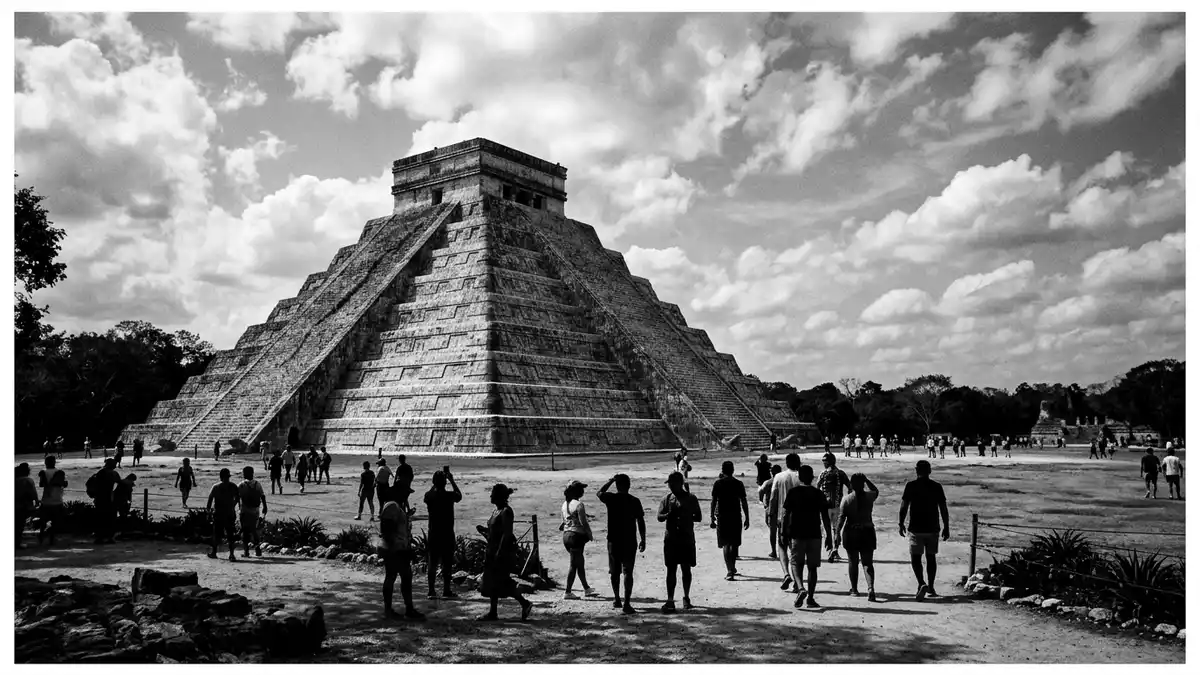
Chichen Itza is a pre-Hispanic Mayan city on the limestone plain of the Yucatán Peninsula in Mexico, east of Valladolid, where monumental stone structures rise from low forest and scrub. The site flourished as a major centre of the Maya and later Maya-Toltec world between about the tenth and fifteenth centuries, leaving a dense core of temples, platforms and courts aligned on the plateau.
From Mayan city to World Heritage landscape
Chichen Itza occupies an area of several square kilometres in south-central Yucatán state, standing on gently rolling ground above karst rock where natural sinkholes open in the landscape.south-central Yucatán state The ancient city lies near the modern town of Pisté in Tinúm Municipality, with its ceremonial precinct laid out around open plazas linked by broad processional ways.
The city’s origins reach back into the first millennium AD and it is traditionally dated to the fifth century for its founding by the Itza, a Maya group whose name is linked with water and sorcery in later accounts.founded by the Itza Monumental construction intensified in the Terminal Classic and early Postclassic periods, roughly between the tenth and twelfth centuries, when influences associated with the Toltec of central Mexico entered the region.Maya-Toltec civilisation In recognition of its cultural importance, the “Pre-Hispanic City of Chichen-Itza” was inscribed as a UNESCO World Heritage Site in 1988 and is protected under Mexican federal law as an archaeological monument.Pre-Hispanic City of Chichen-Itza
El Castillo and the geometry of Kukulkan
The most recognisable structure at Chichen Itza is the Temple of Kukulkan, widely known as El Castillo, a step-pyramid that dominates the main plaza and sets the visual rhythm of the site.Temple of Kukulkan Rising above a square platform, the pyramid is formed of nine stepped bodies with a stairway climbing each face and a temple at the summit, its limestone blocks weathered but sharply profiled against the sky.nine staggered bodies Each staircase is flanked at the base by serpent heads, reflecting Kukulkan’s identity as a feathered serpent deity in Yucatec Maya tradition.
The pyramid’s proportions reflect a complex interest in calendrical and astronomical ordering. The staircases together have a total of 364 visible steps, one for each day in a notional year, with the platform at the top forming a further level that brings the count to 365.365 days of the solar year The stepped terraces and the temple at the summit create long, sharp edges that interact with the low sun around equinox dates, casting triangular shadows along the northern staircase that align with the carved serpent heads below.
Ball courts, platforms and cenotes on the Yucatán plain
Beyond El Castillo, Chichen Itza is a landscape of stone courts, columned halls and circular platforms laid out in zones that reflect different phases of its development.rich in monumental architecture On the northern side of the core stands the Great Ball Court, one of the largest known ball courts of the Maya world, defined by long parallel walls pierced by stone rings high above the playing alley. Nearby, the Temple of the Warriors rises behind a broad stepped platform fronted by rows of columns, while the so-called Group of a Thousand Columns forms a dense grid of pillars that once supported roofing elements and framed processional routes.
The city’s relationship with water is visible in the presence of cenotes, natural sinkholes that open in the limestone and create sheer-sided pools. The Sacred Cenote lies to the north of the main ceremonial group and is linked to it by a straight processional way, while other cenotes dot the surrounding terrain and would have provided permanent water sources in an otherwise dry landscape.sacred site with cenotes Together, the plazas, courts and cenotes create a city plan in which architecture and natural openings in the rock are tightly interwoven.
Visiting Chichen Itza: what travellers from Western Europe should know
- Chichen Itza lies in Yucatán state in eastern Mexico, inland from the Caribbean coast and east of Valladolid, with the archaeological zone reached by road near the town of Pisté.
- The core monuments stand on level ground but the site covers a wide area, and visiting the ball courts, pyramids and cenotes involves extended walking on firm paths and uneven stone surfaces.
- The climate is tropical, with strong sun on the exposed plazas; shade is limited, and the heat on the open stone platforms and courts can be intense in the middle of the day.
- The official language is Spanish and the currency is the Mexican peso.
- Entry requirements depend on your nationality; UK travellers can check the FCDO travel advice at gov.uk/foreign-travel-advice, Irish travellers the Department of Foreign Affairs at ireland.ie.
Searching for Chichen Itza on social platforms
These links open searches for Chichen Itza on each platform.
Frequently asked questions about Chichen Itza
Where is Chichen Itza in relation to Valladolid?
Chichen Itza lies east of Valladolid in Yucatán state, inland between the city of Mérida and the Caribbean coast and close to the small town of Pisté.
What should a visitor expect on a first visit?
A visit centres on walking between stone pyramids, ball courts, columned halls and cenotes spread across a broad archaeological zone on largely level but sometimes uneven ground.
What makes Chichen Itza distinctive among Mayan sites?
The combination of the Kukulkan pyramid, extensive ball courts, columned platforms and cenotes, together with its role as a major Maya-Toltec city and World Heritage Site, gives it particular weight.


