
Chengdu Xiongmao Jidi and the living campus of giant panda conservation
Published on 08/31/2026 at 08:41 | Editorial responsibility: Rafael Müller, Editor-in-Chief AD HOC NEWS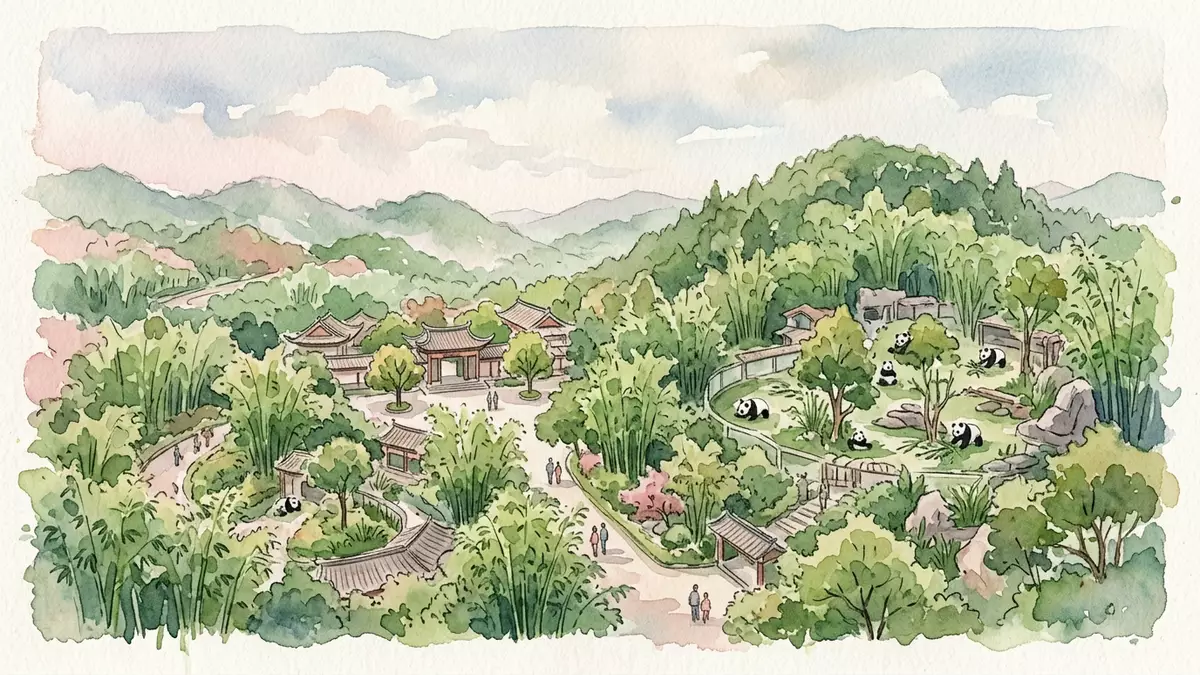
Chengdu Xiongmao Jidi in Chengdu, in the south-west of China, brings giant panda conservation, scientific research and public visiting routes together on a single landscaped campus. Established in 1987 as the Chengdu Research Base of Giant Panda Breeding, it grew out of work with rescued wild pandas and has developed into an extensive complex of enclosures, laboratories and paths in the northern suburbs of the city.Chengdu Research Base of Giant Panda Breeding
A purpose-built landscape for giant pandas on the edge of Chengdu
Chengdu Xiongmao Jidi lies in Chenghua District, on low hills north of central Chengdu, reached along a road known as Panda Avenue that signals the base’s presence long before the entrance gates.Panda Avenue, Chenghua District The site covers several square kilometres, with the developed part of the campus arranged as a series of wooded enclosures, ponds, footpaths and service buildings, separated from the surrounding urban fabric by fences and belts of planting.spread across square kilometres Inside the grounds, bamboo thickets, mature trees and patches of lawn form the setting for the animals’ outdoor areas, giving the impression of a semi-natural park woven into the folds of the terrain.
The base was established by the Chengdu municipal government in 1987, when work with a small group of weakened wild pandas rescued after bamboo flowering in the Qionglai Mountains highlighted the need for a dedicated facility.decision to build a base in 1987six pandas when it opened in 1987 Construction began on the Futoushan hills in the northern suburbs, turning previously undeveloped slopes into a research campus with panda houses, service roads and landscape features designed around the animals’ needs.Futoushan hills in the northern suburbs Over the late twentieth century the site expanded section by section, adding new enclosure clusters, nurseries, laboratories and veterinary facilities as experience and funding grew.
From rescue centre to large ex-situ conservation base
When Chengdu Xiongmao Jidi opened in 1987, it held a small population of giant pandas that had been brought in from the wild in poor condition, and early work focused on stabilising and caring for these animals.small population in 1987rescued from the wild Over the following decades, breeding programmes, veterinary care and careful management increased the captive population, and by 2011 well over a hundred giant pandas lived at the base.108 pandas in 2011 This growth transformed Chengdu Xiongmao Jidi from a small rescue operation into one of the principal ex-situ conservation centres for the species, with multi-generation bloodlines managed on site.
The institution describes itself as a government-funded, non-profit breeding and research base dedicated to giant pandas, red pandas and other endangered wild animals endemic to China, combining conservation with scientific study and education.government-funded non-profit basemission to protect and breed endangered animals Research teams at Chengdu Xiongmao Jidi have worked for more than three decades on feeding and management, reproduction and cub rearing, disease prevention and control, and genetic management of giant pandas, building up a stable captive population that supports wider conservation strategies.technical work on feeding and genetics In parallel, the base has developed nature education and popular science programmes that explain the biology, habitat and conservation challenges of giant pandas to visitors.
Experiencing the panda base as a visitor
For travellers, Chengdu Xiongmao Jidi is experienced through a network of paths, viewing platforms and indoor corridors that lead through the different panda complexes, nurseries and interpretation spaces. The enclosures vary in scale and planting, but many combine grass, bamboo and climbing structures, with pools or watercourses and shelters where the animals can withdraw from view.open enclosures and bamboo groves Between them, glazed galleries and covered walkways bring visitors past indoor dens and nursery rooms, where cubs and juveniles are looked after by staff.
Beyond the panda houses, the base incorporates laboratories, a veterinary hospital and support buildings, as well as small lakes, planted islands and ornamental landscape features that break up the campus into distinct zones.laboratories and visitor routes Interpretation centres and exhibition halls present information on topics such as panda biology, habitat distribution and conservation history, while nature education facilities host talks and school groups as part of the base’s science outreach.popular science education and cultural tourism The combination of working research infrastructure, landscaped enclosures and organised visitor circulation makes Chengdu Xiongmao Jidi a rare example of a conservation campus designed to be both a specialist institution and a major attraction.
Visiting Chengdu Xiongmao Jidi: what travellers from Western Europe should know
- Chengdu Xiongmao Jidi stands on Futoushan in Chenghua District, in the northern suburbs of Chengdu, and is reached by road along Panda Avenue from the city centre.location on Panda Avenue
- Walking around the base involves extended routes on paved paths and occasional slopes between different enclosure clusters, with internal staircases and corridors inside some of the panda houses.
- The grounds include ponds and wooded areas, so weather on the day of a visit influences underfoot conditions in outdoor sections, while indoor viewing areas offer shelter within the panda houses.
- The official language is Chinese and the currency is the renminbi yuan.
- Entry requirements depend on your nationality; UK travellers can check the FCDO travel advice at gov.uk/foreign-travel-advice, Irish travellers the Department of Foreign Affairs at ireland.ie.
Searching for Chengdu Xiongmao Jidi on social platforms
These links open searches for Chengdu Xiongmao Jidi on each platform.Frequently asked questions about Chengdu Xiongmao Jidi
Where is Chengdu Xiongmao Jidi located?
Chengdu Xiongmao Jidi stands on the Futoushan hills in Chenghua District, in the northern suburbs of Chengdu in Sichuan Province, reached along Panda Avenue from the city centre.Chenghua District in Chengdu
What can visitors expect on a visit to Chengdu Xiongmao Jidi?
Visitors encounter giant pandas and red pandas in landscaped outdoor enclosures and indoor dens, move along organised paths and viewing platforms, and can explore interpretation centres and nature education halls about panda biology and conservation.outdoor and indoor viewing areas
What makes Chengdu Xiongmao Jidi distinctive among panda facilities?
Chengdu Xiongmao Jidi combines a large captive panda population built up since 1987 with a broad research programme in feeding, reproduction, disease control and genetics, all set in a landscaped campus that is laid out for public access and nature education.ex-situ conservation and popular science


