
Chengdu Xiongmao Jidi and its living panda landscape
Published on 09/23/2026 at 21:50 | Editorial responsibility: Rafael Müller, Editor-in-Chief AD HOC NEWS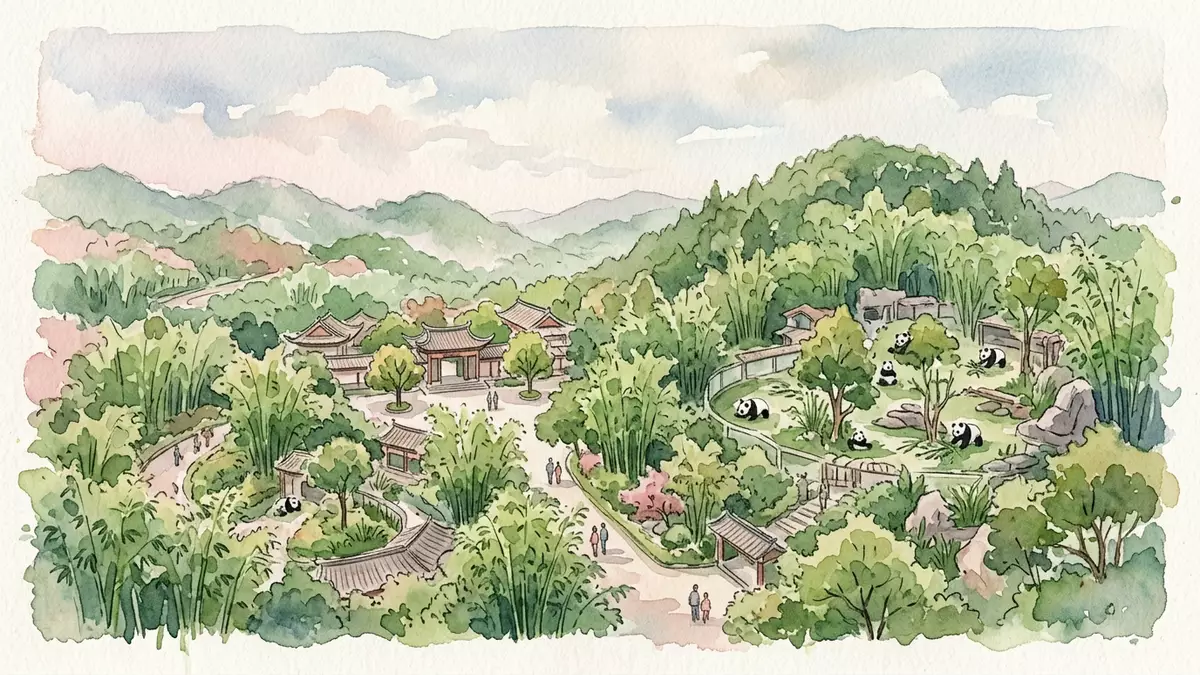
Chengdu Xiongmao Jidi is a conservation campus on the northern side of Chengdu, where giant panda enclosures sit among planted slopes, woodland and paths. Established in 1987, the Chengdu Research Base of Giant Panda Breeding combines animal care, scientific research, education and cultural tourism within one landscape.
Chengdu Xiongmao Jidi is a landscape of bamboo and enclosures
The base occupies 3.07 square kilometres in Chenghua District, at 1375 Panda Avenue. Its setting includes wooded hills, planted areas, watercourses and enclosure groups arranged across the site, giving the complex the character of a large living campus.
Giant pandas are the central presence, but the base also provides facilities for red pandas and other endangered wild animals native to China. The grounds include panda homes, feeding areas, research laboratories and a panda hospital, alongside paths and educational spaces. the base’s conservation role extends from breeding and veterinary care to research and public education.
From a 1987 rescue facility to a research institution
The base was founded in 1987 after weakened wild pandas were brought into care during bamboo shortages in Sichuan’s mountain regions. Construction began in March 1987, and the first facility was completed in 1988.
Its work developed beyond the care of individual animals. Giant panda breeding, cub rearing, disease prevention, genetic management and scientific study became part of the institution’s remit. The base also developed conservation education, with displays and programmes connecting the biology of pandas to the protection of wildlife habitats. the base’s founding in 1987 remains central to its identity.
Research, education and the wider Panda Valley
Chengdu Xiongmao Jidi is not only an animal enclosure complex. Its laboratories, veterinary facilities and education areas place the visible panda landscape alongside work that concerns reproduction, health, husbandry and conservation science.
A related field centre, Panda Valley, lies in Dujiangyan rather than within the Chenghua campus. Construction there began in May 2010, its first phase entered operation in 2012, and it opened to the public on 20 April 2015. The field centre includes ecological enclosures, red panda zones, reintroduction facilities and research areas. Panda Valley’s field centre is associated with wild training, reintroduction research and nature education.
Visiting Chengdu Xiongmao Jidi: what travellers from Western Europe should know
- Chengdu Xiongmao Jidi is at 1375 Panda Avenue in Chenghua District, north of central Chengdu. Chengdu Metro Line 3 reaches Panda Avenue station, followed by local transport to the base.
- The site spreads across wooded hills and planted slopes. Walking routes connect separate enclosure areas, research buildings and educational spaces.
- The related Panda Valley field centre is in Majiagou, Yutang Town, Dujiangyan City, near the Dujiangyan Irrigation Project and Mount Qingcheng.
- The official language is Mandarin Chinese and the currency is the Chinese yuan.
- Entry requirements depend on your nationality; UK travellers can check the FCDO travel advice at gov.uk/foreign-travel-advice, Irish travellers the Department of Foreign Affairs at ireland.ie.
Searching for Chengdu Xiongmao Jidi on social platforms
These links open searches for Chengdu Xiongmao Jidi on each platform.Frequently asked questions about Chengdu Xiongmao Jidi
Where is Chengdu Xiongmao Jidi?
It is in Chenghua District on Panda Avenue, on the northern side of Chengdu in Sichuan Province. The campus is reached through the city’s road and metro network.
What can visitors expect at the base?
The site combines panda enclosures, wooded paths, education areas and conservation facilities. Giant pandas are presented within a broader setting of research, veterinary care and public learning.
What makes Chengdu Xiongmao Jidi distinctive?
Its visible landscape joins bamboo planting and animal habitats with laboratories, a panda hospital and education facilities. The result is a conservation institution experienced through a landscaped campus.


