
Chefchaouen Medina and its blue-washed Rif mountain lanes
Published on 09/01/2026 at 20:17 | Editorial responsibility: Rafael Müller, Editor-in-Chief AD HOC NEWS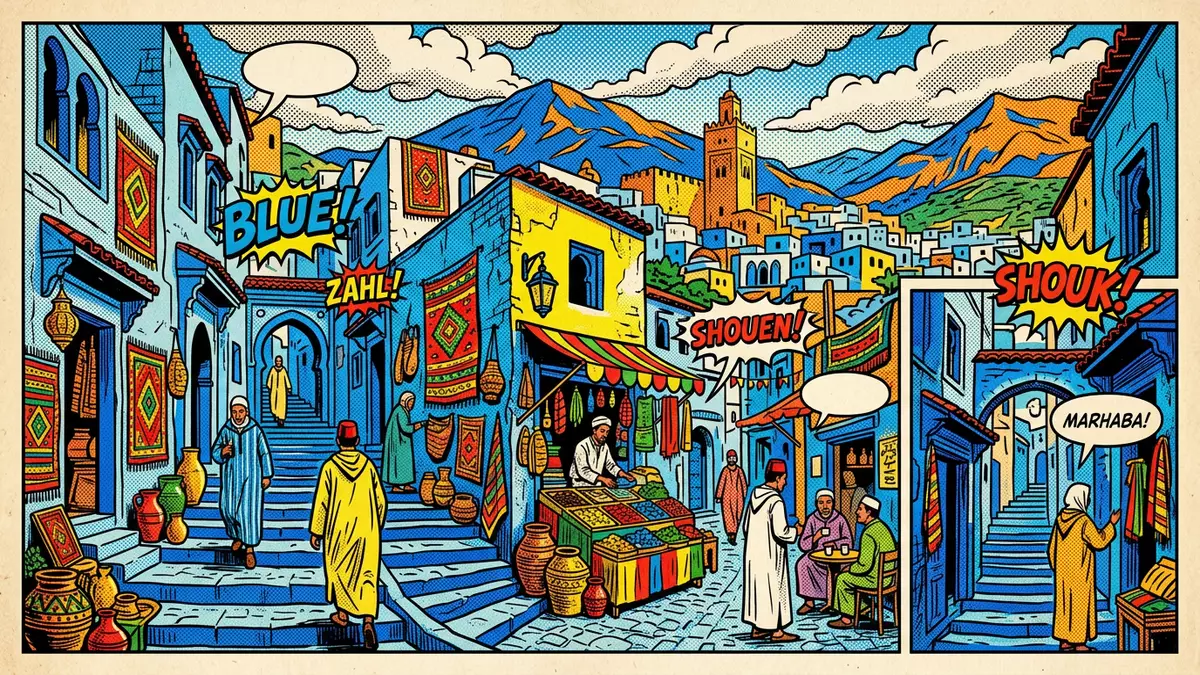
Chefchaouen Medina is the compact, blue-washed old town of Chefchaouen in northern Morocco, wrapped around a fifteenth-century fortress in the Rif Mountains and enclosed by historic walls.
Blue paint on stone lanes and stepped alleys
Walking through Chefchaouen Medina means passing along stepped alleys, narrow passages and small neighbourhood squares where walls, stair risers and doorframes are painted in shades of blue against white limewash. The district forms the historic heart of Chefchaouen, a town founded in the fifteenth century in the Rif Mountains, with its older fabric concentrated around a central square and the adjoining citadel. In the medina the houses generally rise two or three storeys, built in masonry with plastered facades, and many retain simple timber doors and small windows above them, giving the streets a continuous wall of domestic architecture broken only by entrances and occasional overhanging upper floors.
The dominance of blue and white paint is one of the most recognisable visual features of the medina, covering exterior walls and many staircases and courtyards.blue and white paint dominates The town’s association with blue extends across the old quarters, and the colour is maintained on houses and small shops alike, from simple residential lanes to streets that open towards the main square. This colour scheme stands out particularly where natural rock or unpainted brick appears at the base of walls or in small retaining structures, underscoring the contrast between the painted surfaces and the stony mountain setting.the walls of Chefchaouen are daubed with all shades of blue
A fifteenth-century fortress town in the Rif Mountains
Chefchaouen itself was founded in 1471 by Moulay Ali ben Rachid as a mountain stronghold in the Rif, a region of northern Morocco characterised by rugged peaks and valleys.founded in 1471 by Moulay Ali ben Rachid The medina grew as the walled town around a fortress, enclosed by defensive walls pierced by gates that controlled entry and linked the town to surrounding slopes and cemeteries.the medina of Chefchaouen has 5 gates Within these walls, the urban fabric developed in a pattern typical of Moroccan medinas, with irregular streets adapting to the terrain rather than following a strict grid, and with houses and religious buildings placed to form intimate, enclosed spaces.
Historical accounts describe Chefchaouen as a refuge for Muslims and Jews fleeing the Iberian Peninsula in the late fifteenth century, bringing Andalusi architectural influences into the medina’s houses and religious buildings.Andalusian influence in its architecture and culture These influences appear in details such as plasterwork, roof forms, and the arrangement of small internal courtyards within houses, which echo patterns found in Andalusi and Maghrebi domestic architecture. Over the centuries the town remained relatively closed to outsiders, and later came under Spanish control in 1920 before Morocco gained independence in 1956, leaving Spanish-period buildings and details alongside older structures within and around the medina.the city was returned when Morocco gained its independence in 1956
Uta Hammam Square, Kasbah and the Great Mosque
At the centre of Chefchaouen Medina lies Uta Hammam Square, also written Outa Hammam, which functions as the main public space of the old town.Plaza Uta el Hammam is the main square The square is set on lower ground and has long acted as a marketplace and gathering place, bordered by significant buildings including the Kasbah, the Great Mosque and a former caravanserai. Around its edges stand arcaded facades, small cafes and shops, and the entrances to these major structures, making it a focal point where everyday commerce and the town’s historic institutions meet. The Kasbah itself presents solid masonry walls and an internal garden, and together with the mosque and adjacent buildings it defines the architectural frame of the square.
Elsewhere in the medina, gates such as Bab el Ain mark transitions between the walled town and adjoining areas, with some located near cemeteries on the slopes outside the core of the settlement.Bab el Ain is one of the primary entrances The Great Mosque rises close to Uta Hammam Square, with a minaret that reflects local styles and the broader Moroccan tradition of square minaret towers, and its presence underscores the role of the medina as a religious as well as commercial centre. Together these elements give the old town a compact but layered structure, with the square providing a clear spatial reference point amid a network of streets and stairways.
Visiting Chefchaouen Medina: what travellers from Western Europe should know
- Chefchaouen Medina forms the historic centre of Chefchaouen in northern Morocco, set in the Rif Mountains south of Tetouan and reached by road connections from larger regional towns.
- The old town rises on a slope, with many streets laid out as stepped alleys; visiting involves walking on uneven stone surfaces and climbing stairways between levels.
- Chefchaouen lies in Morocco, where the official language is Arabic and the currency is the Moroccan dirham.
- Entry requirements depend on your nationality; UK travellers can check the FCDO travel advice at gov.uk/foreign-travel-advice, Irish travellers the Department of Foreign Affairs at ireland.ie.
Searching for Chefchaouen Medina on social platforms
These links open searches for Chefchaouen Medina on each platform.
Frequently asked questions about Chefchaouen Medina
Where is Chefchaouen Medina located?
Chefchaouen Medina is the historic walled old town of Chefchaouen in northern Morocco, set on the slopes of the Rif Mountains.
What should visitors expect when exploring the medina?
Visitors encounter narrow, stepped streets lined with blue and white painted houses, leading to Uta Hammam Square, the Kasbah and the Great Mosque.
What makes Chefchaouen Medina distinctive among Moroccan old towns?
The medina is characterised by its pervasive blue colour scheme, Rif mountain setting and a fifteenth-century history linked to Andalusi architectural influences.


