
Chefchaouen Medina and its blue-washed maze in the Rif
Published on 09/02/2026 at 19:13 | Editorial responsibility: Rafael Müller, Editor-in-Chief AD HOC NEWS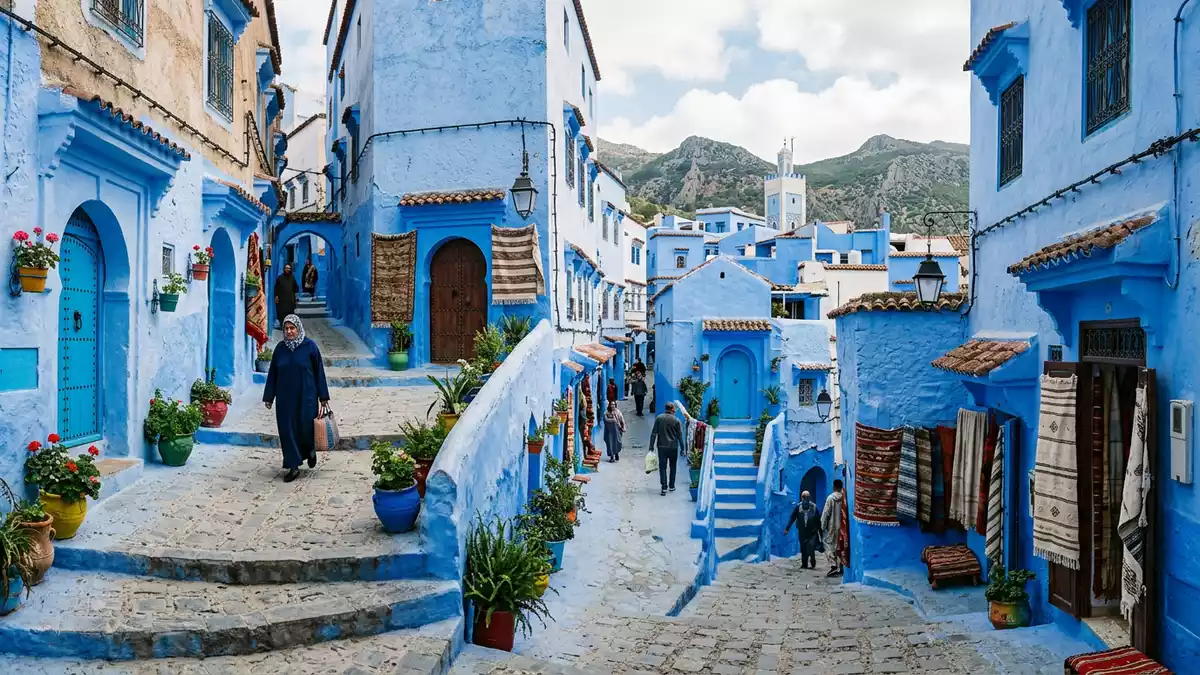
Chefchaouen Medina, the old walled quarter of Chefchaouen in northern Morocco, spreads across the lower slopes of the Rif Mountains in a dense patchwork of blue and white houses. Founded in the fifteenth century as a fortified settlement under Moulay Ali ben Rashid, it has grown into a compact historic centre where Andalusian arches, tiled roofs and painted alleyways still shape everyday life.Founded in 1471 as a holy town
Blue walls on an Andalusian street plan
The core of Chefchaouen Medina dates back to the fifteenth century, when refugees from al-Andalus settled beneath twin mountain peaks and laid out streets on an Andalusian pattern.Andalusian-influenced architecture in the medina Houses rise in compact terraces, their volumes broken by external staircases, projecting balconies and brick archways that brace upper floors above narrow lanes. Many façades carry simple geometric panels picked out in the same limewash as the walls, so the whole street reads as a continuous surface rather than a row of separate plots.
The characteristic blue colour that covers so many walls and steps developed later than the town itself, spreading across the medina during the twentieth century as Jewish and Moorish families maintained the habit of tinting limewash with blue pigment.The blue wash spread across the twentieth century Earlier photographs and local memories describe a much whiter town, and even now the blue is not uniform: some alleys are pale and powdery, others shaded towards indigo where repeated coats have darkened over time. Against this backdrop, painted doors, carved lintels and iron window grilles become delicate details in a single large composition.
The kasbah, mosques and everyday spaces
At the heart of Chefchaouen Medina stands the red-ochre kasbah, a fifteenth-century fortified residence whose high walls and towers still enclose a garden and a small ethnographic museum.Kasbah and central square in the medina Built from rammed earth and local stone, it forms a strong contrast with the blue houses that press close around the main square. Within its walls, planted beds, trees and a central path create a quiet interior landscape that reflects the town’s long connection to surrounding mountain springs.
The principal square outside, Plaza Uta el-Hammam, gathers together some of the medina’s most recognisable buildings, including the Grand Mosque with its distinctive stone minaret and the arcaded façades of cafés and small shops.Plaza Uta el-Hammam with the Grand Mosque and kasbah From here, lanes branch towards different neighbourhoods: older quarters close to the kasbah, areas once associated with the Mellah to the south, and residential districts that climb towards the springs at Ras el-Maa. Throughout, the medina retains its defensive character, with gated entrances and houses that turn much of their life inwards towards private courtyards.
Mountain setting and enclosed pedestrian lanes
Chefchaouen Medina lies at roughly 600 m (about 1,970 ft) above sea level in the western Rif Mountains, a range that runs parallel to the Mediterranean coast.Chefchaouen at 600 metres in the Rif Mountains The town’s historic core climbs a noticeable slope, so streets often turn into flights of steps, with blue-painted risers running between house fronts. In places, stone outcrops appear beside staircases, reminding visitors that the medina is anchored directly to the mountain.
The old quarter is enclosed by walls and functions as a pedestrian zone, with goods moved by handcarts or pack animals rather than cars.A pedestrian medina surrounded by newer neighbourhoods Outside the gates, a twentieth-century grid of wider streets and more recent buildings rings the historic centre, making the blue maze feel like a separate town tucked inside a newer shell. Above the roofs, the twin ridges that gave Chefchaouen its name rise steeply, and from certain alleys the view suddenly opens towards rock faces and distant folds of forested hillside.
Visiting Chefchaouen Medina: what travellers from Western Europe should know
- Chefchaouen Medina stands in northern Morocco, in the Rif Mountains inland from the Mediterranean coast; long-distance buses and shared taxis link Chefchaouen with larger cities such as Tangier and Fez.
- The terrain inside the medina is stepped and sloping, with many narrow stairways and uneven cobbled lanes that require steady footing.
- The Ras el-Maa spring lies just beyond the eastern edge of the medina, where water from the mountains reaches washing areas and small cascades beside stone paths.
- The official language is Arabic and the currency is the Moroccan dirham.
- Entry requirements depend on your nationality; UK travellers can check the FCDO travel advice at gov.uk/foreign-travel-advice, Irish travellers the Department of Foreign Affairs at ireland.ie.
Searching for Chefchaouen Medina on social platforms
These links open searches for Chefchaouen Medina on each platform.
Frequently asked questions about Chefchaouen Medina
Where is Chefchaouen Medina?
Chefchaouen Medina is the historic walled quarter of Chefchaouen, a mountain town in the Rif range of northern Morocco, inland from the Mediterranean coast.
What should visitors expect inside the medina?
Visitors encounter steep, narrow lanes, staircases and small squares, with houses painted in varying shades of blue and white clustered around the central kasbah and mosque.
What makes Chefchaouen Medina distinctive among Moroccan old towns?
The combination of Andalusian-influenced architecture, fifteenth-century kasbah and the extensive blue limewash on walls and steps gives Chefchaouen Medina a strong visual identity within Morocco.


