
Chefchaouen Medina and its blue-washed lanes
Published on 08/16/2026 at 13:25 | Editorial responsibility: Rafael Müller, Editor-in-Chief AD HOC NEWS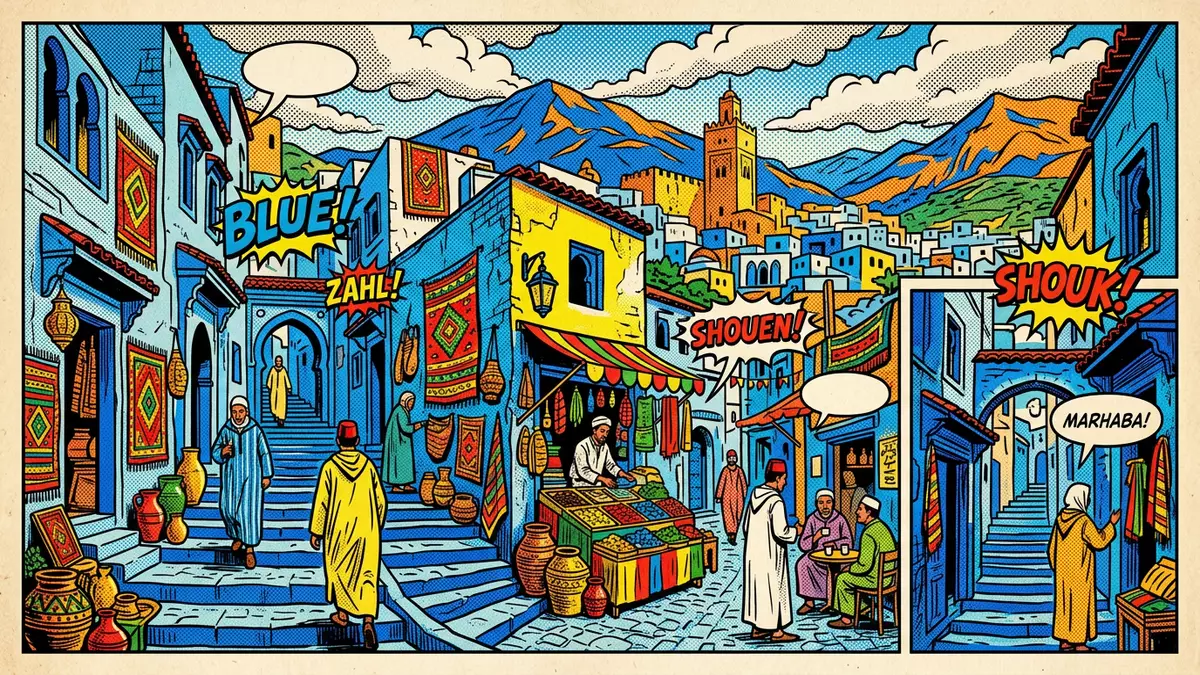
Chefchaouen Medina is the historic heart of Chefchaouen in northern Morocco, a compact old town where houses, stairways and lanes are washed in shades of blue against the slopes of the Rif Mountains. The medina grew around a fortified kasbah founded in the late fifteenth century by Ali ibn Rashid, giving the quarter its core of defensive walls, gates and a central square that still structure the neighbourhood today.historic walled town
Blue walls on a Rif mountainside
Chefchaouen lies in the Rif Mountains of northern Morocco, and its medina climbs a hillside above the newer quarters of the town, creating short flights of steps, sloping alleys and sudden views to surrounding peaks.foot of the Rif mountains Buildings in the old town are built in a Berber-Andalusian style, with rendered walls, tiled roofs and small courtyards, and many of these surfaces are painted in blues that range from pale sky tones to deep cobalt.
The medina is enclosed by historic walls whose gates mark transitions between the old town and the surrounding neighbourhoods, framing views of blue-painted houses as streets pass beneath them.medina of Chefchaouen Within the walls, lanes branch and climb, lined with small fountains, doorways and craft shops, and the blue colour extends along staircases and arches to form sequences of painted surfaces that give Chefchaouen Medina its distinctive character.blue-painted historic core
Kasbah, mosque and the central square
The centre of Chefchaouen Medina is Uta Hammam Square, also called Plaza Uta el-Hammam, a cobbled market square surrounded by some of the most important buildings in the old town.Uta Hammam Square On one side stands the kasbah, a fortress with ochre-coloured walls that formed the original citadel of Chefchaouen and marks the oldest part of the town’s fabric.ancient fortified kasbah
Beside the kasbah rises the Grand Mosque of Chefchaouen, a historic Friday mosque with an octagonal minaret that overlooks the square and anchors the skyline of the medina.Grand Mosque of Chefchaouen Around the square, cafes and small restaurants occupy traditional buildings, while narrow streets lead away between blue-painted facades toward residential quarters and souks where textiles, carpets and other crafts are sold.Place Outa el-Hammam
Neighbourhoods and everyday life in the medina
Chefchaouen Medina is not only a historic site but a living neighbourhood, with quarters such as the Souiqah district housing descendants of old Andalusian families and forming part of a network of streets that link homes, shops and small squares.Souiqah quarter Lanes climb toward outlying points such as Ras El Maa, where water flows down from the mountains, and along the way steps pass carpet sellers, grocery shops and doorways whose bright colours stand out against the blue walls.lanes that rise toward Ras El Maa
The medina’s fabric preserves a mixture of religious and cultural histories, with the kasbah and mosque reflecting its foundation in the late fifteenth century and later development as a Berber-Andalusian town that received Muslim and Jewish communities from Granada.founded in 1475 Within the neighbourhood, small riads with interior patios, tiled fountains and planted courtyards sit behind blue-painted entrances, and everyday life unfolds along alleys where local residents share the space with visitors exploring the medina’s stairways and squares.Berber-Andalusian appearance
Visiting Chefchaouen Medina: what travellers from Western Europe should know
- Chefchaouen Medina forms the old town of Chefchaouen in northern Morocco, in the Rif Mountains inland from the Mediterranean coast; it is reached by road from surrounding cities and by local transport into the town.
- The terrain inside the medina includes sloping cobbled lanes and staircases, and exploring on foot involves walking along uneven surfaces and climbing short flights of steps between different levels.
- The old town is bounded by historic walls with several gates; reaching the central square involves entering through one of these gateways and following narrow streets that lead into the heart of the medina.
- Within Chefchaouen Medina many streets are pedestrian, and vehicles are restricted to the edges, so moving around the quarter generally means walking through lanes and stairways between houses and small squares.
- Morocco’s official language is Arabic, and the national currency is the Moroccan dirham.
Searching for Chefchaouen Medina on social platforms
These links open searches for Chefchaouen Medina on each platform.
Frequently asked questions about Chefchaouen Medina
Where is Chefchaouen Medina located?
Chefchaouen Medina is the historic old town of Chefchaouen, a small city in northern Morocco’s Rif Mountains, inland from the Mediterranean coast.historic core of the city
What can visitors expect when walking through the medina?
Visitors encounter narrow cobbled lanes, blue-painted houses, stairways, small squares and markets, with everyday life unfolding in a compact quarter framed by walls and gates.narrow winding lanes
What makes Chefchaouen Medina distinctive among Moroccan old towns?
The combination of Berber-Andalusian architecture, a fifteenth-century kasbah and mosque, and extensive blue-painted surfaces on houses and alleys gives Chefchaouen Medina a character strongly associated with the town.blue medina of Chefchaouen


