
Chefchaouen Medina and its blue labyrinth of Rif mountain streets
Published on 09/08/2026 at 18:58 | Editorial responsibility: Rafael Müller, Editor-in-Chief AD HOC NEWS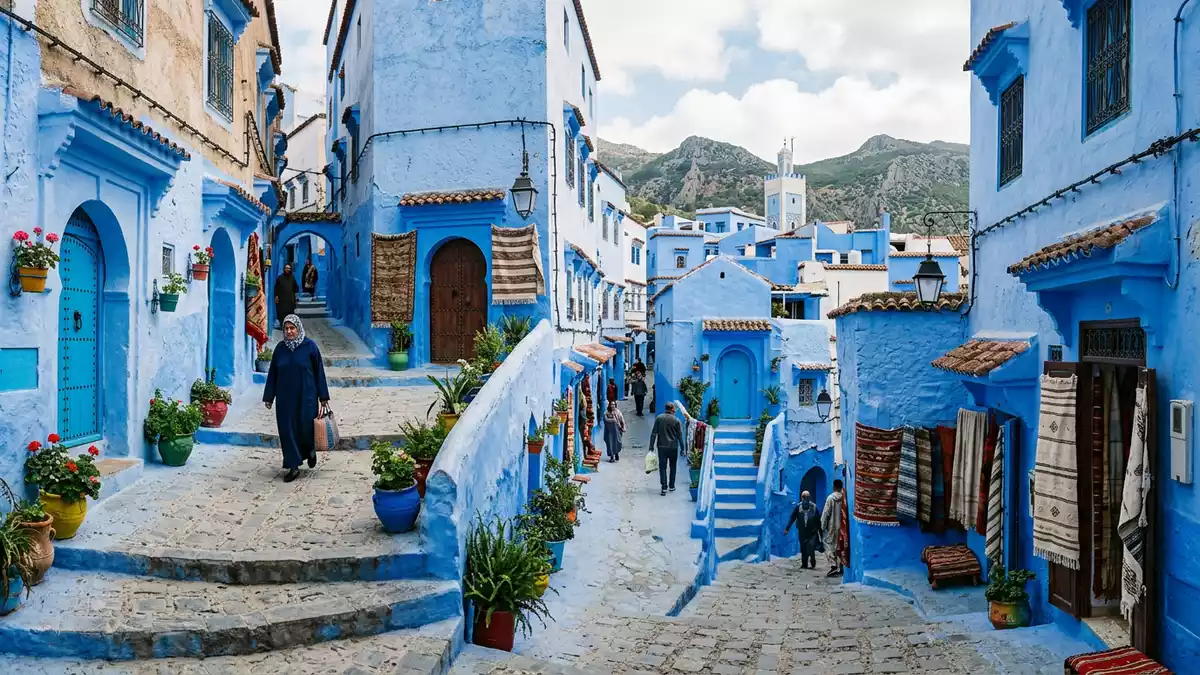
Chefchaouen Medina is the historic heart of Chefchaouen in northern Morocco, a compact hillside old town where blue-painted houses climb around a fifteenth-century mountain fortress at the foot of the Rif range. Founded in 1471 by the local leader Moulay Ali ibn Rashid as a fortified settlement, the medina developed as a refuge for communities arriving from Al-Andalus after the fall of Granada in 1492, giving it a lasting Berber-Andalusian character that remains visible in its streets and houses.The Medina is the historical district
From mountain citadel to blue-washed old town
The story of Chefchaouen Medina begins with the construction of a small fortress in 1471, positioned on the Rif slopes to control passes and resist Portuguese incursions along the coast.Founded in 1471 by Moulay Ali Ben Rachid Around this citadel, a walled town grew, enclosed by defensive ramparts with gates that framed entry into the narrow, stepped streets of the medina.The Medina was enclosed by defensive walls Over time, Muslim and Jewish refugees expelled from Spain settled here, bringing crafts, building techniques and decorative traditions that shaped the look of houses and public spaces.
The oldest part of the medina is the kasbah, a citadel built in the late fifteenth century with thick walls, inner courtyards and a small garden, forming a self-contained ensemble at the centre of the old town.The oldest part of the Medina is the Kasbah Surrounding it, a network of lanes and stairways threads across the slope, lined with houses that combine Berber building practices with Andalusian details such as tiled roofs and decorative plasterwork, giving the medina an architectural character that differs from many larger royal cities on Morocco’s plains.a rural Berber-Andalusian style
Place Outa el-Hammam and the kasbah core
At the centre of Chefchaouen Medina lies Place Outa el-Hammam, the main square where everyday life gathers around low houses, café terraces and two key landmarks: the Grand Mosque and the kasbah. The mosque traces its origins to the fifteenth century, with a distinctive octagonal minaret and simple, robust forms that echo the town’s military beginnings, while the kasbah, with its reddish outer walls, anchors the square as a reminder of the original fortress that gave birth to the settlement.Place Outa el-Hammam, where the 15th-century Grand Mosque and a small kasbah museum overlook a lively square
Radiating from Place Outa el-Hammam, the alleys of the medina climb and curve, often meeting in tiny squares or widening into short streets with views to the mountain ridges above. Within the old walls, neighbourhoods once organised by community and craft are woven together, with the former kasbah quarter and nearby streets preserving traces of the citadel layout, while other parts of the medina reflect later expansions as the town grew along trade routes linking Tetouan and Fez.a medina began to appear around the old fortress
The blue palette on walls and steps
The most striking feature of Chefchaouen Medina is the extensive use of blue on its walls, stairways, doors and low façades, a colour range that stretches from pale turquoise to deep indigo and cobalt. The practice of painting the old town blue took hold during the twentieth century, building on earlier use of blue in Jewish quarters and evolving as residents continued to apply indigo-based pigments to houses and lanes.from the 1930s onwards that its houses began to be painted blue This blue-washing extends across much of the historic district, particularly around the central square and the alleyways leading away from the kasbah, creating an environment where house fronts, steps and low boundary walls carry closely related shades.The medina — the old walled city — is the blue area
Walks through the medina reveal the variety within this colour scheme: some houses are painted in near-white with blue bases, others in uniform sky blue, and others show bands or panels of deeper tones, often framed by simple wooden doors and small windows. In places, decorative flowerpots and textiles introduce further colours against the blue, while archways and door surrounds bear plaster or stone detailing that reflects the town’s Berber-Andalusian building tradition.turquoise, cobalt, navy, powder blue
Visiting Chefchaouen Medina: what travellers from Western Europe should know
- Chefchaouen lies in northern Morocco in the Rif Mountains, south of the Mediterranean coast, with the medina occupying the slopes above the modern town and reached on foot from the lower streets and small squares.
- The terrain inside the medina is steep, with stepped alleys and short staircases linking levels; footwear suited to uneven surfaces is helpful because many streets combine slopes with stone steps.
- Beyond the old walls, roads lead towards Tetouan and Tangier, and from the upper parts of the medina the surrounding mountain ridges and valleys are visible above roofs and minarets.
- The official language is Arabic and the currency is the Moroccan dirham.
- Entry requirements depend on your nationality; UK travellers can check the FCDO travel advice at gov.uk/foreign-travel-advice, Irish travellers the Department of Foreign Affairs at ireland.ie.
Searching for Chefchaouen Medina on social platforms
These links open searches for Chefchaouen Medina on each platform.
Frequently asked questions about Chefchaouen Medina
Where is Chefchaouen Medina located?
Chefchaouen Medina occupies the historic centre of Chefchaouen, a mountain town in northern Morocco’s Rif region south of the Mediterranean coast.
What should visitors expect inside the medina?
Visitors encounter steep, narrow alleys, stepped streets and blue-painted houses clustered around the central square of Place Outa el-Hammam and the kasbah citadel.
What makes Chefchaouen Medina distinctive among Moroccan old towns?
Its combination of fifteenth-century fortress origins, Berber-Andalusian architecture and extensive twentieth-century blue-washing of walls and stairways gives the medina a character different from many larger Moroccan cities.


