
Chateau de Versailles and the theatre of French power
Published on 09/18/2026 at 11:27 | Editorial responsibility: Rafael Müller, Editor-in-Chief AD HOC NEWS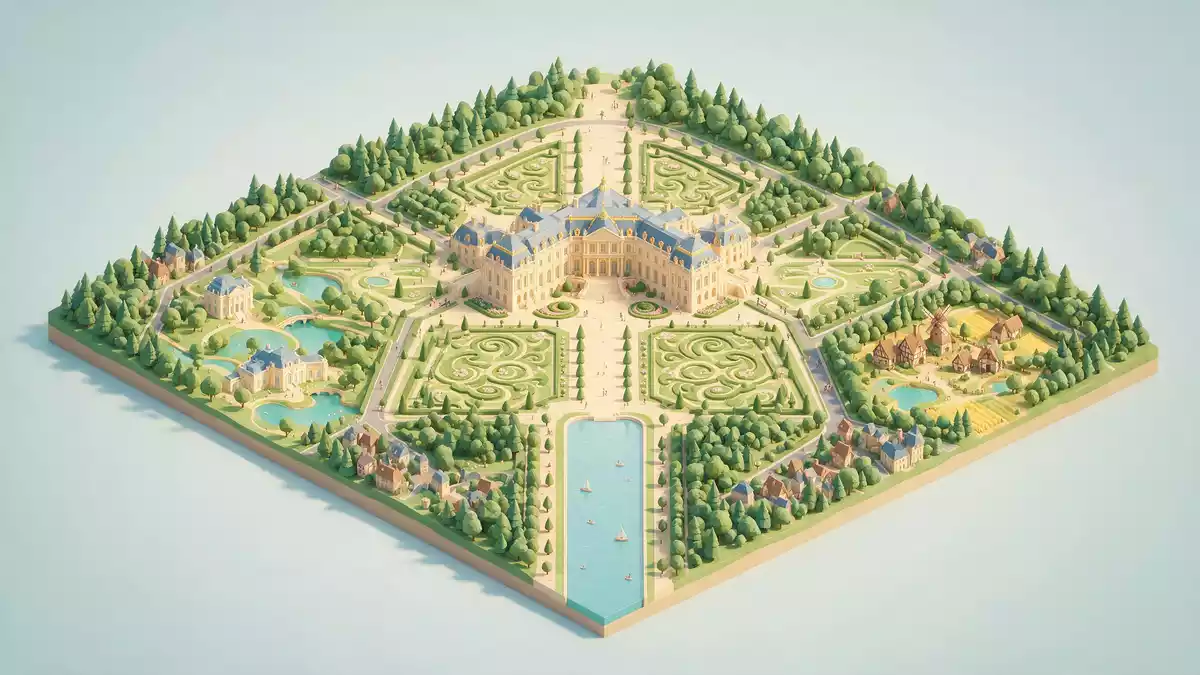
Chateau de Versailles in Versailles is a former royal residence turned museum, framed by formal gardens that stretch across the landscape. Built up from a hunting lodge of Louis XIII and transformed under Louis XIV in the seventeenth century, it became a stage on which French power and style were displayed in stone, water and gilded interiors.
From hunting lodge to royal palace
The story of Chateau de Versailles begins with Louis XIII, who established a residence on the plateau at Versailles in the early seventeenth century as a retreat linked to the surrounding forests. That modest lodge was enlarged into a château and then, under his son Louis XIV, into a palace whose construction began in the 1660s, drawing in architects, painters and landscape designers over several decades.former French royal residence Under Louis XIV, Louis XV and Louis XVI, Versailles served as the principal residence of the French kings and the centre of court life, with the royal government based there from 1682 until the upheavals of 1789.principal residence of the French kings
The palace complex grew in phases into an immense ensemble of buildings and gardens, shaped by figures such as Louis Le Vau, Jules Hardouin-Mansart and André Le Nôtre, and is widely recognised as a major work of French classicism in architecture.classicist palace shaped by leading architects After the French Revolution, the palace ceased to function as a royal residence and was later given a new role as a museum dedicated to the history of France in the nineteenth century under King Louis-Philippe.museum of the History of France
Architecture and interiors in French classicism
Chateau de Versailles presents a long façade articulated by regular windows, pilasters and classical ornament, creating a sense of order that matches its role as a seat of power. Behind this exterior lies a sequence of state rooms where decoration in stucco, gilding and painted ceilings forms a continuous programme. One of the most visited spaces is the Hall of Mirrors, a long gallery where large mirrors face windows opening towards the gardens, lined by decorative pilasters and lit by chandeliers suspended from painted vaults.Hall of Mirrors constructed in 1679
The interiors reflect different phases of work under the three kings who lived at Versailles, and the palace as a whole has been described as a visual history of French architecture from the 1630s to the 1780s.visual history of French architecture Styles that began in the period of Louis XIII, with brick and stone elements, were overlaid by classical stone façades and rich baroque decoration under Louis XIV, followed by later eighteenth-century refinements. Beyond the ceremonial suites, the palace contains chapels, opera spaces and apartments that show how representation and domestic life overlapped inside a royal residence.
Gardens, water features and the wider estate
The palace is set within an extensive park and gardens, laid out under landscape designer André Le Nôtre in a style that became a model for formal gardens across Europe. Terraces descend from the palace towards parterres shaped by clipped hedges and ornamental beds, with paths drawing visitors along axial lines. Beyond the immediate parterres, broad lawns, tree-lined avenues and canals extend the design into the surrounding landscape, integrating water features and geometry on a grand scale.stylised French gardens
Within the grounds lie smaller palaces and retreats, including the Grand Trianon and Petit Trianon, as well as ornamental structures linked to different periods of royal use. The park and palace together form a single World Heritage property inscribed by UNESCO, recognised as an exemplar of a European royal residence and landscape.Palace and Park of Versailles World Heritage Water basins, fountains and canals are integral to this wider estate, combining engineered waterways and decorative sculpture with long views back towards the architectural mass of the palace.
Visiting Chateau de Versailles: what travellers from Western Europe should know
- Chateau de Versailles stands in the town of Versailles in the Île-de-France region, south-west of Paris, and is reached by regional rail services from the capital along lines serving Versailles stations.
- Within the estate, movement between the palace, formal gardens and outlying retreats involves walking over large paved courtyards, broad gravel paths and garden avenues, so a visit involves time on foot across varied surfaces.
- The wider estate includes the Grand Trianon and Petit Trianon residences and ornamental villages within the park, which lie at some distance from the main palace and are linked by paths and internal transport options.
- Versailles lies in France, where the official language is French and the currency is the euro.
Searching for Chateau de Versailles on social platforms
These links open searches for Chateau de Versailles on each platform.
Frequently asked questions about Chateau de Versailles
Where is Chateau de Versailles located?
Chateau de Versailles is in the town of Versailles in the Île-de-France region of France, south-west of Paris, within reach of the capital by regional rail.
What should visitors expect during a visit?
A visit combines palace interiors, long formal gardens and wider parkland, so it involves moving between historic rooms, large courtyards and extensive outdoor areas across the estate.
What makes Chateau de Versailles distinctive among European palaces?
Its combination of French classical architecture, richly decorated interiors and an extensive formal garden and park, recognised as a single World Heritage property, gives it a particular scale and coherence.


