
Chateau de Versailles and the theatre of French power
Published on 09/05/2026 at 12:35 | Editorial responsibility: Rafael Müller, Editor-in-Chief AD HOC NEWS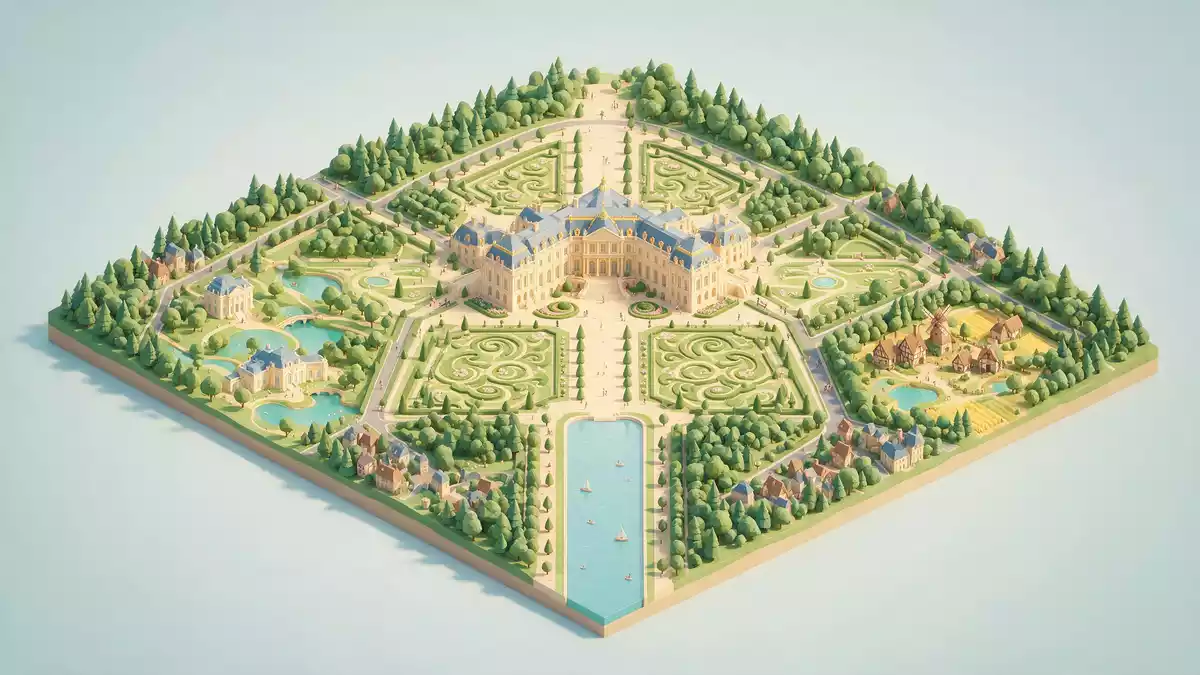
Chateau de Versailles in Versailles, just west of Paris, is the palace where the Bourbon monarchy made architecture, landscape and ceremony serve royal power in the seventeenth and eighteenth centuries. Commissioned by King Louis XIV in the 1660s on the foundations of a earlier residence begun under Louis XIII, the estate grew into a vast complex of stone façades, ceremonial halls and formal gardens that defined the image of the French court.Bourbon monarchy The palace and its park were inscribed as a UNESCO World Heritage Site in 1979, formally recognising the ensemble as a model of the ideal royal residence in Europe.UNESCO World Heritage Site in 1979
From hunting lodge to royal residence
The story of Chateau de Versailles begins with Louis XIII, who established a hunting lodge and then a château on the site in the early seventeenth century, turning farmland and woods into a royal retreat.hunting lodge and château In 1661 his son Louis XIV took that relatively modest residence and launched a programme of expansion that transformed Versailles between 1661 and the early eighteenth century into an immense palace surrounded by stylised French gardens.transformed Versailles between 1661 and the early eighteenth century
Louis XIV made Versailles the principal seat of the French court and government, and from 1682 until 1789 the kings Louis XIV, Louis XV and Louis XVI lived and ruled from the palace and its adjoining buildings.principal seat of the French court and government This long Bourbon presence fixed Versailles in European memory as a symbol of absolute monarchy under the Ancien Régime, with its protocols, audiences and ceremonies staged against a backdrop of gilded panelling, painted ceilings and ordered avenues.
Architecture as a stage for power
The architecture of Chateau de Versailles blends French classicism with Baroque grandeur, its long façades articulated by columns, pilasters and balustrades that frame courtyards and gardens.French classicism with Baroque grandeur Designers such as Louis Le Vau and Jules Hardouin-Mansart shaped the palace’s envelope and added wings for state apartments, chapels and galleries, while the interior decorators and painters developed rich schemes of stucco, sculpture and colour that extend across walls and ceilings.Louis Le Vau and Jules Hardouin-Mansart
Among the most emblematic spaces inside is the Hall of Mirrors, a grand gallery added under Louis XIV on the first floor of the central body of the palace facing the gardens.Hall of Mirrors Built between 1678 and 1684 to designs attributed to Hardouin-Mansart and decorated by Charles Le Brun, the hall runs for around 73 m (240 ft) with high painted ceilings, rows of mirrors aligned opposite windows opening towards the park and ornate chandeliers and statues marking the rhythm of the space.runs for around 73 m
Gardens, estate and setting
Versailles is set in the Île-de-France region, in the Yvelines department of northern France, roughly 16 to 18 km (10 to 11 mi) west-southwest of central Paris.west-southwest of central Paris The palace stands at the heart of a wider estate of avenues, ornamental lakes and groves, conceived by landscape architect André Le Nôtre as a geometric extension of the architecture into the surrounding terrain.wider estate of avenues
The park and gardens cover hundreds of hectares, with long perspectives leading from the central axis of the palace towards the Grand Canal and parallel allées lined with sculpted trees and fountains.park and gardens cover hundreds of hectares Beyond the main palace lie further elements of the estate, including smaller residences and ornamental features that were added over the course of the seventeenth and eighteenth centuries as successive kings adapted Versailles to their needs and tastes.
Visiting Chateau de Versailles: what travellers from Western Europe should know
- Chateau de Versailles stands in the city of Versailles in northern France, reached by rail from Paris and by road from other parts of Île-de-France.
- The palace interior includes grand staircases and long corridors, and a visit through the state apartments and galleries involves extended walking on hard floors.
- The formal gardens around the palace are laid out over a broad area with gravel paths, lawns and terraces, so exploring the park means covering significant distances on foot.
- The official language is French and the currency is the euro.
Searching for Chateau de Versailles on social platforms
These links open searches for Chateau de Versailles on each platform.Frequently asked questions about Chateau de Versailles
Where is Chateau de Versailles?
Chateau de Versailles is in the city of Versailles in the Yvelines department of Île-de-France in northern France, west-southwest of Paris.
What can visitors expect at Chateau de Versailles?
A visit combines richly decorated state rooms such as the Hall of Mirrors with extensive formal gardens laid out in geometric patterns around ornamental lakes and avenues.
What makes Chateau de Versailles distinctive among European palaces?
Versailles is distinctive for the way seventeenth and eighteenth-century architects and landscape designers created a single composition of palace and park that embodied French royal power.


