
Chateau de Versailles and the theatre of absolute power
Published on 09/14/2026 at 18:58 | Editorial responsibility: Rafael Müller, Editor-in-Chief AD HOC NEWS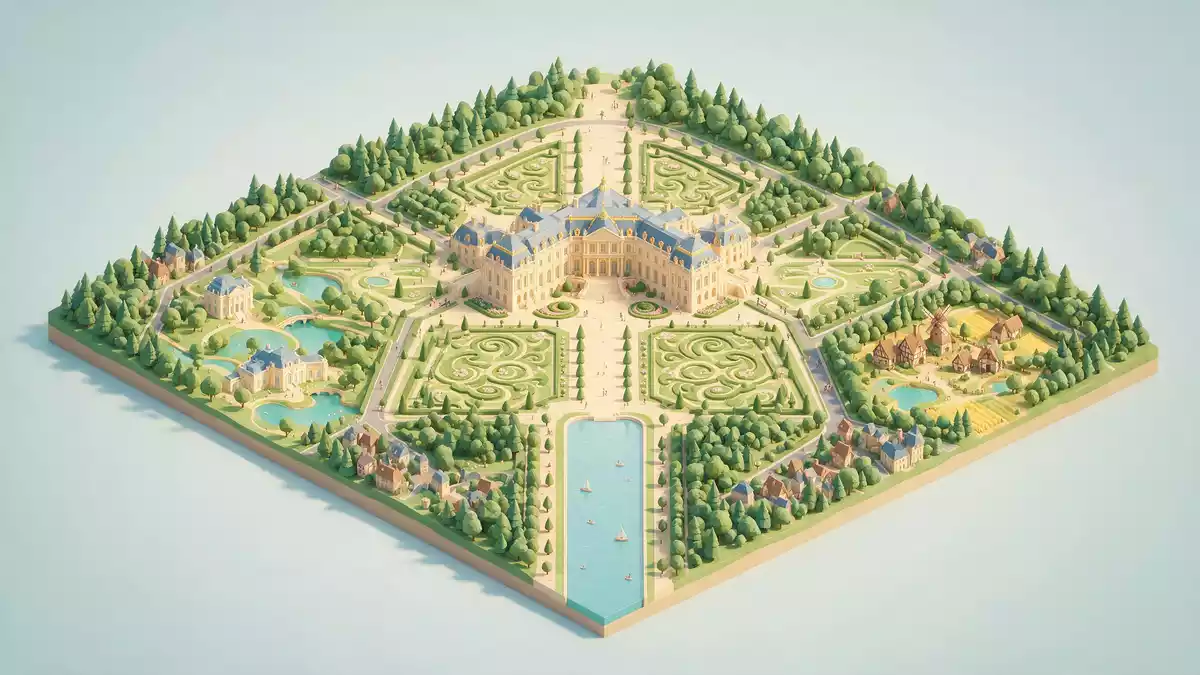
Chateau de Versailles on the outskirts of Versailles is a vast classical palace and park that grew from a royal hunting lodge into the centre of French power in the seventeenth and eighteenth centuries. Built for Louis XIII and transformed under Louis XIV, it became the principal residence of the French kings Louis XIV, Louis XV and Louis XVI and later a museum devoted to the history of France.
From hunting lodge to royal seat of power
The origins of Chateau de Versailles lie in a modest hunting retreat established by Louis XIII on marshy ground west of Paris in the early seventeenth century. In 1623 a small château rose on the site, expanded in the 1630s with walled gardens, drainage works and new approaches that made the area habitable for the king and his household.early seventeenth?century hunting lodge The original residence combined brick, marble and slate, a distinctive mix that survives at the core of the palace.
The decisive change came under Louis XIV, who inherited the Versailles estate and began transforming it into an immense complex after 1661. From that year until around 1710 the building campaigns led by architects Louis Le Vau and Jules Hardouin?Mansart turned the modest château into a palace suited to an absolutist monarchy, wrapping the old structure in an “envelope”, adding grand façades and creating suites of state apartments.Louis XIV’s transformation from 1661 In 1682 Louis XIV installed the royal court and government permanently at Versailles, making the palace the de facto capital of the kingdom.
French classicism in stone, stucco and garden axes
Architecturally, Chateau de Versailles is a major work of French classicism, a style that balances symmetry, order and richly decorated surfaces. The earliest part of the residence, the corps de logis built for Louis XIII, shows materials and forms typical of his reign, while later additions under Le Vau, Hardouin?Mansart and Robert de Cotte introduced grand colonnades, mansard roofs and long terraces that unified the façades facing the gardens.French classical architecture Inside, Charles Le Brun oversaw allegorical ceiling paintings and gilded panelling that linked decoration directly to royal imagery.
The gardens and park surrounding the palace are integral to its design. Landscape architect André Le Nôtre laid out long, straight axes, geometric parterres and basins aligned with the main palace façade, creating a carefully ordered landscape that extends far into the surrounding countryside.palace and park composition Beyond the ornamental gardens lie woods, canals and secondary residences such as the Palaces of Trianon, all forming part of an estate whose origins date to the seventeenth century and which now covers hundreds of hectares.
From royal residence to museum and World Heritage site
Versailles was the principal residence of the French kings from the time of Louis XIV to Louis XVI, housing the king, the court and the royal government for more than a century until the late eighteenth century.principal residence of the French kings After the French Revolution the palace ceased to serve as a royal home, and its functions changed in the nineteenth century when King Louis?Philippe, who came to the throne in 1830, ordered the creation of the Museum of the History of France within its walls. This museum opened in 1837 and filled many rooms with paintings and objects relating to centuries of national history.museum of the History of France since 1837
Since 1979 the Palace and Park of Versailles have been inscribed on the UNESCO World Heritage List, recognised as a model royal residence that influenced architecture, garden design and court life across Europe.inscription on the UNESCO World Heritage List in 1979 The wider estate, including the park, formal gardens and the Trianon residences, forms a single landscape composition around the palace. Within the complex, collections now comprise tens of thousands of works illustrating over five centuries of French history, reinforcing Versailles’ role as both historic seat of power and major museum.
Visiting Chateau de Versailles: what travellers from Western Europe should know
- Chateau de Versailles stands in the town of Versailles, south?west of Paris in the Île?de?France region, and is reached by suburban rail services and local roads.
- Within the palace, major routes rise through grand staircases and long corridors; some interior stairways are narrow and extend over several flights.
- The estate includes extensive gardens and parkland, with long, level walks on gravel and grass; exploring the grounds involves covering significant distances on foot.
- The official language is French and the currency is the euro.
Searching for Chateau de Versailles on social platforms
These links open searches for Chateau de Versailles on each platform.
Frequently asked questions about Chateau de Versailles
Where is Chateau de Versailles?
Chateau de Versailles stands in the town of Versailles in the Île?de?France region of France, south?west of Paris.
What can visitors expect during a visit?
A visit brings grand state rooms, long ceremonial routes through the palace and extensive formal gardens and parkland laid out along geometric axes.
What makes Chateau de Versailles distinctive among European palaces?
Its role as the principal royal residence of the Bourbons, its French classical architecture and its vast formal park together make Versailles a defining royal ensemble.


