
Chateau de Versailles and its mirrored axis of power
Published on 08/26/2026 at 22:55 | Editorial responsibility: Rafael Müller, Editor-in-Chief AD HOC NEWS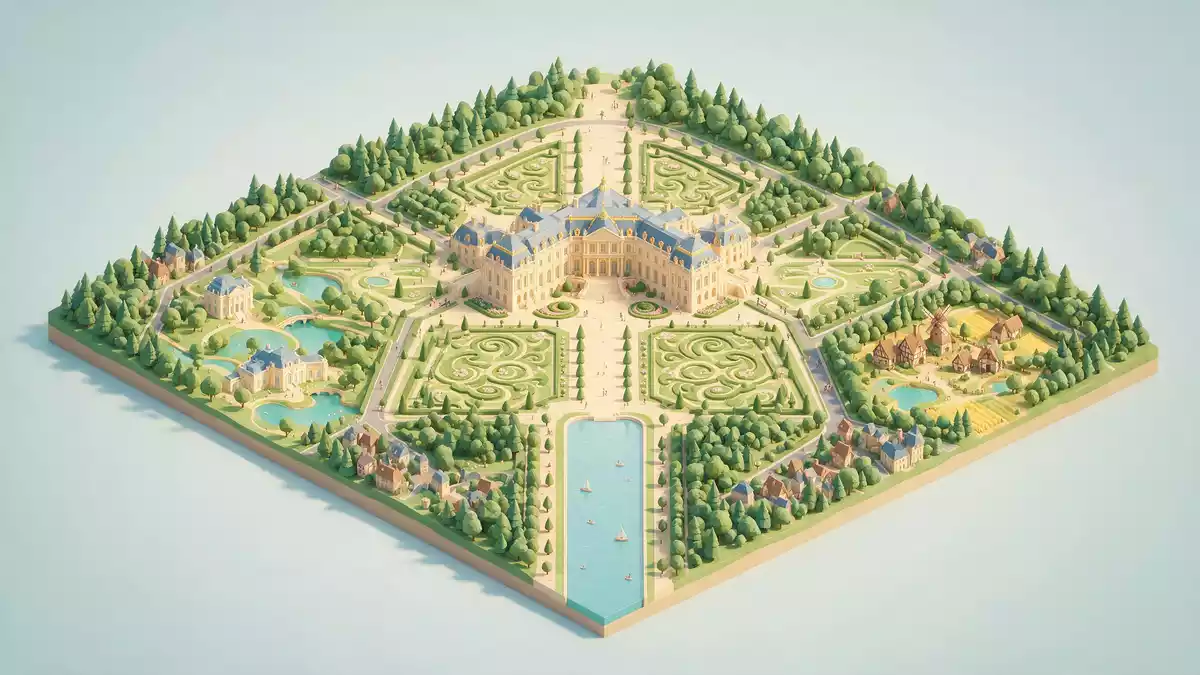
Chateau de Versailles in Versailles, just south-west of Paris, is a former royal residence that crystallises French power, ceremony and geometry along a deliberate east–west axis. The palace grew from a hunting lodge of Louis XIII into the vast seat of Louis XIV’s court in the late seventeenth century, and its combination of mirrored interiors and regimented gardens still anchors how many visitors picture French classical architecture.
A royal residence shaped along an axis
The story of Chateau de Versailles starts with Louis XIII, who had a modest residence constructed on the site in the 1620s as a base for hunting in the surrounding countryside.The original residence was a hunting lodge His son Louis XIV began a sweeping transformation after 1661, enlarging that lodge into a palace and ordering successive phases of construction through the early eighteenth century.Louis XIV commissioned major works from 1661
In 1682 Louis XIV installed the royal court and government permanently at Versailles, making Chateau de Versailles the principal residence of the French monarchy under Louis XIV, Louis XV and Louis XVI.The palace served as the main royal residence from Louis XIV to Louis XVI The palace and park were inscribed as a UNESCO World Heritage Site in 1979, recognising their role as a model of a royal residence that shaped European court architecture.The Palace and Park of Versailles became a World Heritage Site in 1979
Classical architecture in stone, water and parterres
Chateau de Versailles is a vast composition of stone facades, courtyards and gardens planned in the idiom now described as French classical architecture. Architect Louis Le Vau designed early phases of the expanded palace, while Jules Hardouin-Mansart oversaw later and more extensive works, bringing the long elevations and projecting pavilions into a unified whole.Architects Louis Le Vau and Jules Hardouin-Mansart shaped the palace Stone balustrades, pilasters and ordered window rhythms give the exterior a controlled, repetitive character that reflects the court it once housed.
In front of the palace, landscape designer André Le Nôtre laid out the gardens in long terraces and parterres aligned with the central axis, extending the architecture into the landscape.The park was created by generations of landscape designers including André Le Nôtre Pools, basins and canals punctuate the lawns, while tree-lined walks radiate from the palace like spokes, creating controlled vistas that still structure how visitors move through the estate.
The Hall of Mirrors as the palace’s glittering spine
At the heart of Chateau de Versailles, the Hall of Mirrors runs along the garden front as a ceremonial gallery that turns the axis between palace and park into a space of glass, painted ceilings and reflected light. The gallery occupies the length between the king’s and queen’s apartments, replacing an earlier open terrace that once faced the gardens.The Hall of Mirrors replaced a terrace between the royal apartments
Architect Jules Hardouin-Mansart directed the construction of the Hall of Mirrors between 1678 and 1684, while painter Charles Le Brun covered the ceiling with scenes celebrating the reign of Louis XIV.The Hall of Mirrors was built between 1678 and 1684 under Jules Hardouin-Mansart The room’s name refers to the rows of mirrors facing the windows that look out towards the gardens, turning the perspective views into repeated reflections and making the gallery a central symbol of Versailles in paintings and photographs.
Visiting Chateau de Versailles: what travellers from Western Europe should know
- Chateau de Versailles stands in the city of Versailles in the Île-de-France region, south-west of central Paris, and is reached by suburban rail services that terminate at stations in Versailles.
- Moving through the estate involves long walks across terraces and garden paths, with broad staircases and gravel surfaces between the palace, ornamental pools and groves.
- The palace sits within a wider estate that includes the formal gardens and extended parkland, so a visit can encompass both interiors and extensive outdoor areas.
- The official language is French and the currency is the euro.
Searching for Chateau de Versailles on social platforms
These links open searches for Chateau de Versailles on each platform.
Frequently asked questions about Chateau de Versailles
Where is Chateau de Versailles?
Chateau de Versailles is in the city of Versailles in France’s Île-de-France region, south-west of Paris, with rail links connecting it to the wider Parisian network.
What can visitors expect inside and around the palace?
Visitors encounter grand stone courtyards, richly decorated state rooms such as the Hall of Mirrors and extensive formal gardens laid out along a central axis with pools and groves.
What makes Chateau de Versailles distinctive among royal residences?
Chateau de Versailles is distinctive for its role as the principal residence of Louis XIV, Louis XV and Louis XVI, its French classical architecture and its mirrored gallery facing axial gardens.


