
Chateau de Versailles and its grand axis of power
Published on 09/16/2026 at 06:20 | Editorial responsibility: Rafael Müller, Editor-in-Chief AD HOC NEWS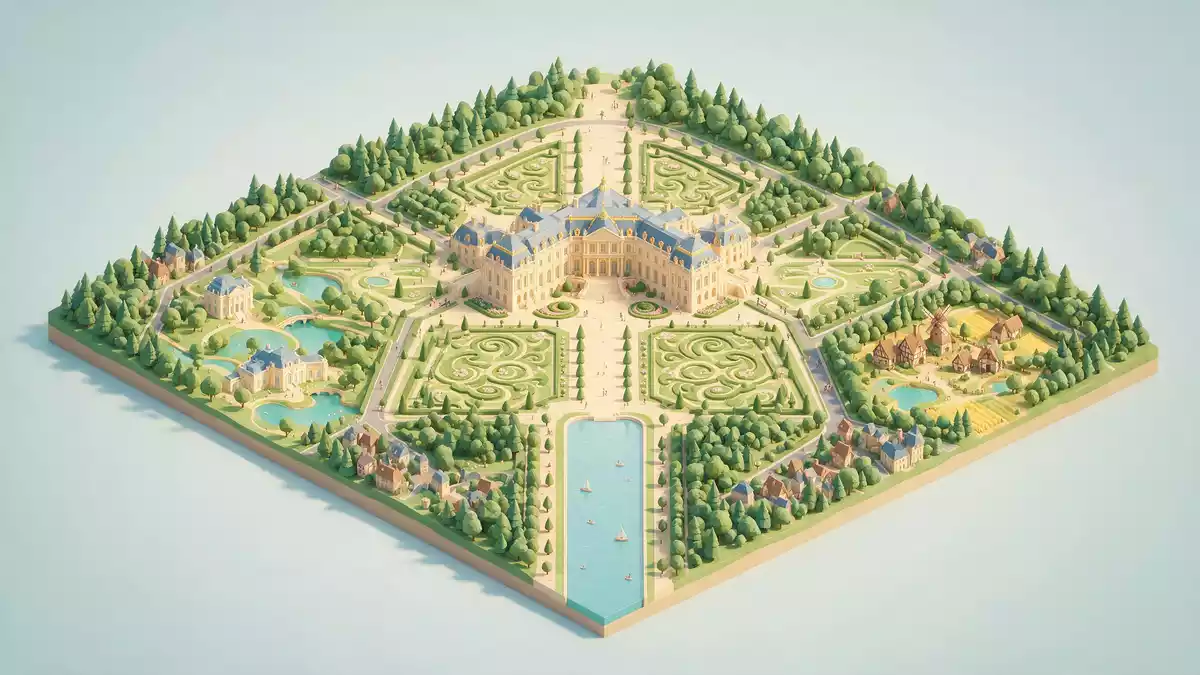
Chateau de Versailles, just south-west of Paris in Versailles, grew from a modest royal retreat into a vast palace and formal landscape organised around a single grand east–west axis. Built and expanded largely under Louis XIV in the later seventeenth century, it became the principal residence of the French monarchy and a model for royal architecture across Europe.
The royal palace that reshaped Versailles
The site at Versailles first held a hunting residence for Louis XIII in the early seventeenth century, before his son Louis XIV transformed it into a major courtly complex.Louis XIII’s hunting lodge stood at the heart of the early estate, and construction of the later palace began in the 1660s as the court’s focus moved away from Paris.Work on the palace from 1661 established Versailles as a seat of royal power in the Île-de-France region.
Under Louis XIV, the residence was rebuilt and extended in the style often labelled French classicism, with long, ordered façades and repetitive windows expressing rhythm across the courtyards.French classical architecture defined the main ranges and set the tone for later additions. Louis XV and Louis XVI continued to adapt the interiors and wings as court life evolved, but the palace retained its formal organisation around ceremonial spaces such as the state apartments and the chapel.
The Hall of Mirrors and ceremonial interiors
Inside Chateau de Versailles, the Hall of Mirrors is the most widely recognised room, occupying a long gallery on the garden side of the central block.The Hall of Mirrors replaced an earlier open terrace designed by Louis Le Vau, enclosing the view towards the gardens behind a sequence of arched windows and mirrored panels. Crystal chandeliers, gilded stucco and painted ceilings combine with the reflections to multiply light and decorative detail along the gallery.
The Hall of Mirrors sits among suites of royal apartments, an ornate chapel and further galleries that together form a spatial sequence for court ritual. Rooms were aligned to face the central gardens, and many ceilings carry painted scenes relating to Louis XIV and his predecessors.The palace as royal residence meant these interiors were designed for audiences, ceremonies and daily life in a court that spent much of the late seventeenth and eighteenth centuries here.
Gardens, grand canal and the long perspective
Beyond the palace walls, the formal gardens of Versailles extend along a strong east–west line that visitors can see framed by the central windows of the Hall of Mirrors.The Grande Perspective runs away from the palace through terraces, pools and lawns towards woodland and water. André Le Nôtre, appointed to oversee the layout in the 1660s, developed this axis and widened the principal path, giving the estate its characteristic long view.
Le Nôtre also oversaw the excavation of the Grand Canal, which stretches across the lower part of the park and intersects the main alignment of the gardens.The palace and park of Versailles together encompass formal avenues, bosquets cut into the woodland and water basins that mirror the sky. Sculpture, clipped hedging and geometrically laid out flowerbeds underline the controlled character of the landscape seen from the palace, where straight lines and measured proportions run from the Water Parterre out towards the horizon.
Visiting Chateau de Versailles: what travellers from Western Europe should know
- Chateau de Versailles stands in Versailles, a town south-west of Paris in the Île-de-France region, and is reached by road and suburban rail from the capital.
- The palace complex combines grand state interiors with extensive formal gardens, and a visit involves walking on stone floors, gravel paths and broad terraces.
- The Grand Canal and surrounding parkland lie below the main palace, so exploring the lower grounds involves descending garden slopes and returning uphill to the central building.
- The official language is French and the currency is the euro.
Searching for Chateau de Versailles on social platforms
These links open searches for Chateau de Versailles on each platform.Frequently asked questions about Chateau de Versailles
Where is Chateau de Versailles located?
Chateau de Versailles is in the town of Versailles in the Île-de-France region of France, south-west of Paris.
What should visitors expect on a visit to the palace and gardens?
A visit combines richly decorated royal interiors such as the Hall of Mirrors with extensive formal gardens laid out along a grand axis and the Grand Canal below.
What makes Chateau de Versailles distinctive among European royal residences?
The combination of French classical palace architecture with the long, geometric garden perspective developed by André Le Nôtre gave Versailles a lasting influence on royal residences across Europe.


