
Chateau de Versailles and its grand axis of power
Published on 09/09/2026 at 06:45 | Editorial responsibility: Rafael Müller, Editor-in-Chief AD HOC NEWS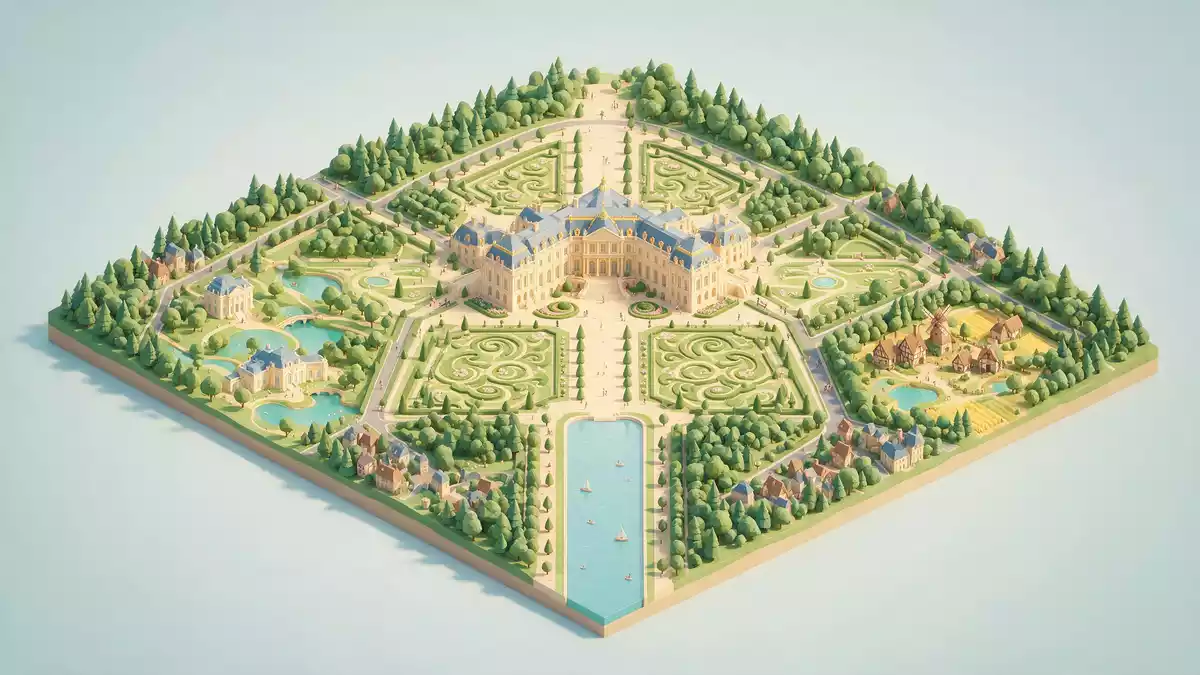
Chateau de Versailles in Versailles is a royal residence turned museum, set out along a strong east–west line that connects its stone façades with formal gardens and water. Built for Louis XIII in the seventeenth century and transformed under Louis XIV, the palace became the principal residence of the French monarchy during the Ancien Régime.
An elongated palace facing a formal garden world
The core of Chateau de Versailles stretches horizontally, with long classical façades running parallel to terraces that drop gently towards the Grand Canal. The earliest building on the site took shape as a hunting retreat for Louis XIII in the 1620s, a modest lodge later encased within a larger envelope when his son Louis XIV began major expansion campaigns from 1661.Louis XIII’s hunting lodge remains structurally embedded within the later palace, even though its original scale is now hard to read behind the grand fronts.
Under Louis XIV, architects including Louis Le Vau and Jules Hardouin-Mansart created a stone shell that wrapped the older buildings and extended the palace towards newly laid gardens.Classical façades and garden fronts define the palace’s outward face, with rhythmic windows and pilasters framing views onto parterres, fountains and avenues of trees. Inside, Charles Le Brun’s interiors layer gilding, painted ceilings and sculptural decoration along suites of rooms that follow the building’s length.
A court laid out along an axis
From 1682, when Louis XIV moved his court to Versailles, the palace functioned as the centre of royal government until 1789.The court of Versailles operated along the same east–west alignment, with ceremonial routes running from the town side through courtyards, into the palace and out towards the gardens. The Hall of Mirrors, completed in the late seventeenth century, occupies a long gallery beside the principal garden front, matching its length to the parterre outside and reflecting the ordered geometry of the lawns and basins.
Beyond the immediate terraces, André Le Nôtre’s French formal gardens extend the palace axis into woodland and water.The palace and park of Versailles form a single composition, with straight avenues, clipped hedges and sculptural fountains aligned on the palace’s central line. The Grand Canal lies further west, catching the axis in a long sheet of water where perspective emphasises the palace’s role as a point of origin for the surrounding landscape.
From royal residence to museum of national history
Chateau de Versailles was the principal residence of Louis XIV, Louis XV and Louis XVI, and their reigns added successive layers of architecture and decoration to the complex.Generations of architects and artists worked on extensions, chapel and opera house, as well as apartments arranged along the main structural lines. After the French Revolution in 1789, the palace ceased to serve as a royal home, and in the nineteenth century Louis-Philippe re-established it as a museum dedicated to French history, inaugurating this function in 1837.A museum of “all the glories of France” occupies former state apartments and galleries.
As a museum, Chateau de Versailles presents paintings, sculptures and historic rooms that document royal life and national events across centuries. Visitors move through sequences of salons, staircases and grand galleries where the linear plan continues to frame experience: long axes guide views from the palace out towards the gardens, and internal lines of rooms mirror the geometry visible outside. The town of Versailles has grown around the estate in the Île-de-France region south-west of Paris, but the palace and park still read as a composition focused on the historic axis laid out under Louis XIV.
Visiting Chateau de Versailles: what travellers from Western Europe should know
- Chateau de Versailles stands west of Paris in the town of Versailles in the Île-de-France region of France, reached by suburban rail services from the capital and by road.
- The palace interior involves long walks along corridors and through large halls, with staircases connecting levels; the gardens stretch over extensive, mostly level terrain with formal paths and gravel surfaces.
- The official language is French and the currency is the euro.
Searching for Chateau de Versailles on social platforms
These links open searches for Chateau de Versailles on each platform.Frequently asked questions about Chateau de Versailles
Where is Chateau de Versailles?
Chateau de Versailles stands in the town of Versailles in the Île-de-France region of France, to the south-west of Paris.
What should visitors expect on a visit?
Visitors encounter extensive palace interiors with decorated galleries and salons, alongside formal gardens, fountains and woodland laid out around the Grand Canal.
What makes Chateau de Versailles distinctive?
The palace and its park form a single composition aligned on a clear axis, reflecting the seventeenth- and eighteenth-century role of Versailles as the principal residence of the French monarchy.


