
Chateau de Versailles and its grand axis of power
Published on 09/07/2026 at 19:38 | Editorial responsibility: Rafael Müller, Editor-in-Chief AD HOC NEWS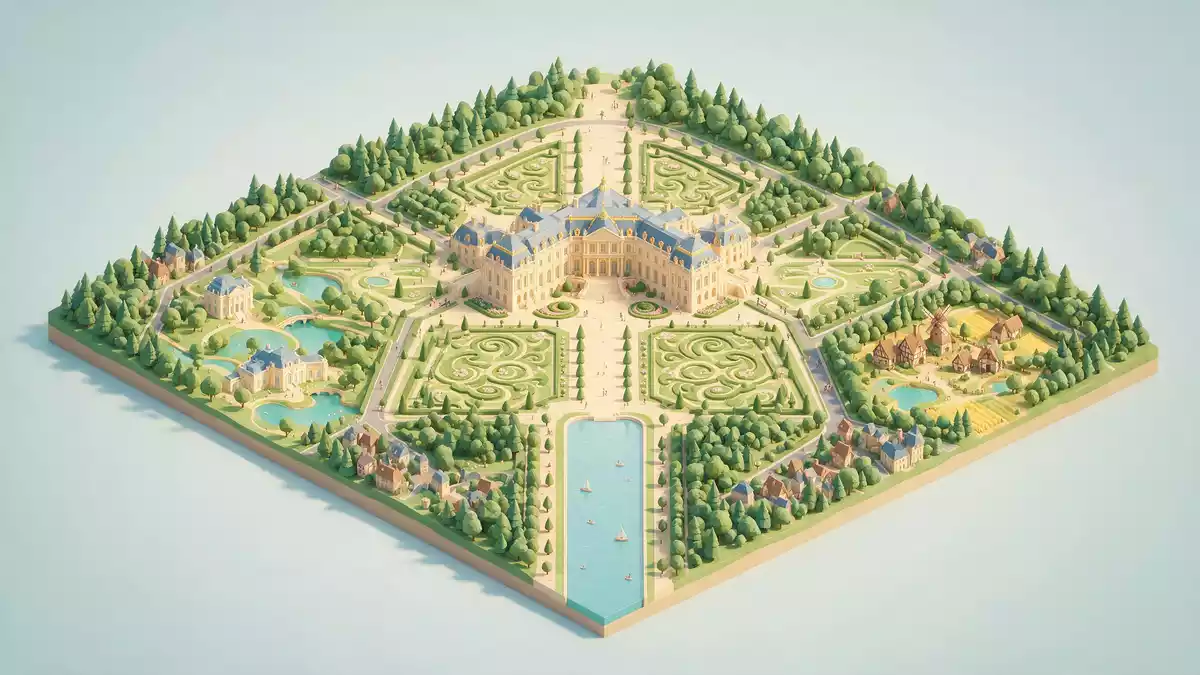
Chateau de Versailles in Versailles, west of Paris in France, is a former royal residence whose long central axis ties palace, gardens and water together in a single composition. Commissioned by King Louis XIV in the seventeenth century and developed over several generations, it became a model for royal architecture and garden design across Europe.
The royal palace stretched along a ceremonial spine
The palace at Versailles developed from a hunting lodge built for Louis XIII in the early seventeenth century into a residence of French classicism under his son Louis XIV. From 1661 the Sun King embarked on a transformation that enlarged the building in phases and aligned it with a ceremonial layout focused on a straight line running from the palace through the gardens.Louis XIV embarked on the transformation Architects including Louis Le Vau and later Jules Hardouin-Mansart added wings and façades during this process, creating a palace whose length matches the ambition of the court it housed.Louis Le Vau and Jules Hardouin-Mansart
Versailles served as the principal residence of the French kings Louis XIV, Louis XV and Louis XVI, and from 1682 it became the main seat of the royal court and government. This shift gave the palace a political role that matched its physical dominance, turning the grand axis into a line of approach for ambassadors, courtiers and ceremonial entries. Later, after the end of the monarchy, the building took on a new identity as a museum dedicated to the history of France, yet the alignment from palace to park still reveals its origin as a stage for royal power.principal residence of the French kings
Gardens that extend the palace into the landscape
West of the palace, formal gardens unfold along the same central axis, stretching from the decorative parterres near the building towards canals and woodland further away. The layout was developed broadly in the seventeenth century under landscape architect André Le Nôtre, whose work shaped terraces, geometric flower beds and groves that form a continuation of the palace architecture into the open air.André Le Nôtre created and renovated the gardens The gardens today cover hundreds of hectares, with a significant portion arranged as formal French-style compositions characterised by straight lines, clipped hedges and planned perspectives.the gardens cover some 800 ha
Hidden within the wooded sections lie groves that function as outdoor rooms off the main axis. Many of these groves originated under Le Nôtre and were later modified by Hardouin-Mansart, combining trees, paths, statues and fountains in enclosed spaces that contrast with the open lawns and water nearer the palace.the groves of Versailles created by André Le Nôtre At the far end of the composition, the Grand Canal extends the line of sight, anchoring the axial design and reflecting the sky, with smaller waterways branching away from it.
A palace and park recognised as a World Heritage ensemble
The palace and surrounding park of Versailles form a single heritage ensemble that has been recognised by UNESCO for its artistic and historical significance. Inscribed on the World Heritage List in 1979, the “Palace and Park of Versailles” represent a comprehensive royal residence whose architecture, interiors and gardens together illustrate the exercise of power in seventeenth and eighteenth century France.Palace and Park of Versailles The listing highlights the contribution of many architects, sculptors, painters and landscape designers whose work over more than a century shaped the ensemble visible today.
The park around the palace once extended over thousands of hectares before the French Revolution, and even in its reduced form it still spreads over more than 800 hectares, with formal gardens occupying a substantial area near the palace.the park of the Palace of Versailles covers 815 hectares today Within this space, visitors encounter broad avenues, water basins, statues and groves aligned with the same axial logic that organises the palace façade, making the estate an example of how architecture and landscape can be combined into a single ordered whole.
Visiting Chateau de Versailles: what travellers from Western Europe should know
- Chateau de Versailles stands in the town of Versailles in the Île-de-France region of France, south-west of central Paris, and is reached by suburban rail services that terminate at stations including Versailles-Château-Rive-Gauche.
- The estate covers an extensive area, and a visit involves walking on stone floors inside the palace and on gravel, grass and paved paths in the gardens, with some staircases and gentle gradients between terraces.
- The Grand Canal lies beyond the main formal gardens, and reaching its banks on foot from the palace takes visitors along wide avenues lined with trees and past water features and statues.
- The official language at Versailles is French and the currency is the euro.
Searching for Chateau de Versailles on social platforms
These links open searches for Chateau de Versailles on each platform.
Frequently asked questions about Chateau de Versailles
Where is Chateau de Versailles and what is it?
Chateau de Versailles is a former royal residence in the town of Versailles in the Île-de-France region of France, south-west of Paris.
What should visitors expect on a visit to Versailles?
A visit combines richly decorated palace interiors with extensive formal gardens, groves and water features arranged along a grand central axis that extends into the surrounding park.
What makes Chateau de Versailles distinctive among European palaces?
The estate’s combination of French classical palace architecture, André Le Nôtre’s axial gardens and its role as a World Heritage-listed royal residence gives Versailles a scale and coherence that define its character.


