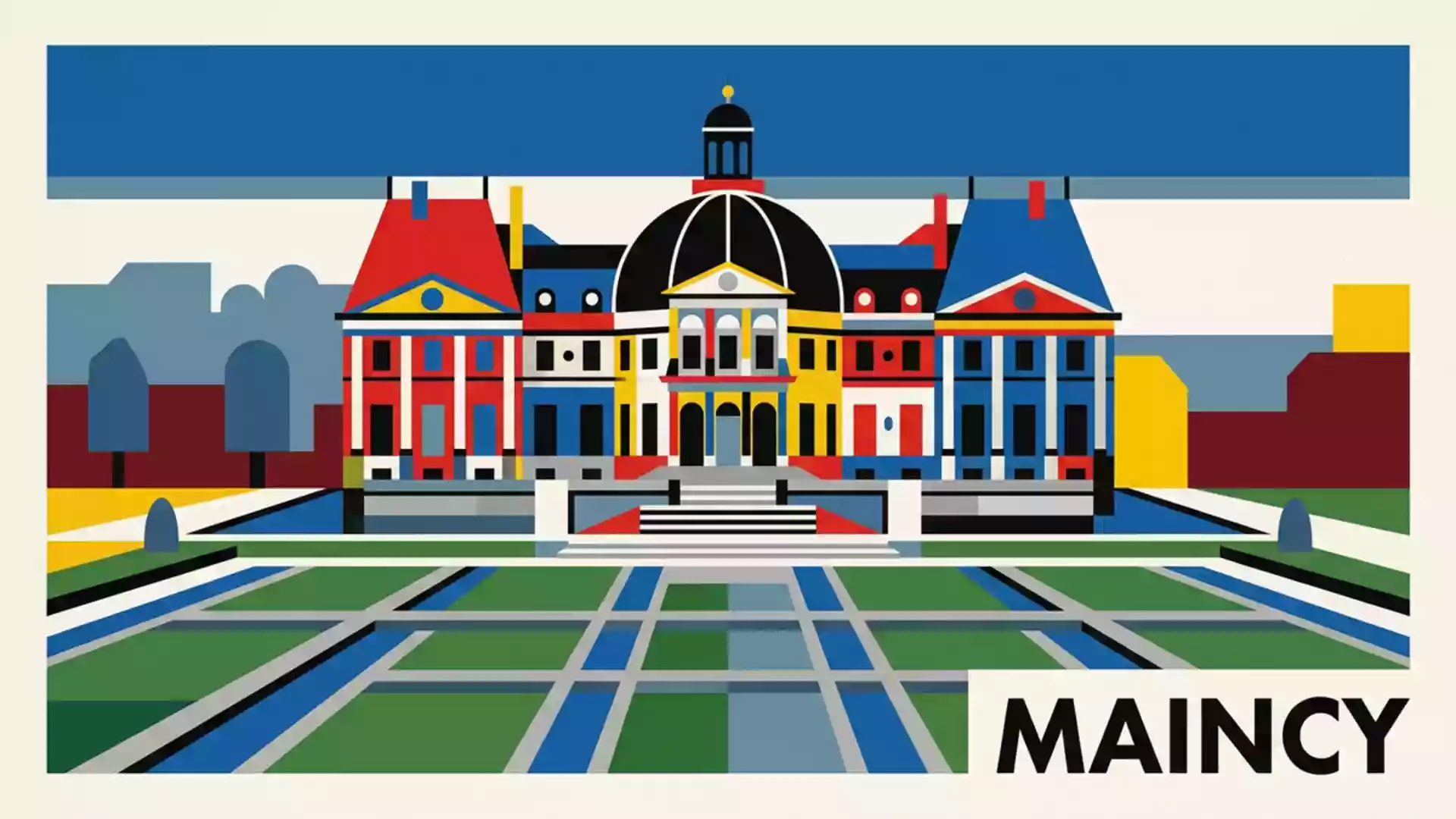
Chateau de Vaux-le-Vicomte and its perfectly staged 17th-century ensemble
Published on 09/03/2026 at 15:15 | Editorial responsibility: Rafael Müller, Editor-in-Chief AD HOC NEWS
Chateau de Vaux-le-Vicomte, near Maincy in northern France, is a 17th-century estate where the house, its richly decorated interiors and the surrounding formal gardens form one continuous composition. Conceived for Nicolas Fouquet, Superintendent of Finances to Louis XIV, and built in the late 1650s, it became a model of French classical and Baroque residential architecture.
The birth of a 17th-century masterpiece
Vaux-le-Vicomte stands in Seine-et-Marne, south-east of Paris, and took shape for Nicolas Fouquet after he acquired the estate in the 1640s. The château itself was constructed in the second half of the seventeenth century, with work concentrated between 1656 and 1661 under the direction of architect Louis Le Vau.built between 1658 and 1661 The project brought together three leading artists of the age: Le Vau for the architecture, André Le Nôtre for the landscape, and Charles Le Brun for the interiors, a collaboration that helped define the emerging Louis XIV style.considered one of the masterpieces of French Baroque residential architecture
The château’s historical significance lies partly in this team and partly in its timing. In the 1650s and early 1660s, France was consolidating royal power after the turmoil of earlier decades, and patrons such as Fouquet turned to classical architecture to express order and grandeur. At Vaux-le-Vicomte, the controlled façades, axial composition and carefully proportioned rooms demonstrate how Italian and antique models were adapted into a distinctly French idiom, later echoed on a far larger scale at Versailles.a 17th-century masterpiece born from the genius of Louis Le Vau, André Le Nôtre, and Charles Le Brun
Architecture on a raised platform
The core of Chateau de Vaux-le-Vicomte is a compact yet stately main building set on a broad, raised platform surrounded by a moat. This platform emphasises the château’s classical form: balanced façades articulated with pilasters, sculptural decoration and a prominent central volume topped by a large dome.a large raised platform surrounded by a moat The composition reads as a carefully staged approach, with visitors crossing the water and ascending to the main entrance before encountering the enfilade of rooms inside.
Within, Charles Le Brun’s interiors extend the architectural grammar into painted ceilings, sculpted panelling and coordinated decorative schemes. His work at Vaux-le-Vicomte forms part of the visual language later associated with the court of Louis XIV, where allegorical themes, rich materials and controlled symmetry support the architecture rather than competing with it.Le Brun creates the decors of the interior of the château Standing in the main salons and galleries, the continuity between walls, ceiling and view through the windows reinforces the sense that house and garden belong to a single design.
André Le Nôtre’s geometric gardens
Behind the château, André Le Nôtre organised the grounds into a broad axial composition that runs from the house out across terraces, pools and lawns towards the distant landscape. Paths, water, parterres and woodland are arranged around a central line, with perspective effects that extend the apparent length of the estate and frame the building itself.the château at the centre of a vast composition axée integrating the gardens The gardens occupy part of a wider estate measuring several hundred hectares, including a core of formal gardens surrounded by woodland and agricultural land.
Le Nôtre’s design at Vaux-le-Vicomte became a prototype for later French formal gardens, notably at Versailles, where similar terraces, pools and tree-lined axes were extended and multiplied. Here, the scale is grand yet readable, with clear transitions from the immediate terraces near the house to more distant pools and features. From many points in the garden, the view back to the dome and façades of the château underlines how closely architecture and landscape were coordinated.
Visiting Chateau de Vaux-le-Vicomte: what travellers from Western Europe should know
- Chateau de Vaux-le-Vicomte lies in Seine-et-Marne near Maincy, south-east of Paris, with rail and road connections via the nearby town of Melun.
- The estate includes formal gardens and a raised château platform bordered by a moat, so visiting involves walking on gravel paths, terraces and gentle slopes.
- The surrounding area is largely rural, with woodland and agricultural land forming the wider estate around the formal gardens.
- The official language is French and the currency is the euro.
Searching for Chateau de Vaux-le-Vicomte on social platforms
These links open searches for Chateau de Vaux-le-Vicomte on each platform.
Frequently asked questions about Chateau de Vaux-le-Vicomte
Where is Chateau de Vaux-le-Vicomte located?
Chateau de Vaux-le-Vicomte is in Seine-et-Marne near Maincy, south-east of Paris, with Melun as the nearest town of note.
What should visitors expect on a visit?
Visitors encounter a seventeenth-century château on a raised platform, richly decorated interiors by Charles Le Brun and extensive formal gardens laid out by André Le Nôtre.
What makes Chateau de Vaux-le-Vicomte distinctive?
Its distinction lies in the unified design conceived by Nicolas Fouquet’s team of Louis Le Vau, André Le Nôtre and Charles Le Brun, where architecture, interior decoration and gardens were planned as a single ensemble.