
Chateau de Chillon on Lake Geneva’s rocky island
Published on 09/12/2026 at 20:08 | Editorial responsibility: Rafael Müller, Editor-in-Chief AD HOC NEWS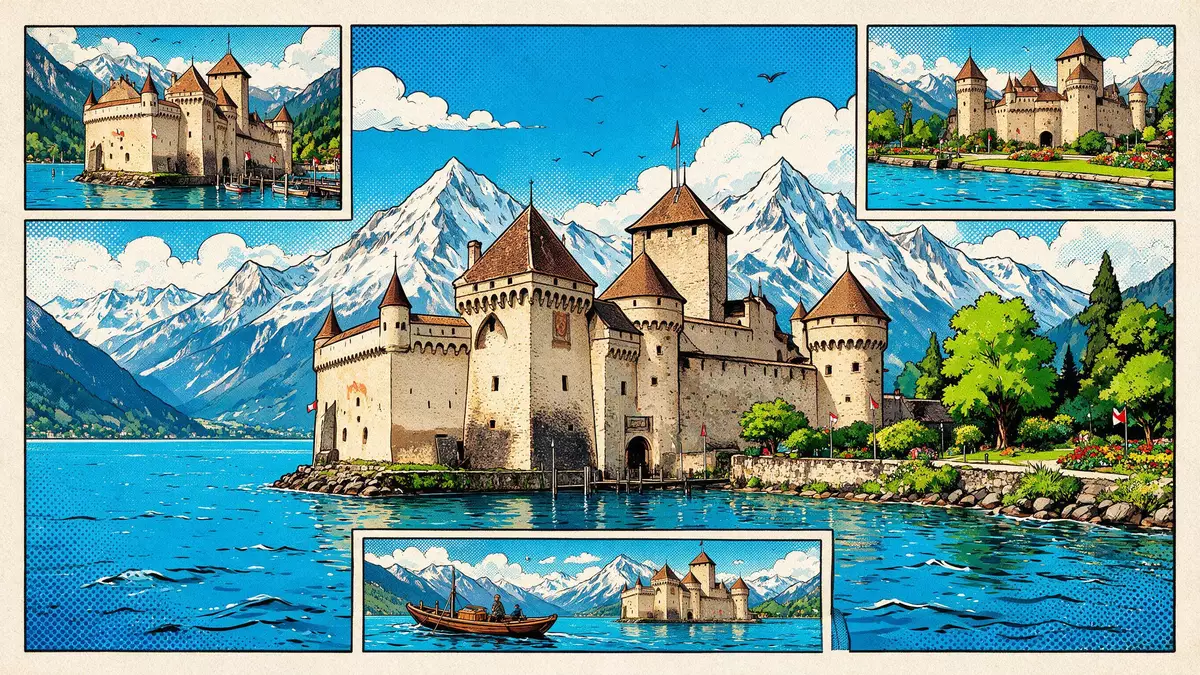
Chateau de Chillon is a medieval fortress on a rocky island in Lake Geneva near Montreux, a long, low ensemble of towers and walls pressed between water and mountains. Its position beside the narrow lakeside route has made it a strategic stronghold for centuries, and the castle that stands there today reflects successive phases of power, architecture and use.
A lakeside fortress shaped over centuries
Chateau de Chillon occupies a rocky islet along the shore of Lake Geneva in the commune of Veytaux, close to Montreux in the canton of Vaud in western Switzerland.moated castle on a rocky island The complex is not a single block but a chain of buildings and courtyards aligned with the island, their stone faces rising almost directly from the water.series of buildings from the 12th to 17th century From the lakeside path or from a boat, the outer walls form a continuous waterfront rampart, backed by slender towers and rooflines that follow the curve of the shore.
The site has been fortified since at least the Middle Ages, and archaeological work has shown that occupation on the rock reaches back to the Bronze Age.Bronze Age occupation of the site The oldest known written mention of the castle dates from 1150, when the Savoy family already controlled the fortress and the lakeside road, and the castle’s development is traditionally dated to three broad eras: the Savoy Period from the 12th century to 1536, the Bernese Period from 1536 to 1798, and the Vaudois Period from 1798 onwards.three great periods of the castle’s history
Counts of Savoy, Bernese bailiffs and Vaudois authorities
From the late 12th century, Chateau de Chillon served as a principal residence and stronghold for the Counts of Savoy, a dynasty whose territories once stretched from what is now south-eastern France into parts of modern Switzerland and northern Italy.principal residence of the Counts of Savoy Under Peter II of Savoy, who lived from 1203 to 1268, the fortress was substantially enlarged in the thirteenth century, with great halls, towers and underground vaults added by the master builder William of Rossilon.expansions by Peter II of Savoy The chapel and the keep include masonry dating to the late eleventh century, so the Savoy work layered newer halls and defensive structures over older cores.
In 1536, during the religious and political conflicts of the sixteenth century, forces from Bern captured Chateau de Chillon and the surrounding Vaud region, releasing prisoners from the lower vaults and turning the castle into a Bernese administrative centre.Bernese seizure in 1536 The Bernese era saw the complex used as a residence for the bailiff, an arsenal and a state prison, a function it retained into the eighteenth century.Bernese residence and prison In 1798, during the Vaud Revolution, local patriots in Vevey and Montreux drove out the Bernese authorities and the castle passed to the new Vaudois administration, later becoming a cantonal weapons depot and eventually a museum under the Chillon Castle Foundation.
Architecture, interiors and literary echoes
Architecturally, Chateau de Chillon is a compact complex of around two dozen buildings grouped around multiple courtyards and undercroft spaces, all enclosed by a defensive wall and surrounded by water on most sides.complex of buildings and vaults Inside, visitors move through great halls with timber roofs, narrow passages along the curtain walls, service rooms and storerooms, and vaulted cellars supported by stout stone columns. Fourteenth-century murals survive on some interior walls, including painted decoration in the chapel that shows the castle’s role as a residence as well as a fortress.chapel and late 11th-century keep
Below the main level, the lakeside vaults and the former dungeon gained literary resonance in the nineteenth century. The Genevan monk François Bonivard was imprisoned in these spaces from 1530 to 1536 by the Duke of Savoy, and his story inspired Lord Byron’s poem “The Prisoner of Chillon” after Byron’s visit in 1816.Bonivard and Byron’s poem The combination of stone vaults, low light and glimpses of the lake through the outer defences gives these rooms a distinct character compared with the brighter ceremonial halls above, and they form one of the most recognisable sequences of spaces in the castle.
Visiting Chateau de Chillon: what travellers from Western Europe should know
- Chateau de Chillon stands on Lake Geneva in the municipality of Veytaux, south-east of Montreux in the canton of Vaud, and is reached by road, lakeside path, bus and regional train along the lakeshore.
- The fortress occupies a rocky island separated from the shore, with stone steps, narrow internal staircases and uneven floors linking the courtyards, halls and lower vaults.
- Lake Geneva lies at a moderate altitude, and weather can change along the shore, so castle approaches and the open courtyards can feel exposed to lake wind and mountain conditions.
- The official language is French and the currency is the Swiss franc.
- Entry requirements depend on your nationality; UK travellers can check the FCDO travel advice at gov.uk/foreign-travel-advice, Irish travellers the Department of Foreign Affairs at ireland.ie.
Searching for Chateau de Chillon on social platforms
These links open searches for Chateau de Chillon on each platform.
Frequently asked questions about Chateau de Chillon
Where is Chateau de Chillon located?
Chateau de Chillon stands on a rocky island in Lake Geneva in the municipality of Veytaux, close to Montreux in the canton of Vaud in western Switzerland.
What can visitors expect inside the castle?
Visitors move through courtyards, great halls with timber roofs, stone-lined passages, fourteenth-century murals and vaulted lower chambers that once served as storerooms and prison spaces.
What makes Chateau de Chillon distinctive among Swiss castles?
The combination of its lakeside island setting, multi-period medieval architecture linked to the Savoy, Bernese and Vaudois eras, and the literary association with Lord Byron’s “The Prisoner of Chillon” gives it a particular character.


