
Chateau de Chillon and its ring of stone over Lake Geneva
Published on 09/15/2026 at 09:18 | Editorial responsibility: Rafael Müller, Editor-in-Chief AD HOC NEWS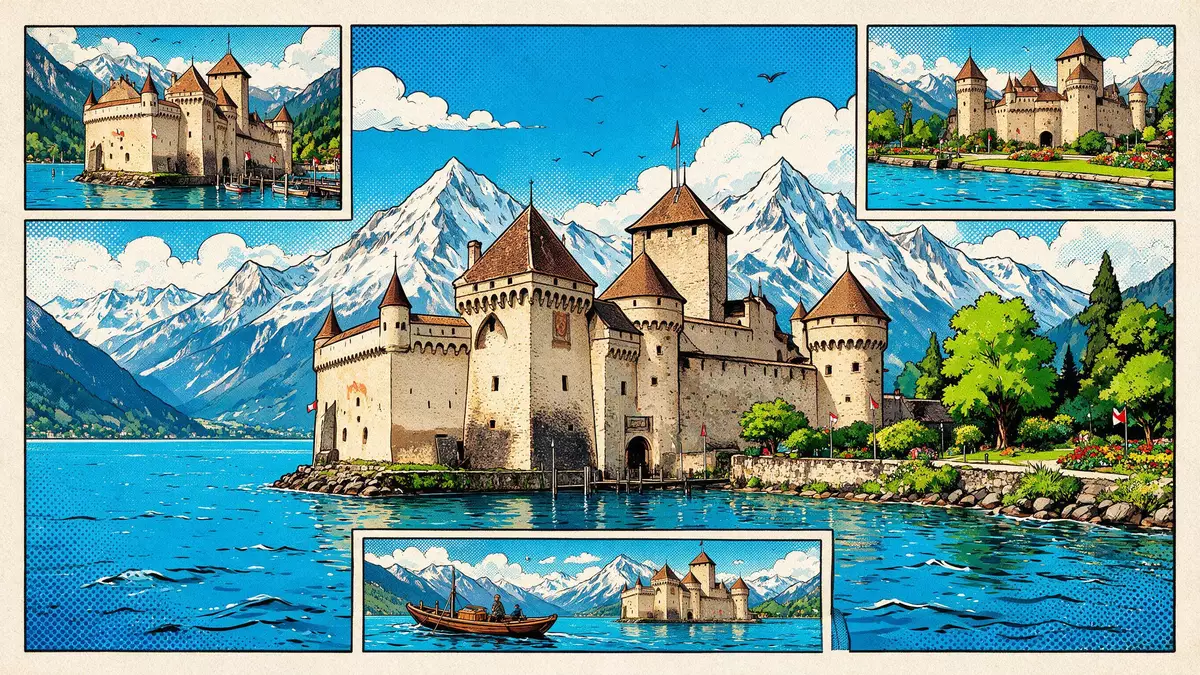
Chateau de Chillon rises from a rocky island by Montreux, where Lake Geneva meets a fortified medieval complex. Its outline follows the island, and the castle belongs to the Canton of Vaud; the first written mention dates to 1150.
Stone, water and the island’s outline
The castle’s most striking feature is its setting on the rock itself. The building takes on an oval plan that echoes the island, with walls, towers and courtyards gathered around a central keep.
The site has been occupied since the Bronze Age, and Albert Naef’s excavations from the late nineteenth century helped establish that long sequence of use. The surviving castle is the result of centuries of building and alteration, not a single campaign.
The Savoy family controlled Chillon in the medieval period, and Peter II of Savoy turned it into a summer residence in the thirteenth century. That mix of residence and stronghold still shapes the way the rooms are arranged, from defensive fronts to lake-facing chambers.
The castle’s outline and the medieval sequence are part of what gives the place its character.
From Savoy possession to Vaudois ownership
Chateau de Chillon appears in the record in 1150, when it was already in Savoy hands. The House of Savoy held it until 1536, when the Bernese took over and turned the castle into an administrative centre, arsenal and prison.
That change of ownership left visible traces in the rooms and murals. Bernese coats of arms, later decorative schemes and altered interiors sit beside medieval masonry, so the castle reads as a layered record of rule and reuse.
François Bonivard gives Chillon one of its best-known historical associations. Lord Byron’s 1816 poem made Bonivard’s imprisonment part of the castle’s cultural memory, and the prison vaults remain among the most memorable parts of the interior.
The three historical periods and Bonivard’s prison anchor the castle in both political and literary history.
Rooms, vaults and the castle’s inner route
Inside, the rooms move between domestic spaces, halls of rule and utilitarian chambers. The Aula Magna, the chapel, the prison spaces and the keep each show a different phase of use, while vaulted ceilings and stone pillars give the interior a dense, layered character.
Chillon also preserves a sequence of courtyards, ramparts and bridge access that makes the circulation of the castle unusually legible. The keep stands near the centre, while the lake side holds the residential parts and the land side carries the defensive front.
The architectural fabric includes medieval masonry, later restorations and decorative painting from different centuries. That combination makes Chateau de Chillon more than a single monument: it is a compact record of Savoy, Bernese and Vaudois control.
The keep and courtyards and the vaulted interiors remain the clearest parts of that sequence.
Visiting Chateau de Chillon: what travellers from Western Europe should know
- The castle stands by Veytaux-Montreux, close to the shore of Lake Geneva. Rail travellers reach Montreux, then continue by local transport towards Chillon.
- The approach includes bridge access, courtyards and stairways. Some interiors include narrow passages, stone steps and low openings.
- The castle sits on rock in the lake, with walls gathered tightly around the central core. That compact layout is part of its medieval form.
- The official language is French and the currency is the Swiss franc.
Searching for Chateau de Chillon on social platforms
These links open searches for Chateau de Chillon on each platform.
Frequently asked questions about Chateau de Chillon
Where is Chateau de Chillon?
It stands in Veytaux near Montreux, on the edge of Lake Geneva in the canton of Vaud. The castle sits on a rocky island linked to the shore.
What does a visit show?
The route moves through courtyards, vaulted rooms, a chapel, defensive towers and the prison spaces linked to Bonivard. The castle is compact, with stone steps and a clear division between defensive and residential areas.
What makes Chateau de Chillon distinctive?
Its island setting, oval outline and layered medieval fabric set it apart within the lakeside landscape. The succession of Savoy, Bernese and Vaudois control is visible in the building itself.


