
Chateau de Chambord and its soaring Renaissance skyline
Published on 08/19/2026 at 18:54 | Editorial responsibility: Rafael Müller, Editor-in-Chief AD HOC NEWS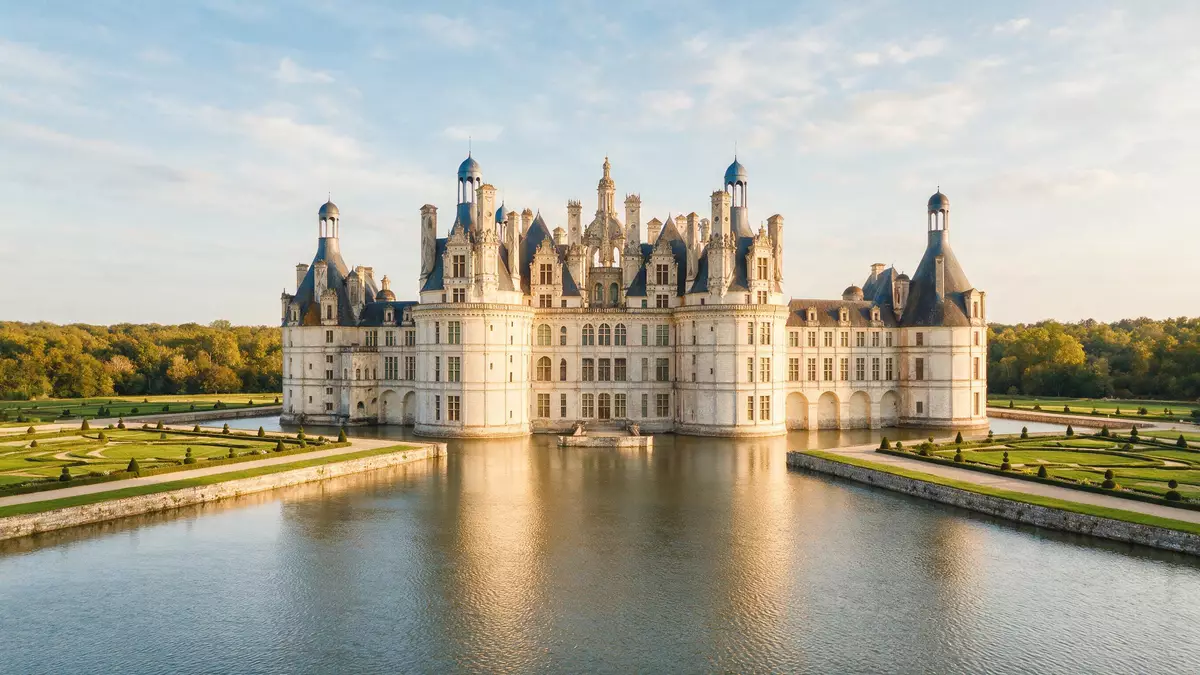
Chateau de Chambord in Chambord, in France’s Loire Valley, is immediately recognisable for the forest of towers, chimneys and turrets that rises above its stone walls. Conceived for King Francis I in the early sixteenth century, it combines the massing of a medieval fortress with the ornament of the French Renaissance, so that the skyline itself becomes the château’s defining spectacle.
A Renaissance palace built for a hunting king
Chateau de Chambord stands in the commune of Chambord in the Loir-et-Cher department, in the eastern part of the Loire Valley. The site is surrounded by an extensive walled park used historically as a royal hunting ground, with woodland stretching away from the château on all sides.walled hunting park The building was commissioned by Francis I of France, whose reign began in 1515, and work on the main structure started in 1519.commissioned by Francis I
Construction continued through the sixteenth century and into the seventeenth century, with later French kings adding wings and completing elements of the design.completed by King Louis XIV The château follows the plan of a fortified residence, with a central square building known as the keep and substantial corner towers, yet its role was less defensive than ceremonial and recreational, serving as a grand base for hunting expeditions in the surrounding forest.
Massive stone walls and a celebrated double-helix stair
The main body of Chateau de Chambord is built from pale stone, laid out around a central courtyard with symmetrical façades and high slate roofs. Within the keep, a geometrically striking open staircase rises through the centre of the building, formed as two intertwined flights that allow people to ascend and descend side by side without meeting on the same steps.double-helix staircase This stair is one of the most discussed features of the château and is frequently linked to Renaissance experimentation with form.
The façades combine elements associated with medieval fortified castles, such as corner towers and a surrounding moat, with Renaissance ornament, including classical string courses and window surrounds.medieval layout and Renaissance details High above, the upper levels are packed with chimneys and stair turrets, carved with sculpted details that animate the roofline. The overall composition creates the impression of a stone palace rising from a hunting landscape, with the built mass set against the plain of the surrounding park.
A skyline of chimneys, lanterns and sculpted detail
The skyline of Chateau de Chambord is central to its identity. From the courtyard, visitors look up to a dense array of chimneys, lantern-like structures and stair turrets that stand above the roofs in multiple tiers, each capped with finials and sculpted motifs. Contemporary descriptions and later guides underline how this upper crown of architecture gives Chambord a silhouette that is widely cited as emblematic of the French Renaissance.exceptional Renaissance silhouette
The roofscape is not simply decorative; it marks the points where staircases reach the upper levels and where fireplaces rise through the thick stone walls. Counts of its features indicate hundreds of rooms, numerous staircases and a great many chimneys distributed through the structure, all expressed at roof level as an intricate thicket of stone.façade length and roof features From outside the moat, the view of these rising elements above the lower walls has made the château one of the most photographed landmarks of the Loire castles.
Visiting Chateau de Chambord: what travellers from Western Europe should know
- Chateau de Chambord lies east of Blois in the Loir-et-Cher department, within the Centre-Val de Loire region of France. It is reached by local roads that pass through the forested Chambord estate, and regional bus services and tours link it with nearby Loire Valley towns.
- The château complex includes the massive stone keep, surrounding wings and an extensive enclosed park. Visiting the interiors involves movement across large courtyards and through broad staircases within the keep.
- The surrounding landscape is predominantly flat woodland and meadows at low altitude. Paths around the château and across parts of the estate offer level walking on compacted surfaces.
- The official language is French and the currency is the euro. Entry requirements depend on your nationality; UK travellers can check the FCDO travel advice at gov.uk/foreign-travel-advice, Irish travellers the Department of Foreign Affairs at ireland.ie.
Searching for Chateau de Chambord on social platforms
These links open searches for Chateau de Chambord on each platform.
Frequently asked questions about Chateau de Chambord
Where is Chateau de Chambord located?
Chateau de Chambord is located in the commune of Chambord in the Loir-et-Cher department, in the Centre-Val de Loire region of France.
What can visitors expect during a visit?
Visitors encounter a large stone château with a central courtyard, grand staircases, extensive roof structures and an enclosing parkland that reflects its origins as a royal hunting residence.
What makes Chateau de Chambord distinctive among Loire châteaux?
Chambord is distinguished by its combination of a medieval-style keep with French Renaissance ornament and by the dense, sculpted skyline of chimneys and turrets above its roofs.


