
Chateau d'Azay-le-Rideau, a Renaissance mirror on the Indre
Published on 09/18/2026 at 14:44 | Editorial responsibility: Rafael Müller, Editor-in-Chief AD HOC NEWS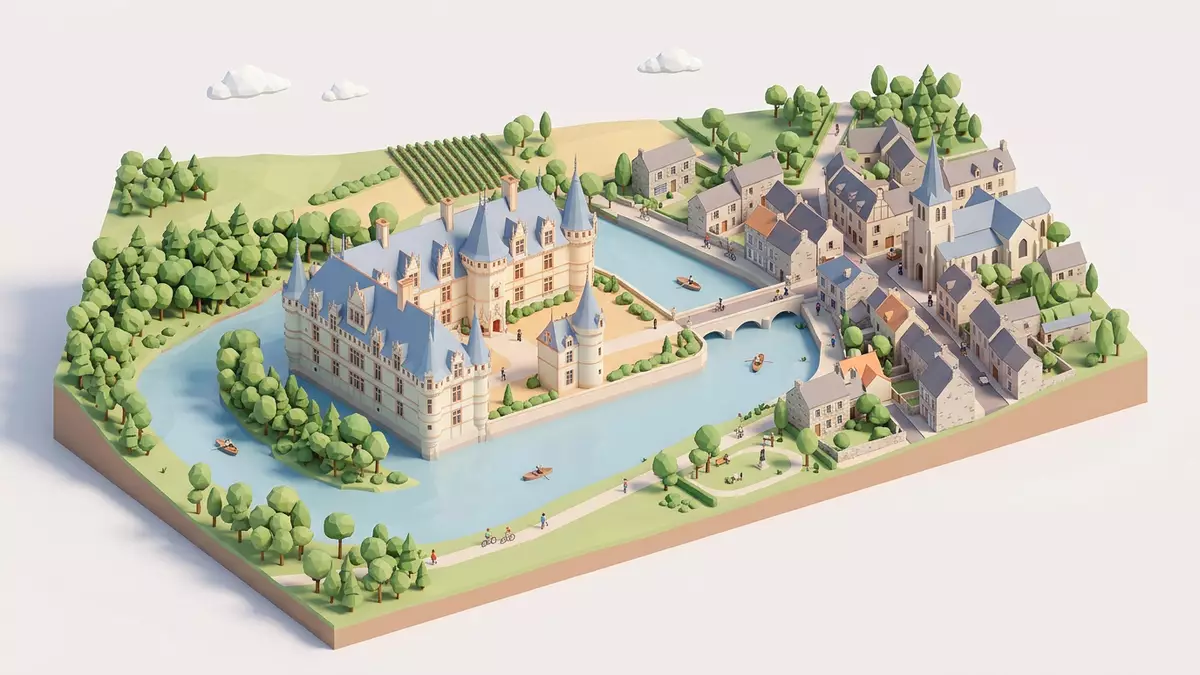
Chateau d'Azay-le-Rideau stands on an island in the river Indre at Azay-le-Rideau, its pale stone walls and slate roofs mirrored in the surrounding water. Built in the early sixteenth century for the royal financier Gilles Berthelot during the reign of Francis I, it is recognised as an early example of French Renaissance architecture in the Loire Valley.
Renaissance architecture on an island in the Indre
The present Chateau d'Azay-le-Rideau was begun in 1518 for Gilles Berthelot on the site of an older fortress that had controlled the road between Tours and Chinon across the Indre.begun in 1518 The decision to build within the river channel created a compact residence whose façades rise directly above the water on foundations set into the riverbed, giving the impression that the château emerges from the Indre itself.set on an island in the middle of the Indre
Architecturally, Chateau d'Azay-le-Rideau belongs to the phase often described as the “Première Renaissance”, when French builders combined late Gothic traditions with imported Italian ornament. Its façades are organised in horizontal tiers, with arcaded ground levels, pilasters and dormer windows enriched by carved medallions, scrolls and heraldic devices, all cut into pale tuffeau limestone typical of the Loire Valley.Première Renaissance limestone façades The corner turrets and steep slate roofs recall the fortified past of the site while the large windows and rich sculptural decoration signal a residence designed for display rather than defence.
From medieval stronghold to landscaped residence
The site at Azay-le-Rideau carried a castle centuries before the Renaissance house seen today, with a medieval stronghold attested from the eleventh and twelfth centuries.history of the castle During the reign of Francis I, Gilles Berthelot and his wife Philippe Lesbahy embarked on a programme that replaced most of the feudal structure with new wings aligned along the water, embedding elements of the former fortress in a residence shaped by Renaissance taste.Gilles Berthelot and Philippe Lesbahy
The nineteenth century brought another layer of transformation under the Biencourt family, who undertook a major restoration of the château and its grounds.Biencourt restoration in the nineteenth century Work in this period completed the outline with additional towers and roof features, aiming for stylistic unity in a purely Renaissance idiom.stylistic unity to the work of the Marquis de Biencourt At the same time, the surrounding park was reshaped with planted avenues, lawns and carefully framed views over the river, creating a setting in which architecture and landscape appear as a single composition. In 1905 the French state acquired Chateau d'Azay-le-Rideau, integrating it into the national network of historic monuments and ensuring its preservation as a representative Loire Valley Renaissance château.bought by the state in 1905
Experiencing stone, water and reflection
A visit to Chateau d'Azay-le-Rideau is shaped by the encounter between stone and water. Approaches lead through the landscaped park to vantage points where the building’s long river façade and corner turrets form a symmetrical composition doubled in the Indre, a view that has made the château a widely reproduced image of the Loire Valley.river façade and park perspectives Paths around the island reveal different aspects: from one angle the château appears compact and self-contained; from another, the angles of the wings and the projecting stair tower break the volume into interlocking planes of stone and slate.
Inside, the layout retains the character of a French Renaissance residence influenced by Italian models, with reception rooms organised around a central staircase and decorated with wooden panelling, sculpted fireplaces and ceilings. The river and grounds remain visible from many windows, reinforcing the sense that interior and exterior are closely linked. Seen from the park, the combination of tuffeau stone, slate roofs and water gives Chateau d'Azay-le-Rideau a distinctive presence among the Loire Valley châteaux, less monumental than some neighbours yet marked by clear lines and refined carving that reward close attention.appears to float on water
Visiting Chateau d'Azay-le-Rideau: what travellers from Western Europe should know
- Chateau d'Azay-le-Rideau stands within Azay-le-Rideau in central France’s Loire Valley, with regional rail services linking Tours to nearby stations and roads following the Indre valley landscape.
- Approaches to the château involve walking through the park and across level paths around the river, with staircases inside the building providing access to upper floors.
- The official language is French and the currency is the euro.
Searching for Chateau d'Azay-le-Rideau on social platforms
These links open searches for Chateau d'Azay-le-Rideau on each platform.
Frequently asked questions about Chateau d'Azay-le-Rideau
Where is Chateau d'Azay-le-Rideau located?
Chateau d'Azay-le-Rideau stands in the town of Azay-le-Rideau in the Loire Valley of central France, on an island formed by a branch of the river Indre.
What can visitors expect when exploring the château?
Visitors encounter a compact Renaissance residence with sculpted stone façades, slate roofs, interior rooms arranged around a grand staircase, and park paths offering varied views over the river.
What makes Chateau d'Azay-le-Rideau distinctive among Loire Valley châteaux?
Its combination of early French Renaissance architecture, island setting in the Indre and carefully composed parkland perspectives gives Chateau d'Azay-le-Rideau a characteristic interplay of stone, water and reflection.


