
Charminar rises from a square of four arches in Hyderabad
Published on 09/23/2026 at 21:43 | Editorial responsibility: Rafael Müller, Editor-in-Chief AD HOC NEWS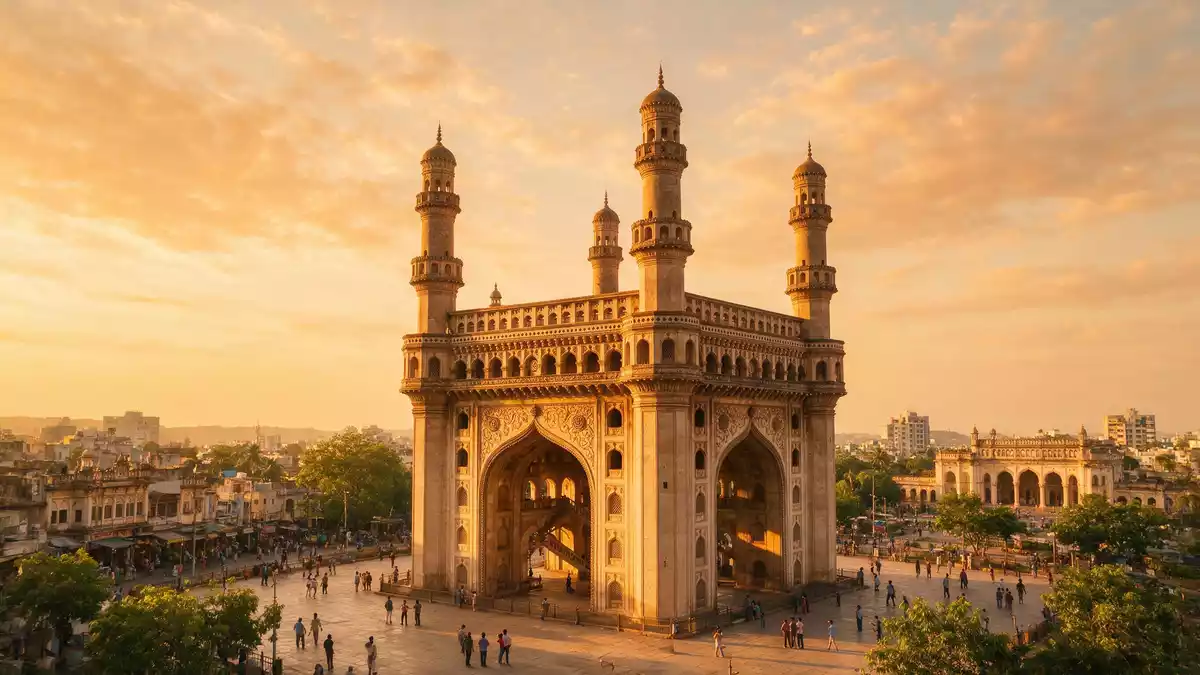
Charminar rises at the centre of Hyderabad as a square monument pierced by large arches and crowned with four minarets. Built in 1591 by Sultan Muhammad Quli Qutb Shah, it combines a mosque, a ceremonial gateway and a civic landmark in one compact form.
Four arches shape Hyderabad’s historic centre
The name Charminar means four minarets, and the building’s four corner towers define its outline. Each side presents a broad pointed arch, opening towards the streets that meet around the monument. The plan is square, with each side measuring about 20 metres.
The structure belongs to the architectural world of the Qutb Shahi dynasty, the Deccan sultanate that ruled from Golconda. Its surfaces carry stucco ornament, moulded details and carved decoration. Balconies divide the minarets into distinct levels, while domed tops complete the vertical composition.
Muhammad Quli Qutb Shah and the city of 1591
Muhammad Quli Qutb Shah, the fifth ruler of the Qutb Shahi dynasty, founded Hyderabad in the late sixteenth century. Charminar formed the centre of the new city and dates to 1591, a date preserved in the monument’s historical identity. Charminar’s 1591 foundation connects the building with the creation of Hyderabad.
The monument has a religious level above its arches, including a mosque. Its lower passages connect the four sides, while the upper architecture gathers prayer space, balconies and decorated surfaces beneath the minarets. The building therefore joins movement through the city with Islamic architectural forms.
Deccan materials, minarets and layered detail
Charminar is built from masonry finished with plaster and ornament. Its pale exterior carries repeated arches, cornices, recessed panels and delicate surface work. The building’s visual effect comes from the contrast between broad horizontal arches and the narrow rise of the corner towers.
The minarets reach roughly 49 metres (161 ft), according to the architectural dimensions most consistently associated with the monument. Spiral staircases run inside the towers, and projecting balconies divide their shafts. the four corner minarets give the square its characteristic profile.
Charminar’s form also places it within Indo-Islamic architecture, with Deccan and Persian influences visible in its arches, domes and ornamental vocabulary. its Qutb Shahi architecture belongs to the cultural history of Hyderabad and the wider Deccan plateau.
Visiting Charminar: what travellers from Western Europe should know
- Charminar stands in Hyderabad’s old city, close to the Musi River and the historic markets around Laad Bazaar. Hyderabad’s road network and local public transport connect the monument with other parts of the city.
- The upper level is reached by an internal staircase. The ascent is narrow and includes many winding steps inside the historic structure.
- The monument’s four arches face the surrounding streets, while the mosque occupies the upper level. The site combines an exterior city landmark with enclosed historic spaces.
- The official language is Telugu and the currency is the Indian rupee.
- Entry requirements depend on your nationality; UK travellers can check the FCDO travel advice at gov.uk/foreign-travel-advice, Irish travellers the Department of Foreign Affairs at ireland.ie.
Searching for Charminar on social platforms
These links open searches for Charminar on each platform.Frequently asked questions about Charminar
Where is Charminar?
Charminar is in Hyderabad’s old city in Telangana, India. It stands among historic markets and streets near the Musi River.
What can visitors expect at Charminar?
Visitors encounter a square masonry monument with four broad arches, an upper mosque and internal staircases leading towards the minarets.
What makes Charminar distinctive?
Its four corner minarets, four-sided plan and 1591 foundation combine into a single architectural landmark associated with Hyderabad’s creation.


