
Charminar in Hyderabad and its fourfold silhouette
Published on 09/18/2026 at 19:04 | Editorial responsibility: Rafael Müller, Editor-in-Chief AD HOC NEWS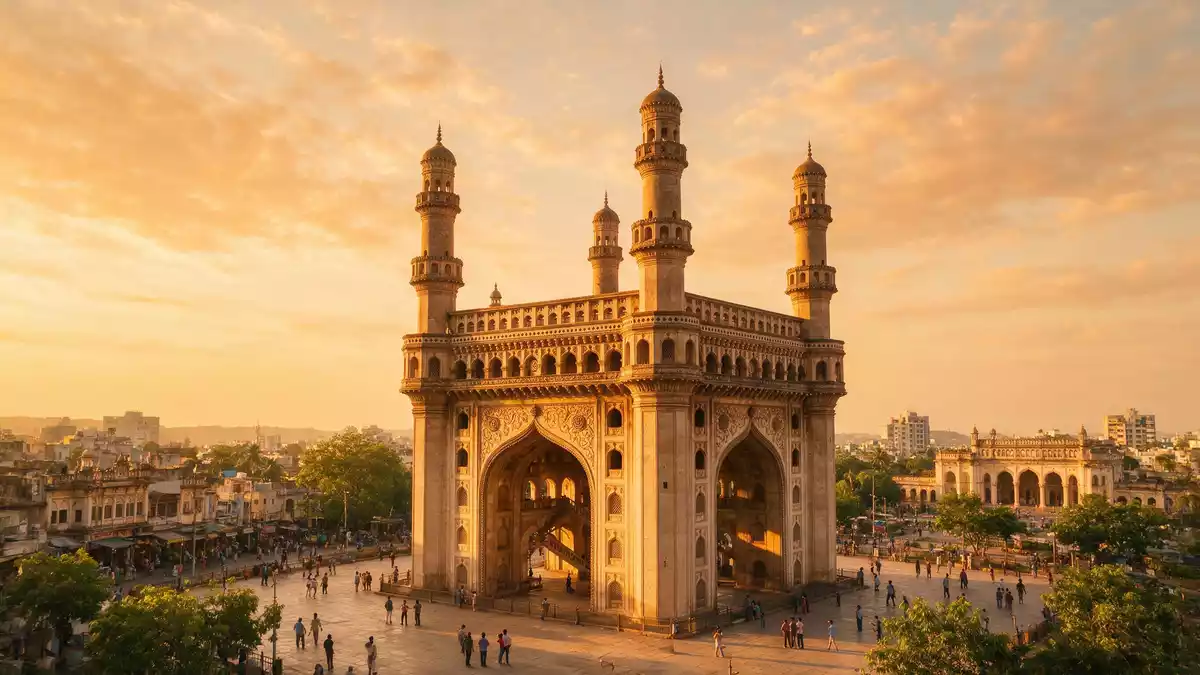
Charminar is the monument that fixes the outline of old Hyderabad, a square mass of stone lifted at each corner into a slender minaret and opened on all sides by deep arches. Built in 1591 during the rule of the Qutb Shahi dynasty, it has become the visual shorthand for the city and a compact way to grasp how Hyderabad grew around a single structure.
Charminar at the centre of a planned city
Charminar stands in the historic core of Hyderabad in the Indian state of Telangana, on a site where processional routes and markets meet in a dense grid of streets. It rose under Sultan Muhammad Quli Qutb Shah, the fifth ruler of the Qutb Shahi line, as one of the first major structures in his new capital outside the older stronghold of Golconda.first building in Sultan Muhammad Quli Qutb Shah's new city The year 1591 gives Charminar a clear place in the story of the Deccan, marking the shift from a fort?centred landscape to a city laid out around a ceremonial gateway.
The building’s position in the street plan is deliberate: wide thoroughfares run away from it in four directions, keeping the monument in view from multiple approaches and tying it to the trading life that developed around it.the intersection of the historical trade route The surrounding neighbourhood carries layers of construction from later centuries, but Charminar’s square base and projecting arches remain the reference point for the district.
A square base and four minarets
The form of Charminar is set by its square plan and its four corner towers, which give the monument its name: “char” for four and “minar” for minaret. Each side of the square carries a large pointed arch, creating covered passages that meet beneath a vaulted interior space. Above this, the minarets rise in stages, ringed by balconies and capped in traditional forms that echo mosque architecture elsewhere in the Islamic world.Constructed in 1591 The overall effect is of a compact but vertical building, taller than the shopfronts and houses pressed close to its base.
Charminar is built mainly of granite and lime mortar, with a skin of stucco used to carve mouldings, niches and floral patterns into the otherwise solid surfaces.granite and lime mortar with stucco ornamentation The ornament favours Indo?Islamic forms with Persian influence, including repetitive geometric shapes and stylised plant motifs, and on closer inspection details can be seen that recall forms used in Hindu building traditions as well as in Islamic ones.elements of Hindu architecture visible on this monument
Mosque, market and symbol of Hyderabad
Charminar carries a mosque on an upper floor, set above the main arches and reached by internal stairways, which has been part of the building’s life for centuries.existence of a mosque on its top floor for more than 435 years The combination of monumental gateway and place of worship underlines the way religious and civic functions overlap in the structure. From its galleries and openings visitors look out over the compact roofs and lanes of the old city, with the street market stretching away from the monument’s base.
The monument’s association with the Qutb Shahi dynasty and its late sixteenth?century foundation means Charminar is tied to a specific period in Hyderabad’s development, the era in which the city expanded beyond the hilltop fortifications of Golconda.completed in 1591 CE It has served as a marker of the city across changing rulers and political arrangements, retaining its role in the visual identity of Hyderabad and appearing on emblems and tourism material as an instantly recognisable outline.
Visiting Charminar: what travellers from Western Europe should know
- Charminar stands in the old quarter of Hyderabad in south India, surrounded by dense commercial streets that are lined with small shops and stalls.
- The monument rises above a network of paved lanes, and approaching it on foot involves navigating busy street crossings and short flights of exterior steps.
- The official language in Hyderabad is Telugu, with Urdu and Hindi also widely used, and the national currency is the Indian rupee.
- Entry requirements depend on your nationality; UK travellers can check the FCDO travel advice at gov.uk/foreign-travel-advice, Irish travellers the Department of Foreign Affairs at ireland.ie.
Searching for Charminar on social platforms
These links open searches for Charminar on each platform.Frequently asked questions about Charminar
Where is Charminar located?
Charminar is located in the old city area of Hyderabad in the Indian state of Telangana, on a major crossroads surrounded by traditional markets.
What should visitors expect at Charminar?
Visitors encounter a tall square monument with four minarets, arcaded passages at ground level, and a busy urban setting of shops and street activity around it.
What makes Charminar distinctive among monuments?
Charminar stands out for its fourfold corner towers, late sixteenth?century Indo?Islamic ornament in stucco, and its role as both mosque and landmark at the centre of Hyderabad.


