Charminar and the square heart of Hyderabad
Published on 08/29/2026 at 07:53 | Editorial responsibility: Rafael Müller, Editor-in-Chief AD HOC NEWS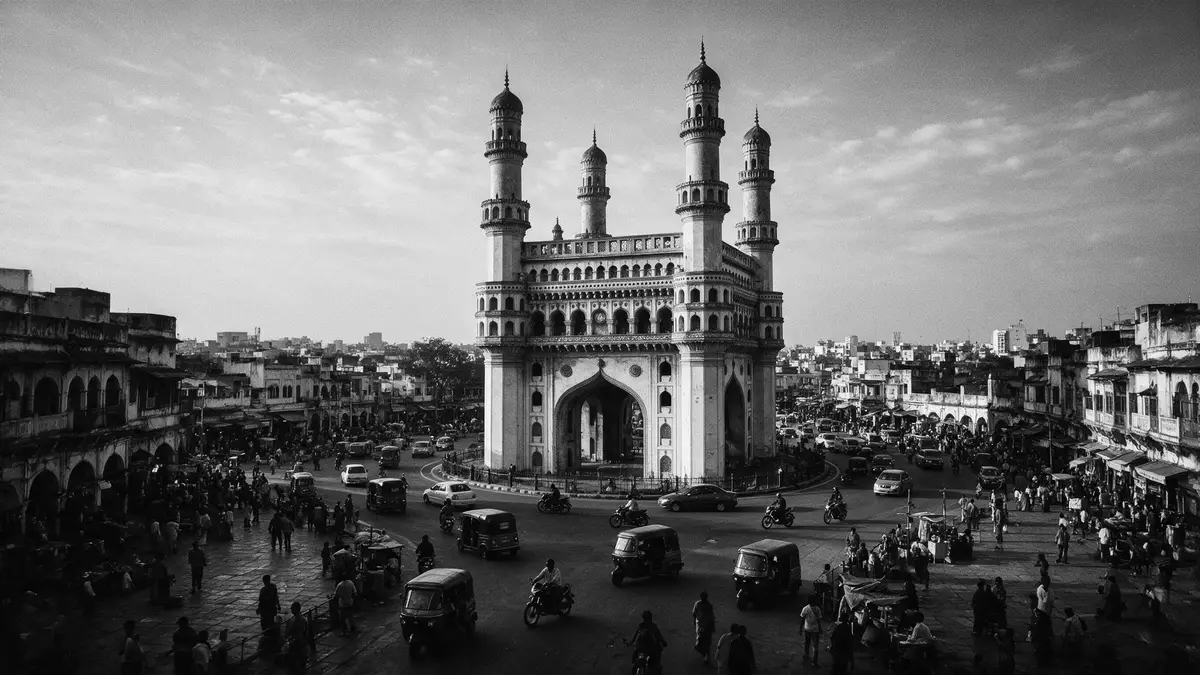
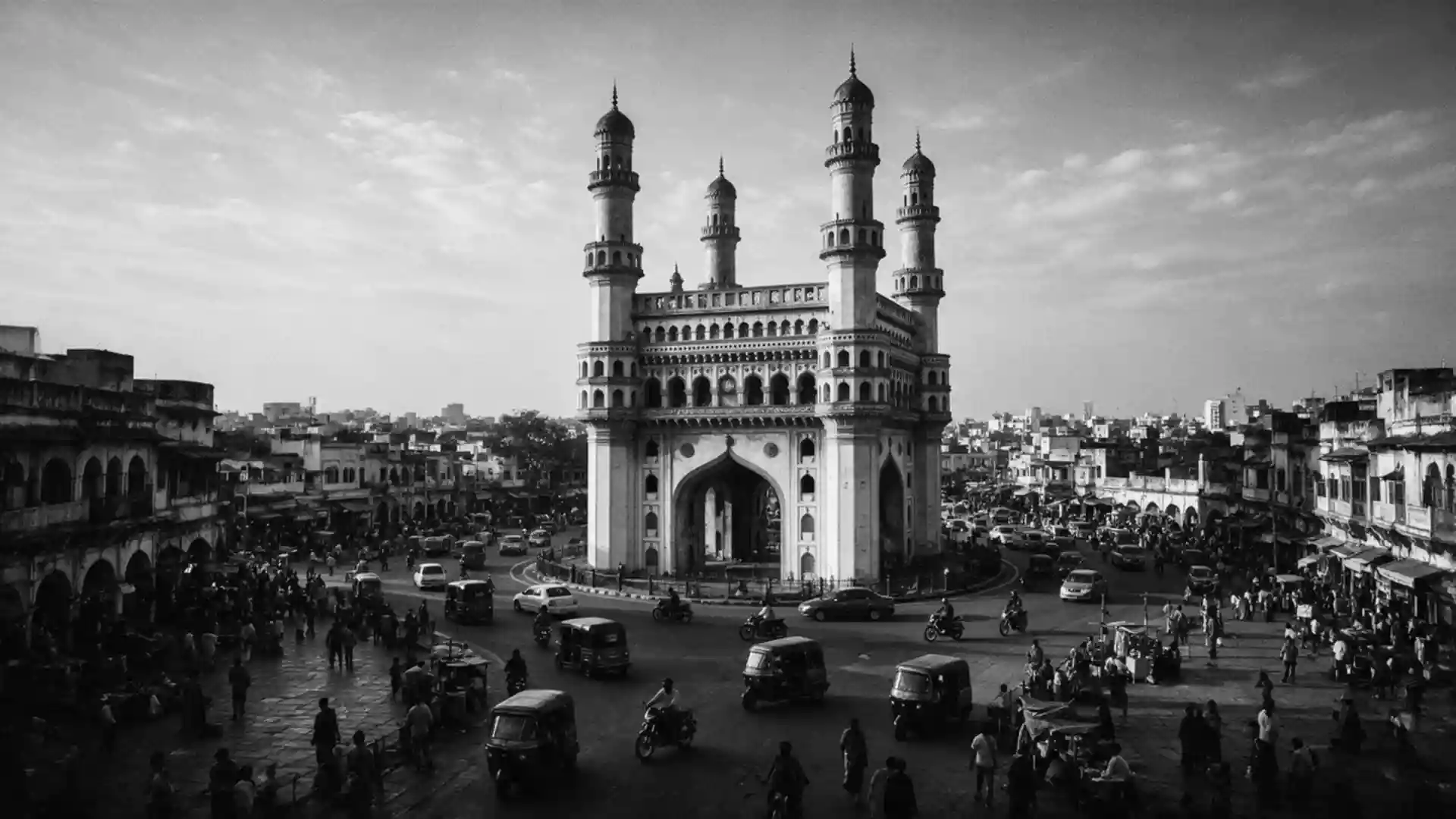
Charminar stands in Hyderabad as a square stone monument with four minarets, one at each corner. Built in 1591 under Sultan Muhammad Quli Qutb Shah, it fixes the centre of the old city in a form that is easy to read from every side.
Charminar’s four-sided form
The monument’s outline is spare and balanced. A square base carries four arches on the cardinal sides, and the corners rise into slender towers that give the structure its name. The result is a building that reads as gateway, shrine and civic marker at once. 1591 under Sultan Muhammad Quli Qutb Shah
The monument belongs to the Qutb Shahi period, when Hyderabad emerged as a planned capital in the Deccan. Its four-sided arrangement and stone surfaces place it among the best-known architectural statements of that court, with a silhouette shaped by arches rather than heavy wall mass.
Hyderabad’s old-city landmark
Charminar occupies a central place in the old city of Hyderabad, near the Musi River and the dense historic streets around it. The setting adds traffic, market activity and layered urban fabric, but the monument itself remains sharply legible as a free-standing composition. Qutb Shahi monuments old city of Hyderabad
The monument is also tied to the wider visual identity of Hyderabad. Its arches open on four sides, its minarets lift the corners, and its square plan makes the building easy to recognise from street level or from a short distance away.
Stone, arches and minarets
Charminar is built in stone and lime mortar, with carving and detailing that are visible on the main surfaces and around the upper levels. The four minarets, a defining feature of the monument, are a standard part of its profile and explain the name that has stayed with it for centuries. four minarets second Islamic millennium
The building’s combination of ceremonial gateway and mosque gives it a layered presence without turning it into a palace or fort. Its formal, symmetrical composition is the main reason it remains one of the clearest monuments of the Qutb Shahi age.
Visiting Charminar: what travellers from Western Europe should know
- Charminar stands in the old city of Hyderabad, and the surrounding streets lead to it through the historic core. Road access is direct, and the monument is a clear point of orientation in that part of the city.
- The building rises above street level with arches, towers and stairways inside the structure. The vertical movement is part of the monument’s fabric, not a separate viewpoint.
- The site sits within a dense urban quarter near the Musi River. Nearby streets and market areas form the immediate setting.
- The official language is Telugu and Urdu, and the currency is the Indian rupee.
- Entry requirements depend on your nationality; UK travellers can check the FCDO travel advice at gov.uk/foreign-travel-advice, Irish travellers the Department of Foreign Affairs at ireland.ie.
Searching for Charminar on social platforms
These links open searches for Charminar on each platform.
Frequently asked questions about Charminar
Where is Charminar?
Charminar is in the old city of Hyderabad in southern India, close to the Musi River. It sits amid the historic streets that form the city’s older core.
What does a visit involve?
The monument is read best as an urban structure, with arches, corners and upper levels visible from the surrounding streets. Its immediate setting is busy and tightly built up.
What makes Charminar distinctive?
Its square plan, four corner minarets and four-sided arch arrangement define it. Those features make it one of the clearest surviving monuments of the Qutb Shahi period.