
Changdeokgung and Seoul’s palace shaped by its landscape
Published on 09/23/2026 at 21:41 | Editorial responsibility: Rafael Müller, Editor-in-Chief AD HOC NEWS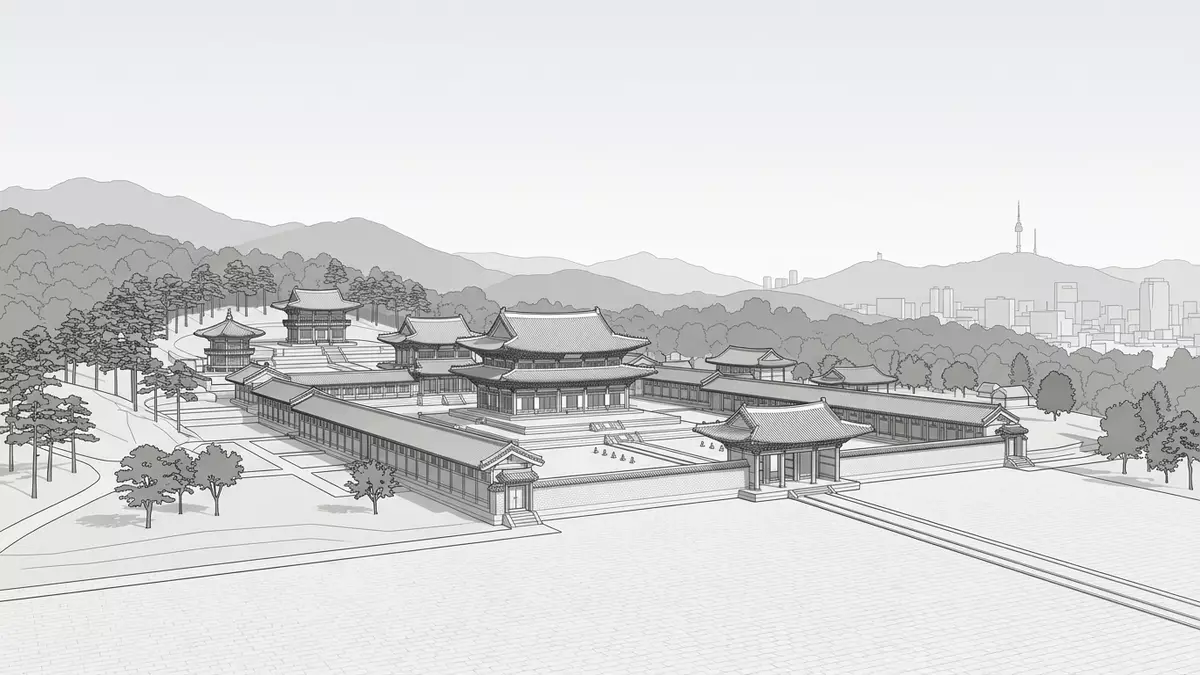
Changdeokgung is a Joseon royal palace in Seoul where painted timber buildings, stone courtyards and Huwon’s wooded garden occupy the same historic complex. Built in 1405 under King Taejong, it is defined by the relationship between palace architecture and the terrain around Mount Baegaksan.
Changdeokgung’s buildings follow the palace landscape
Changdeokgung began as a secondary palace to Gyeongbokgung during the Joseon Dynasty. Its name identifies it as a royal complex, while its layout includes formal halls, gates, residential buildings and garden spaces across a broad site in Jongno-gu.
The palace complex occupies 57.9 hectares at the foot of Ungbong Peak, part of Mount Baegaksan. Buildings and planted areas are arranged across gently changing ground, creating a sequence of courtyards, walls, paths, ponds and wooded spaces. Changdeokgung’s World Heritage listing records its integration of official and residential buildings with the natural setting.
From secondary palace to Joseon royal residence
King Taejong commissioned Changdeokgung in 1405, during the early Joseon period. The palace became the royal court’s principal residence after the destruction of Gyeongbokgung during the Japanese invasions of 1592.
Changdeokgung was reconstructed in 1610 under King Gwanghaegun. It served as the Joseon royal residence for about 270 years, while successive rulers added buildings and expanded the palace grounds. The complex therefore brings together structures from different stages of the dynasty, rather than presenting a single moment in architectural history.
The palace’s history is also visible in its changing status. It began as a companion to the principal palace, became the court’s main residence after 1592, and retained royal importance until Gyeongbokgung regained its former role in the nineteenth century. The palace history records place its construction in 1405 and its UNESCO inscription in 1997.
Huwon places royal gardens behind the halls
Behind the palace buildings lies Huwon, known in English as the Rear Garden. It contains mature trees, ponds, landscaped slopes and traditional pavilions, forming a garden landscape within the royal compound.
Huwon was connected with the royal family and palace life, while its pavilions and water features provided settings for rest, ceremonies and cultural activities. The garden is not a separate attraction detached from Changdeokgung; it is an integral part of the palace complex and its historical composition.
Changdeokgung’s formal buildings and Huwon’s planted spaces show two related kinds of Joseon design. The palace contains gates, halls and residential quarters arranged for court life, while the garden includes water, trees, open ground and small structures. Seoul’s palace guide describes the complex as a representative example of palace architecture arranged with its natural environment.
Changdeokgung Palace Complex entered the UNESCO World Heritage List in 1997. Its recorded significance rests on the combination of Far Eastern palace architecture, garden design and a setting adapted to the existing landscape. The royal complex’s history connects the site with the Joseon dynasty and its long use as a royal residence.
Visiting Changdeokgung: what travellers from Western Europe should know
- Changdeokgung is in Waryong-dong, Jongno-gu, in northern Seoul. Its address is 99 Yulgok-ro, and the palace is reached through Seoul’s public transport network.
- The site combines paved courtyards, steps, garden paths, wooded slopes and ponds. Huwon extends beyond the formal palace buildings and includes uneven ground.
- The official language is Korean and the currency is the South Korean won.
Searching for Changdeokgung on social platforms
These links open searches for Changdeokgung on each platform.Frequently asked questions about Changdeokgung
Where is Changdeokgung?
Changdeokgung is in Jongno-gu, Seoul, near Mount Baegaksan. The palace address is 99 Yulgok-ro in Waryong-dong.
What can visitors expect at Changdeokgung?
The complex contains royal halls, gates, courtyards, residential buildings and Huwon’s garden landscape. Paths connect formal architecture with trees, ponds and pavilions.
What makes Changdeokgung distinctive?
Changdeokgung combines Joseon palace architecture with a large garden shaped around the existing landscape. Its UNESCO inscription dates from 1997.


