
Chan Chan, Trujillo’s earthen capital of the Chimú kingdom
Published on 09/17/2026 at 08:42 | Editorial responsibility: Rafael Müller, Editor-in-Chief AD HOC NEWS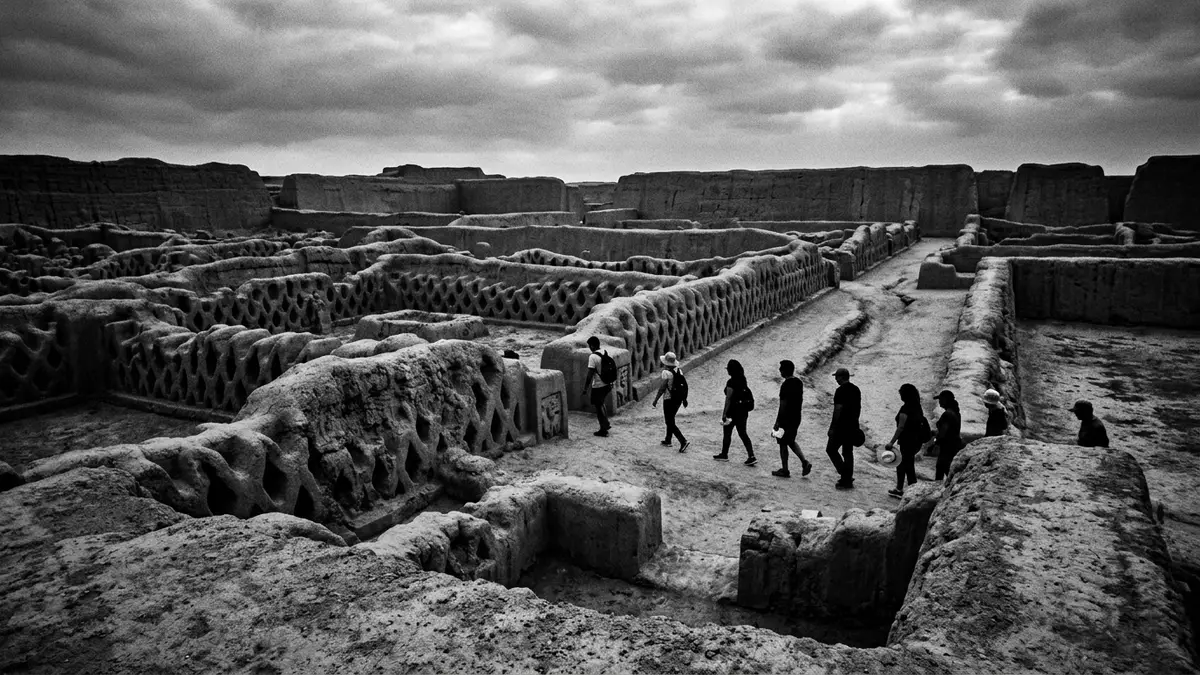
On the coastal plain west of Trujillo in northern Peru, Chan Chan extends across the desert as a pre-Columbian city of adobe walls, courtyards and reliefs built as the capital of the Chimú kingdom in the early second millennium CE. Its monumental core, recognised by UNESCO as the Chan Chan Archaeological Zone since 1986, preserves earthen palaces and ceremonial spaces that still trace the outline of a planned royal metropolis.Chan Chan Archaeological Zone
An earthen metropolis on Peru’s northern coast
Chan Chan lies in the La Libertad region on Peru’s northern Pacific coast, in the lower Moche valley between the shoreline and the modern city of Trujillo.Moche valley between the Pacific Ocean and Trujillo The city occupies a broad desert plain a short distance inland, where low sand and gravel terrain meets irrigated fields fed by rivers descending from the Andes. The archaeological zone covers a large portion of this plain, with the monumental core forming a band of dense architecture surrounded by more fragmentary remains.
From a vantage point on the site, the extent of Chan Chan becomes clear as successive adobe enclosures and perimeter walls recede towards the horizon. Sources place the urban area at around 20 square kilometres, with a monumental centre of roughly six square kilometres that concentrates the largest palace compounds and ceremonial spaces.urban area at around 20 square kilometres Within this core, earthworks, plazas and passages form an organised pattern distinct from the surrounding desert, marking Chan Chan out as a purpose-built city rather than an organically grown settlement.
Citadels, courtyards and adobe reliefs
The most conspicuous structures at Chan Chan are the large rectangular compounds often described as citadels or palaces, enclosed by high earthen walls and arranged in a roughly north–south band across the monumental zone.nine large rectangular complexes Each compound contains a sequence of courtyards, corridor-like passages, storage areas and restricted inner spaces interpreted as ceremonial chambers and burial precincts. Many walls carry moulded relief designs depicting stylised marine creatures, wave patterns and geometric motifs, reflecting the coastal setting and the iconography of the Chimú civilisation.
Walking through the restored sections, the character of the adobe construction is evident in the smooth, planar wall surfaces and crisp angles where passage meets courtyard. Timber and cane elements survive in some areas as impressions or reconstructed details, hinting at roofing and shading systems that once spanned selected spaces. Floors are formed from compacted earth, often raised slightly above surrounding ground to demarcate formal areas, while narrower corridors focus movement towards central courts. In places, low platforms and bench-like structures frame ritual spaces within the compounds.
Capital of the Chimú kingdom and World Heritage site
Chan Chan served as the political and administrative centre of the Chimú kingdom, also known as Chimor, which dominated parts of Peru’s northern coast before its conquest by the expanding Inca Empire around 1470 CE.capital city of the Chimor kingdom Archaeological and historical sources place the foundation of the city around 900 to 1100 CE, with successive Chimú rulers adding new palace compounds rather than reoccupying older ones, creating a layered urban record of dynastic change.capital of the Chimú kingdom After the Inca conquest, the city’s political role declined and many structures fell out of use, leaving the adobe architecture exposed to the coastal climate.
In recognition of its scale, artistic detail and testimony to a vanished civilisation, the Chan Chan Archaeological Zone was inscribed on the UNESCO World Heritage List in 1986 under cultural criteria i and iii.inscribed on the World Heritage List in 1986 The site was simultaneously placed on the List of World Heritage in Danger because its earthen construction is highly susceptible to erosion from wind and rain.World Heritage in Danger Conservation programmes have introduced protective coverings, drainage improvements and controlled visitor routes to reduce physical stress on vulnerable structures while keeping key compounds accessible for study and visitation.
Visiting Chan Chan: what travellers from Western Europe should know
- Chan Chan lies west of Trujillo in Peru’s La Libertad region, between the city and the Pacific shore, and is reached over short roads crossing the coastal plain.
- Within the monumental zone, movement follows earthen paths and passageways, with some circuits including low steps, ramps and long stretches on compacted earth under an open sky.
- The surrounding landscape combines dry desert terrain with irrigated fields, and exposed sections of the site sit at low elevation close to sea level, with limited natural shade.
- The official language is Spanish and the currency is the Peruvian sol.
- Entry requirements depend on your nationality; UK travellers can check the FCDO travel advice at gov.uk/foreign-travel-advice, Irish travellers the Department of Foreign Affairs at ireland.ie.
Searching for Chan Chan on social platforms
These links open searches for Chan Chan on each platform.
Frequently asked questions about Chan Chan
Where is Chan Chan located?
Chan Chan is on Peru’s northern coast in the La Libertad region, west of the city of Trujillo in the Moche valley near the Pacific Ocean.
What can visitors expect when exploring Chan Chan?
Visitors encounter extensive adobe compounds, courtyards and decorated walls within a desert landscape, following marked routes through restored palace complexes and open areas of archaeological remains.
What makes Chan Chan distinctive among ancient American cities?
Chan Chan is distinguished by its scale as a planned earthen metropolis, its role as Chimú capital and its formal recognition as a UNESCO World Heritage site with large palace compounds.


