
Chan Chan’s adobe metropolis on Peru’s northern coast
Published on 08/29/2026 at 17:59 | Editorial responsibility: Rafael Müller, Editor-in-Chief AD HOC NEWS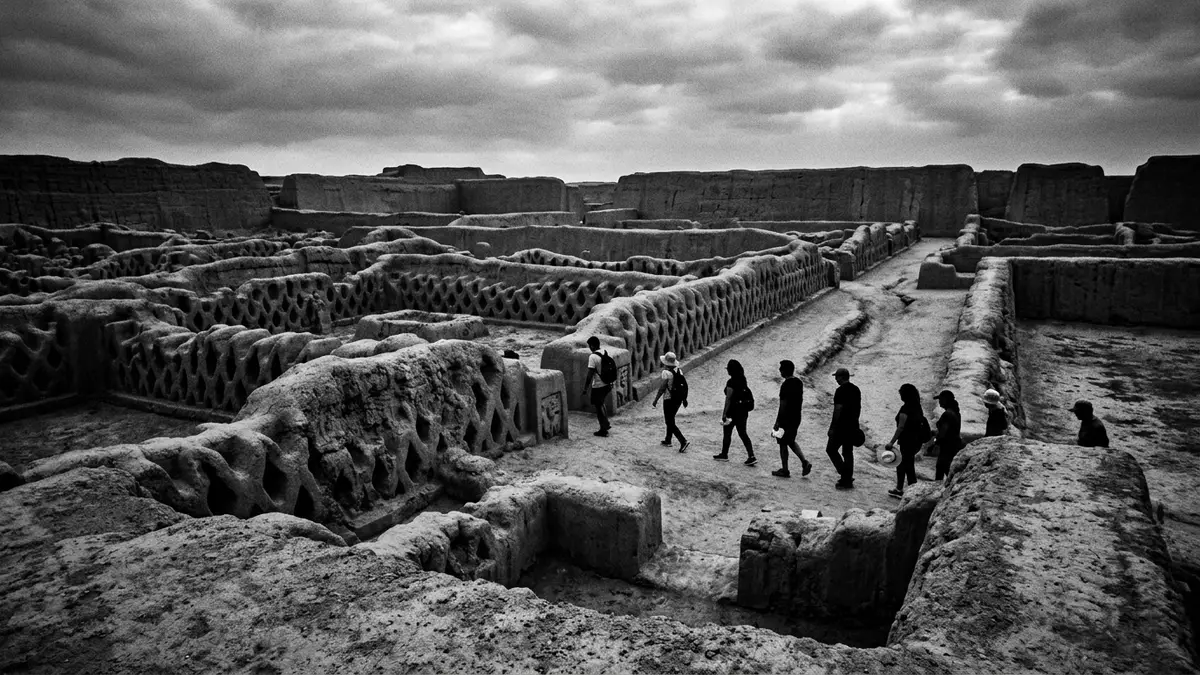
On the coastal plain west of Trujillo in northern Peru, Chan Chan spreads across the Moche valley as an immense pre-Columbian city of adobe architecture that once served as the capital of the Chimú kingdom in the late pre-Hispanic period.capital of the Chimú kingdom In 1986 the site was inscribed as the Chan Chan Archaeological Zone on the UNESCO World Heritage List as a cultural property recognised for its earthen urban landscape.Chan Chan Archaeological Zone
An earthen city carved from desert
Chan Chan occupies part of the coastal desert between the city of Trujillo and the Pacific Ocean, in the broader Moche valley whose rivers once fed an extensive irrigation network.between the Pacific Ocean and Trujillo Across this flat terrain the ruins form a low, geometric relief of adobe walls, plazas and compounds, their surfaces weathered to soft edges under centuries of wind and salt-laden air.
The city’s core consists of large walled enclosures often called ciudadelas, whose perimeter walls reach notable heights and lengths and are generally aligned along a north–south axis.ciudadelas perimeter walls Within these compounds lie sequences of courtyards, narrow corridors and chambers, many decorated with repeating relief motifs of stylised birds, waves and fish that reflect the coastal environment and the maritime focus of Chimú art.earthen architecture complex
Chimú capital and UNESCO World Heritage
Archaeological and historical research places Chan Chan within the Chimú period, a civilisation that developed on Peru’s northern coast from around the tenth century AD until its incorporation into the Inca Empire in the fifteenth century.developed between the ninth and fifteenth centuries Chan Chan functioned as a political, religious and administrative centre of this kingdom, concentrating power in a landscape of palatial enclosures, storage sectors and craft areas that extended over many square kilometres of the valley floor.department of La Libertad
On 28 November 1986 UNESCO inscribed Chan Chan as a World Heritage Site under cultural criteria that recognise both its urban planning and its status as a rare surviving example of large-scale earthen architecture.inscribed on the World Heritage List in 1986 In the same year the site was added to the List of World Heritage in Danger, reflecting concerns about erosion of the adobe structures from rainfall and environmental change along this part of Peru’s coast.added to the List of World Heritage in Danger
Layout, reliefs and the experience of scale
Walking through the accessible sectors of Chan Chan reveals how the city’s designers organised space with long axial corridors, angled turns and sequences of plazas, some with low platforms that mark ceremonial or administrative areas. The city’s surface today is subdued, but the surviving walls still create a sense of enclosure and distance as they trace the outlines of compounds that once stood several storeys high.
Many of the relief panels along interior passages and courtyards share a visual vocabulary of repeated geometric bands and stylised fauna. These patterns run horizontally along walls and are framed by plain sections of adobe, giving each compound a distinct decorative scheme while preserving a coherent Chimú aesthetic across the site.decorative reliefs of animals and waves From vantage points near the tops of conserved walls, the view takes in successive enclosures and open spaces, emphasising how Chan Chan operated as a whole urban landscape rather than a single monument.
Visiting Chan Chan: what travellers from Western Europe should know
- Chan Chan lies west of Trujillo in the La Libertad region of northern Peru, between the urban area and the Pacific shore in the wider Moche valley. The archaeological zone is reached by road along routes that also serve the coastal district of Huanchaco.
- The terrain within the visitable compounds consists of packed earth paths and uneven adobe surfaces, with low steps and ramps leading into courtyards and through corridors. Footwear with good grip is advisable for walking across the dusty ground and occasional loose sand.
- In the broader coastal strip around Chan Chan, the climate is arid with minimal rainfall, and the adobe architecture sits at low altitude near sea level. Sun exposure can be strong on the open plazas and perimeter paths.
- The site is within sight of the Pacific Ocean and close to other archaeological locations in the region, including temple complexes in the Moche valley that are frequently visited in the same excursion.
- The official language is Spanish and the currency is the Peruvian sol. Entry requirements depend on your nationality; UK travellers can check the FCDO travel advice at gov.uk/foreign-travel-advice, Irish travellers the Department of Foreign Affairs at ireland.ie.
Searching for Chan Chan on social platforms
These links open searches for Chan Chan on each platform.Frequently asked questions about Chan Chan
Where is Chan Chan located in relation to Trujillo?
Chan Chan stands in the La Libertad region of northern Peru, on the coastal plain to the west of Trujillo in the wider Moche valley.
What should visitors expect when exploring Chan Chan?
Visitors encounter a broad expanse of adobe ruins with walled compounds, corridors and courtyards, set on dry, sandy ground with minimal shade and simple, unpaved paths.
What makes Chan Chan distinctive among ancient American cities?
Chan Chan is distinguished by its scale as an earthen metropolis of monumental compounds, its role as Chimú capital and its UNESCO recognition as a World Heritage earthen urban landscape.


