
Chan Chan’s adobe labyrinth between desert and sea
Published on 08/27/2026 at 15:38 | Editorial responsibility: Rafael Müller, Editor-in-Chief AD HOC NEWS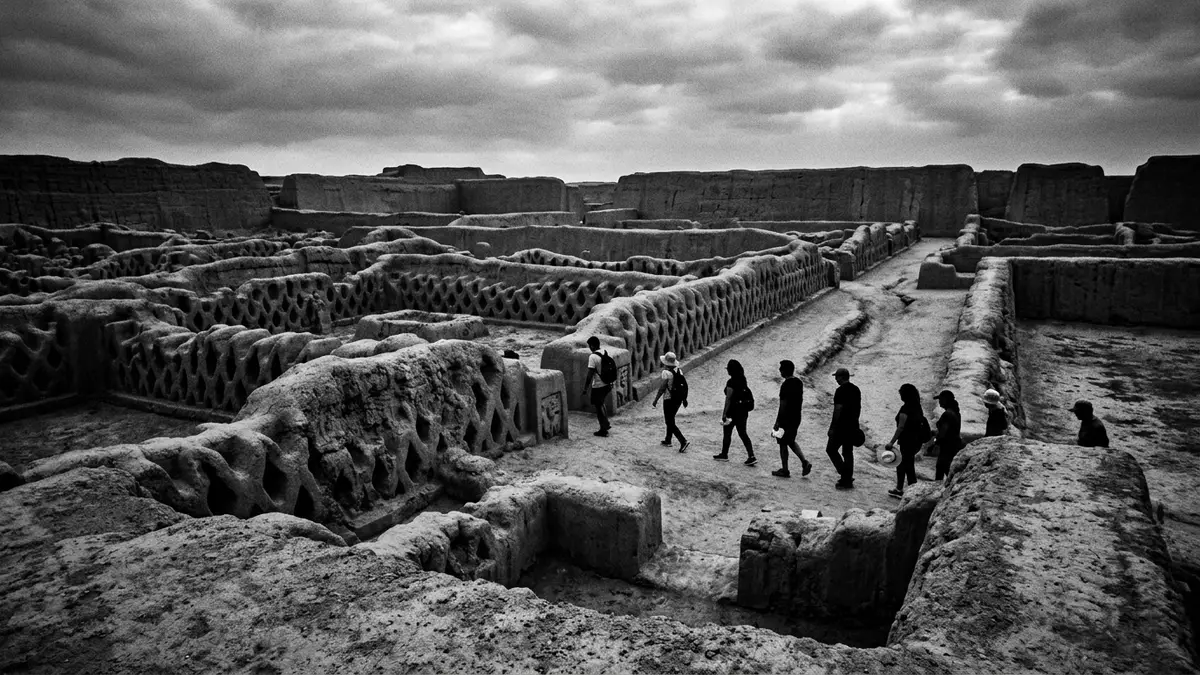
On the coastal plain west of Trujillo in northern Peru, Chan Chan stretches across the desert as an extensive city of adobe walls and long, straight avenues. Built as the capital of the Chimú kingdom in the first millennium AD, it forms one of the largest pre-Columbian urban ensembles in the Americas and has been recognised as a UNESCO World Heritage Site since 1986.
An earthen capital of the Chimú kingdom
Chan Chan occupies the northern coast of Peru in the Moche valley, between the Pacific shoreline and the urban spread of Trujillo. Its core forms a dense grid of ceremonial and residential compounds laid out in adobe, the sun-dried mixture of mud and plant fibre that defines the architecture of this coastal desert city.The monumental zone covers around six square kilometres within a much larger archaeological area, framing a landscape of walled enclosures, corridors and open plazas.
Archaeological and historical studies describe Chan Chan as the capital of the Chimú kingdom, a coastal polity that flourished on Peru’s north coast before its conquest by the Inca in the fifteenth century.The city was a major centre from around the twelfth century until about 1470, when Chimú power came under Inca control. In 1986, Chan Chan was inscribed on the UNESCO World Heritage List as a cultural property of global importance and was placed on the List of World Heritage in Danger because of the fragility of its earthen fabric in this dry but occasionally rain-swept environment.The site has since been the focus of long-running conservation programmes.
Nine citadels and an intricate urban landscape
The most striking feature of Chan Chan’s layout is the repetition of large, rectangular compounds, each enclosed by high adobe walls and organised around broad ceremonial spaces. Within the central part of the site, nine of these major complexes, often described as citadels or palaces, stand as autonomous units. Their walls create a pattern of corridors, courtyards and restricted passages that once controlled movement through the city.
Inside the compounds, visitors encounter long processional routes, rooms arranged around open courtyards and a succession of smaller spaces that suggest administrative, ritual and storage functions.The urban centre extends over about six square kilometres within a wider area of roughly twenty square kilometres, with outlying sectors that include workshops, smaller dwellings and agricultural features. Even in their eroded state, the alignment of walls and the hierarchy of spaces give a sense of a carefully planned city with distinct ceremonial and residential zones.
Carved reliefs and desert light
Beyond its sheer scale, Chan Chan is defined by the surface of its walls. Many corridors and courtyards preserve bands of low-relief decoration, where artisans modelled the wet adobe into geometric friezes and stylised motifs drawn from the coastal environment. Repeating patterns of birds, abstract waves and nets appear across the interiors of the compounds, giving the city a continuous decorative skin that catches the changing desert light.These reliefs are a hallmark of Chimú artistic practice.
The earthen material gives Chan Chan a distinctive palette that shifts subtly through the day, with walls, plazas and surviving ramps sharing the same muted tones as the surrounding plain. From some vantage points, the city reads as a continuous mass of adobe rising from the sand, while from others, the depth of the compounds becomes apparent in the shadows of their interior corridors.The combination of large-scale planning and finely worked relief makes the site a rare example of earthen urbanism on this scale.
Visiting Chan Chan: what travellers from Western Europe should know
- Chan Chan lies on the coastal plain of northern Peru, just outside the city of Trujillo in the La Libertad region, between the urban area and the seaside town of Huanchaco.
- The archaeological zone occupies a flat desert landscape, with walking routes across compacted sand and through long corridors; some areas involve gentle ramps and extended distances on foot between compounds.
- The site stands a short way inland from the Pacific Ocean, and the combination of sun exposure and reflected light from the pale ground makes head coverings and sun protection important for extended exploration.
- Interpretive signage on site focuses on the Chimú period and the earthen construction techniques, with marked paths guiding visitors through one of the principal citadels.
- The official language is Spanish and the currency is the Peruvian sol. Entry requirements depend on your nationality; UK travellers can check the FCDO travel advice at gov.uk/foreign-travel-advice, Irish travellers the Department of Foreign Affairs at ireland.ie.
Searching for Chan Chan on social platforms
These links open searches for Chan Chan on each platform.
Frequently asked questions about Chan Chan
Where is Chan Chan located?
Chan Chan stands on the coastal desert plain of northern Peru, in the Moche valley between the Pacific Ocean and the city of Trujillo in the La Libertad region.
What can visitors expect when exploring Chan Chan?
Visitors walk through expansive adobe compounds, long corridors and open plazas, seeing carved earthen reliefs and the broad layout of a planned Chimú capital in a desert setting.
What makes Chan Chan distinctive among archaeological sites?
Chan Chan combines the scale of a pre-Columbian city with finely modelled adobe reliefs and a grid of walled citadels, all constructed in earthen material between desert and sea.


