
Chan Chan, an earthen capital between Trujillo and the Pacific
Published on 09/16/2026 at 09:08 | Editorial responsibility: Rafael Müller, Editor-in-Chief AD HOC NEWS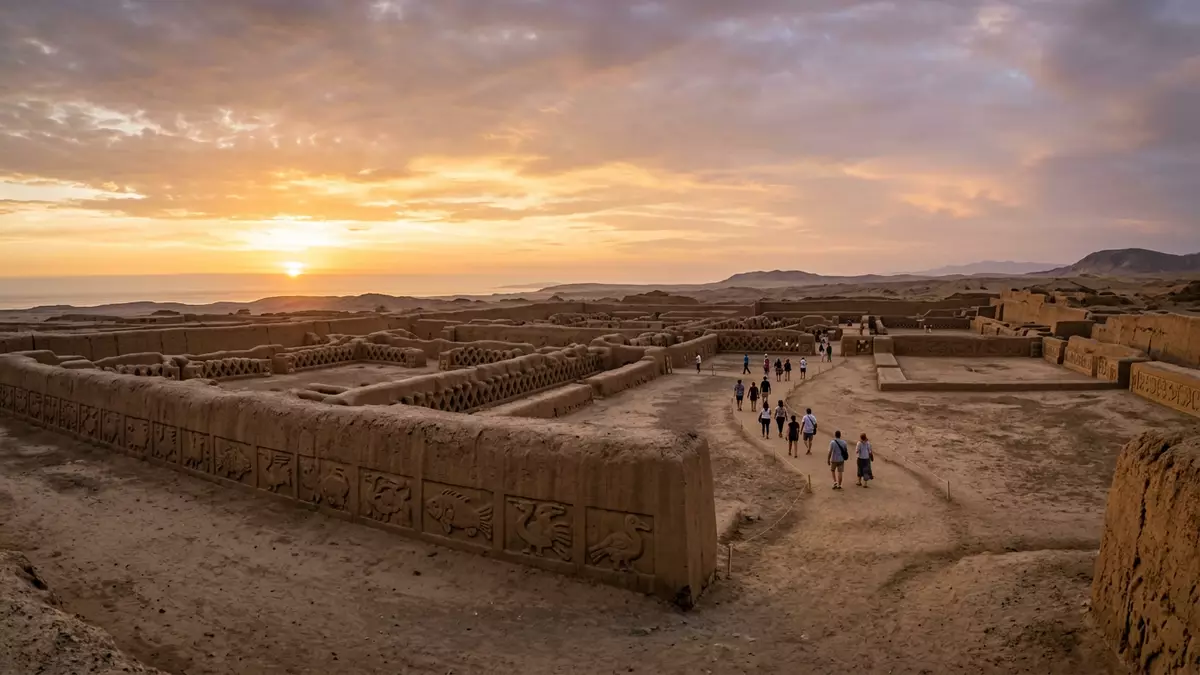
On the coastal plain between Trujillo and the Pacific in northern Peru, Chan Chan stretches across the desert as a planned city built almost entirely of adobe. Once the capital of the Chimú kingdom in the pre-Columbian era, it survives as an archaeological zone where long earthen walls and enclosed plazas still give a clear sense of urban ambition in the Moche valley.
An earthen metropolis of the Chimú kingdom
Chan Chan lies in the La Libertad region on Peru’s northern coast, in the broad Moche valley between the modern city of Trujillo and the shoreline of the Pacific Ocean.The site sits between Trujillo and the ocean and occupies part of an ancient city laid out across the desert. Archaeological surveys describe an urban area of around 20 km² (7.7 sq mi), making Chan Chan the largest known earthen city in pre-Columbian America and a major adobe settlement in the wider world.The ancient city covered about 20 km²
The city was the political centre of the Chimú kingdom, an Andean coastal power that flourished on Peru’s northern shore before falling to the Incas in the fifteenth century.Chan Chan served as the capital of the Chimú kingdom Within its earthen fabric, the planning reflected a clear hierarchy, with monumental complexes and administrative spaces standing alongside residential quarters and areas devoted to craft production. The surviving ruins give a structural view of Chimú society, expressed through the way space, walls and passageways divide the landscape.
The monumental zone and its adobe architecture
Today, visiting Chan Chan means entering the monumental zone, a central area of about six square kilometres where high adobe walls enclose large rectangular compounds.The monumental zone covers around six square kilometres These compounds are widely referred to as citadels or palaces and are defined by thick earthen walls that rise above the desert floor. Within them, visitors encounter corridors, courtyards, ceremonial spaces and areas with relief decoration moulded directly into the mud.
The earthen construction is the defining material character of Chan Chan. Adobe bricks and packed earth form the walls, surfaces and platforms, creating a city where structural mass and texture are inseparable. In some sectors, geometric and figurative reliefs decorate the lower parts of walls, depicting stylised marine creatures, birds and abstract patterns in repeated bands.Reliefs and thick earthen walls are characteristic of the palaces These details bring a visual rhythm to otherwise plain surfaces and show how the Chimú integrated imagery into architectural space.
UNESCO recognition and conservation challenges
Chan Chan is formally recognised as the Chan Chan Archaeological Zone on the UNESCO World Heritage List, a status granted in 1986 in acknowledgement of its cultural significance.The Chan Chan Archaeological Zone was inscribed on the World Heritage List in 1986 The inscription highlights the city as an outstanding example of pre-Hispanic earthen architecture and urban planning, and as a record of the organisational complexity of the Chimú civilisation.
Alongside this recognition, Chan Chan is also listed as a World Heritage site in danger, reflecting the vulnerability of adobe structures to climate and environmental factors.Chan Chan appears on the World Heritage in Danger list Rain, wind and humidity affect the earthen fabric, softening edges and eroding reliefs. Conservation initiatives therefore focus on stabilising walls, protecting decorated surfaces and managing water across the site. For travellers, this work is visible in sheltered areas, reinforced edges and marked paths that guide movement through the ruins while preserving fragile structures.
Visiting Chan Chan: what travellers from Western Europe should know
- Chan Chan lies a short distance west of Trujillo in northern Peru, on the road towards the coastal district of Huanchaco in the La Libertad region. Access is by road from Trujillo, with the site reached from the highway that links the city to the shoreline.
- The terrain within the monumental zone is largely flat but covered with compacted sand and earth, with long stretches between walls, ceremonial spaces and viewing points. Walking routes include uncovered sections, and some interior areas are reached along narrow passageways and low ramps.
- The archaeological zone stands between the Pacific Ocean and Trujillo’s urban area, in an open coastal landscape. The approach passes through the outskirts of the city into a broad desert plain where the earthen walls begin to rise out of the sand.
- The official language is Spanish and the currency is the Peruvian sol.
- Entry requirements depend on your nationality; UK travellers can check the FCDO travel advice at gov.uk/foreign-travel-advice, Irish travellers the Department of Foreign Affairs at ireland.ie.
Searching for Chan Chan on social platforms
These links open searches for Chan Chan on each platform.
Frequently asked questions about Chan Chan
Where is Chan Chan located?
Chan Chan is on Peru’s northern coast in the La Libertad region, in the Moche valley between the city of Trujillo and the Pacific Ocean.
What should visitors expect on a visit to Chan Chan?
Visitors walk through a monumental earthen landscape of adobe walls, courtyards and passageways, following marked routes across compacted sand and earth in a broad coastal plain.
What makes Chan Chan distinctive among archaeological sites?
Chan Chan stands out for its scale as a planned adobe city, its role as capital of the Chimú kingdom and its recognition as a World Heritage site dedicated to pre-Hispanic earthen architecture.


