Chan Chan, an earthen capital between Trujillo and the Pacific
Published on 09/09/2026 at 22:38 | Editorial responsibility: Rafael Müller, Editor-in-Chief AD HOC NEWS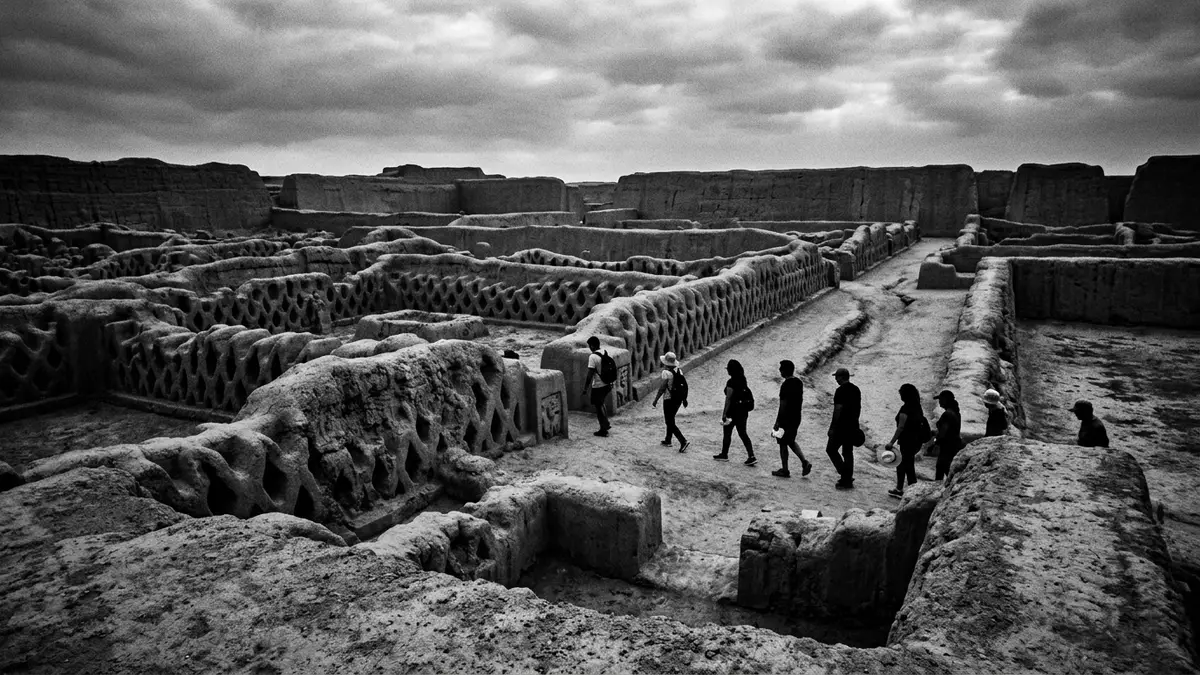
On the coastal plain of northern Peru, between the modern city of Trujillo and the Pacific shore, Chan Chan spreads across the desert as a vast city of adobe walls and open plazas. Once the capital of the Chimú kingdom in the pre-Columbian era, it survives as an archaeological zone where earthen architecture on an urban scale remains visible across the Moche valley landscape.
An earthen metropolis of the Chimú kingdom
Chan Chan lies in the La Libertad region of northern Peru, in the Moche valley between Trujillo and the Pacific Ocean, on a broad coastal plain of sand and low scrub. Archaeological surveys describe a planned city laid out over about 20 km² (7.7 sq mi), making it one of the largest pre-Hispanic urban centres built largely in earthen materials in the Americas.planned city laid out over about 20 km² Within this wider urban area, the monumental zone at Chan Chan covers around six square kilometres and concentrates the most visible remains of palaces, ceremonial spaces and high earthen walls.monumental zone at Chan Chan
The city functioned as the capital of the Chimú kingdom from roughly the twelfth century until the fifteenth century CE, before the region was incorporated into the Inca Empire.capital of the Chimú kingdom In this period Chan Chan grew into one of the largest cities of pre-Columbian America, an urban centre whose scale is reflected in the extensive spread of earthen compounds, reservoirs and thoroughfares across the valley floor.one of the largest cities of pre-Columbian America
Citadels, walls and adobe reliefs
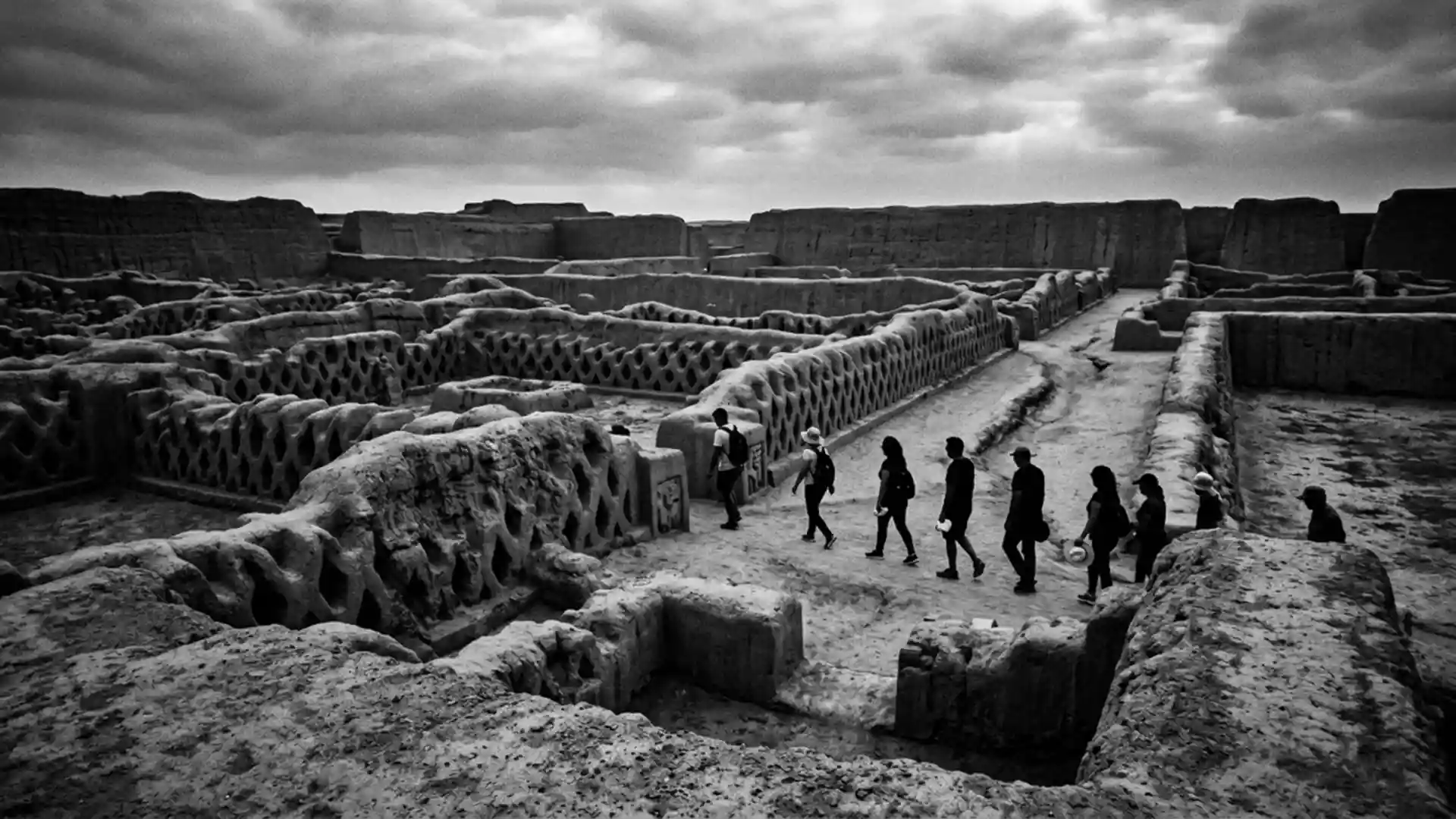
The monumental heart of Chan Chan is defined by a series of large rectangular compounds, often described as citadels or palaces, enclosed by thick adobe walls that still rise sharply from the surrounding sand. Within these compounds, long corridors, open courtyards and processional routes create a sequence of spaces that visitors follow through restored and stabilised sections of the site.large rectangular compounds enclosed by thick adobe walls The Nik An compound, also known as Tschudi, preserves an especially clear arrangement of plazas, audience platforms and relief-decorated walls, offering a view into the organisation of a Chimú royal residence.Nik An compound
Earthen reliefs are a distinctive feature of Chan Chan’s architecture, carved in sun-dried mud along interior walls to form repeating bands of geometric patterns, stylised marine creatures and abstracted bird and wave motifs. These reliefs line passageways and frame ceremonial spaces, turning simple adobe surfaces into patterned screens whose themes reflect the coastal setting between the valley and the sea. Alongside the decorated walls lie open plazas, reservoirs lined with adobe and low platforms that once supported wooden or textile structures now lost to time, all contributing to the sense of a planned ceremonial city conceived in earthen materials.
World Heritage status and desert setting
Chan Chan stands on Peru’s northern coast about 480 km (298 mi) north of Lima, between Trujillo and the Pacific, in a region where rain is scarce and the coastal desert meets irrigated farmland in the Moche valley.between Trujillo and the Pacific The low, dry terrain around the site leaves the adobe architecture exposed to wind, salt-laden air and occasional heavy rainfall associated with El Niño events, making conservation of the earthen structures a continuing concern for archaeologists and heritage managers.conservation of the earthen structures
The cultural importance of Chan Chan has been recognised internationally since 1986, when the “Chan Chan Archaeological Zone” was inscribed as a UNESCO World Heritage Site under cultural criteria that highlight its earthen architecture and its testimony to Chimú civilisation.inscribed as a UNESCO World Heritage Site in 1986 The designation covers the monumental zone and associated areas of the wider city, protecting both standing architecture and buried remains that continue to inform research into pre-Hispanic urban planning on Peru’s northern coast.pre-Hispanic urban planning on Peru’s northern coast
Visiting Chan Chan: what travellers from Western Europe should know
- Chan Chan lies on the coastal plain of the La Libertad region in northern Peru, a short distance west of Trujillo on the road towards the seaside district of Huanchaco in the Moche valley.
- Within the monumental zone, the walkable areas consist mainly of compacted sand and adobe surfaces, with long straight corridors and broad plazas linked by ramps and stairways that require steady footing under strong sun.
- The archaeological zone stands between irrigated fields and the Pacific shoreline, so a visit can combine the desert city with nearby coastal viewpoints and the urban fabric of Trujillo.
- The official language is Spanish and the currency is the Peruvian sol.
- Entry requirements depend on your nationality; UK travellers can check the FCDO travel advice at gov.uk/foreign-travel-advice, Irish travellers the Department of Foreign Affairs at ireland.ie.
Searching for Chan Chan on social platforms
These links open searches for Chan Chan on each platform.
Frequently asked questions about Chan Chan
Where is Chan Chan and what kind of site is it?
Chan Chan is an extensive pre-Columbian adobe city on Peru’s northern coast in the La Libertad region, between Trujillo and the Pacific, preserved as an archaeological zone.
What should visitors expect when walking through Chan Chan?
Visitors follow corridors and plazas defined by high earthen walls, with restored sections of decorated adobe reliefs and open spaces under strong coastal desert light.
What makes Chan Chan distinctive among ancient American cities?
Its combination of large-scale planned urban layout, earthen palatial compounds and rich mud relief decoration marks Chan Chan as a major capital of the Chimú civilisation.