
Chan Chan, adobe capital of the Chimú near Trujillo
Published on 08/21/2026 at 11:34 | Editorial responsibility: Rafael Müller, Editor-in-Chief AD HOC NEWS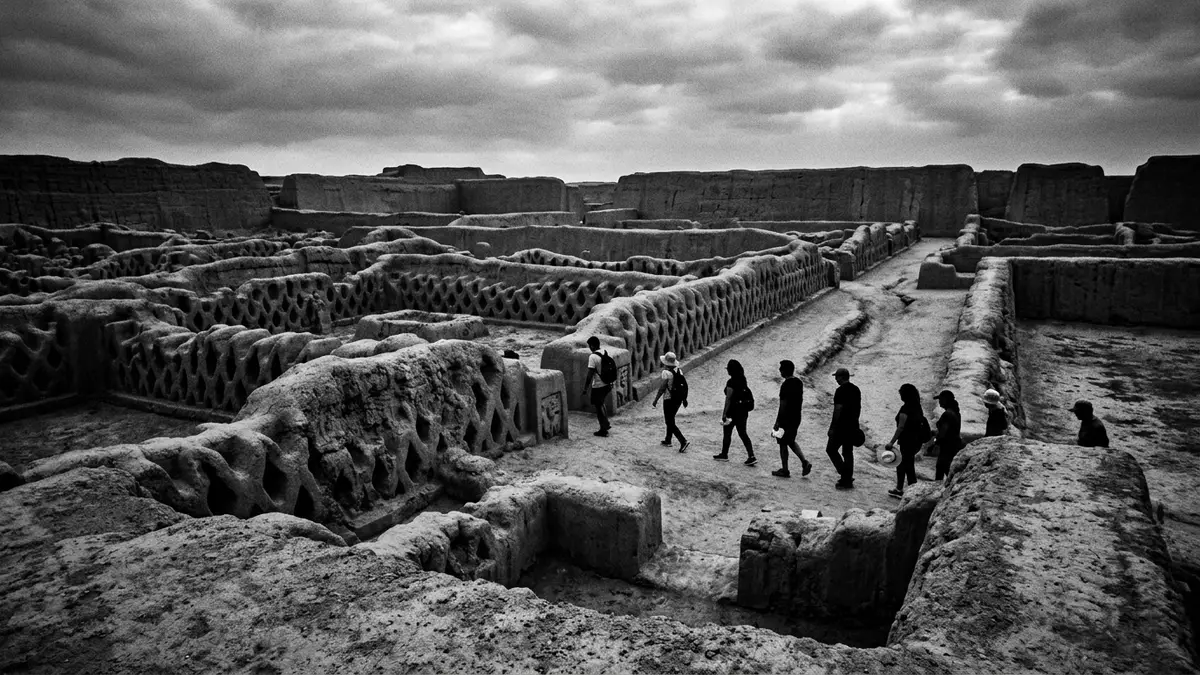
On the desert fringe west of Trujillo in northern Peru, Chan Chan spreads across the coastal plain as a vast pre?Columbian city built largely from adobe. Once the political and ceremonial capital of the Chimú kingdom between about 900 and 1470 CE, it is now an archaeological zone recognised as a cultural World Heritage Site for its monumental earthen architecture and urban scale.
An adobe metropolis on Peru’s northern coast
Chan Chan lies in the La Libertad Region on Peru’s northern coastline, in the lower Moche valley between the Pacific Ocean and the modern city of Trujillo. From the air or from surrounding dunes, the site reads as a dense carpet of geometric earthen forms, with long rectilinear walls enclosing compounds and corridors across the desert surface.Northern coast location
The urban area of Chan Chan once extended across roughly 20 square kilometres of coastal desert, with a monumental core of several square kilometres marked by large palace compounds and ceremonial spaces.Largest adobe city description Within this landscape, nine major rectangular compounds, often termed citadels or palaces, are defined by high earthen perimeter walls and subdivided by internal partitions, passageways and courtyards.Rectangular palace complexes
Capital of the Chimú kingdom
Chan Chan served as the capital of the Chimú kingdom, also known as Chimor, a regional power that controlled long stretches of Peru’s north coast until its conquest by the Inca in the fifteenth century.Chimor capital The city is generally dated to about 900 CE, following the decline of earlier Andean polities such as the Wari, and remained a major centre until around 1470 when Chimú territories were incorporated into the expanding Inca Empire.Chimú capital period
Within Chan Chan’s walled compounds, archaeologists have identified administrative halls, ceremonial courtyards, storage zones, burial areas and garden spaces, all built from shaped adobe units and earth. The pattern of successive rulers creating new palace compounds has left a series of monumental enclosures across the site, each with its own internal plan and decorative programme, reflecting the political and ceremonial organisation of the Chimú state.Urban centre description
World Heritage status and earthen architecture
Chan Chan’s combination of scale, planning and earthen construction led to its inscription as the “Chan Chan Archaeological Zone” on the UNESCO World Heritage List in 1986, under cultural criteria including its representation of a disappeared civilisation.World Heritage inscription The same year, it was placed on the List of World Heritage in Danger because earthen architecture is highly susceptible to erosion and other forms of decay in the open landscape.Endangered status
Across the site, adobe walls carry repetitive reliefs and friezes, with motifs such as geometric bands and stylised creatures running along long surfaces of compacted earth. The use of earthen materials at such a scale, together with the extensive urban planning of compounds, streets and open spaces, has made Chan Chan a reference point in studies of Andean architecture and pre?Columbian city building.Mud?brick city structure
Visiting Chan Chan: what travellers from Western Europe should know
- Chan Chan lies west of Trujillo in northern Peru, in the La Libertad Region; visitors generally approach it along the road towards the coastal town of Huanchaco.
- The archaeological zone is spread over flat coastal desert, and visiting the monumental compounds involves walking on sandy or earthen surfaces with limited shade.
- The site stands near sea level, and some areas use raised walkways or defined paths to guide visitors through excavated sections and around fragile earthen walls.
- The official language is Spanish and the currency is the Peruvian sol.
- Entry requirements depend on your nationality; UK travellers can check the FCDO travel advice at gov.uk/foreign-travel-advice, Irish travellers the Department of Foreign Affairs at ireland.ie.
Searching for Chan Chan on social platforms
These links open searches for Chan Chan on each platform.
Frequently asked questions about Chan Chan
Where is Chan Chan located?
Chan Chan is situated in the La Libertad Region of northern Peru, between the Pacific Ocean and the city of Trujillo, in the lower Moche valley.
What can visitors expect when exploring Chan Chan?
Visitors encounter extensive adobe walls, monumental palace compounds and open courtyards laid out across a broad coastal desert site, with paths leading through selected excavated areas.
What makes Chan Chan distinctive among archaeological sites?
Chan Chan is notable for its earthen construction at metropolitan scale, its role as capital of the Chimú kingdom and its dual status as a World Heritage Site and endangered cultural property.


