
Cerro Rico, the rich mountain shaping Potosi
Published on 08/22/2026 at 19:39 | Editorial responsibility: Rafael Müller, Editor-in-Chief AD HOC NEWS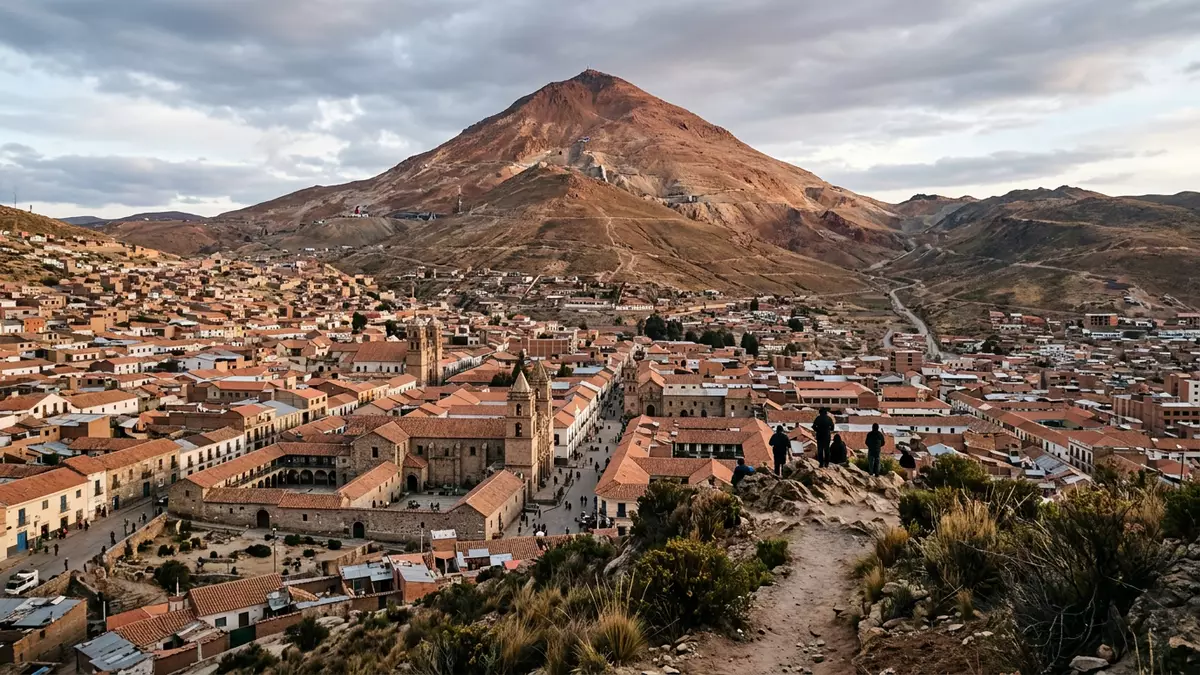
Cerro Rico above Potosi is a high Andean mountain whose mineralised slopes have fed mines since the sixteenth century and given this part of Bolivia its distinctive skyline. Rising as a prominent cone over the city, it is both a geographical landmark and a landscape shaped by centuries of underground work.
A cone of mineral-rich rock above Potosi
Cerro Rico stands immediately above the city of Potosi in the Bolivian Andes, dominating the surrounding plateau as a separate peak rather than part of a distant range. The mountain is also known as Cerro Potosí and by the Quechua name Sumaq Urqu, meaning “beautiful mountain”, a reminder that it is both a natural formation and a long-recognised landmark for the highland communities around it.Cerro Rico (Rich Mountain)
The summit reaches an elevation of around 4,782 m (15,689 ft) above sea level, placing it well within the high Andean zone where the air is thin and the climate is harsh.an elevation of 4,782 m Cerro Rico forms part of the Andes chain rather than standing as an isolated mesa, yet its conical outline sets it apart from nearby ridges and helps visitors orient themselves when moving through Potosi’s streets.
From imperial silver to layered mining history
In 1545 the Spanish colonial authorities founded the city of Potosi at the foot of Cerro Rico, turning the mountain into a central source of silver for the Spanish Empire.the rich mountain above Potosi The seams of silver ore in Cerro Rico fed a global trade, and the mountain’s Spanish name, meaning “Rich Mountain”, reflects the wealth drawn from its veins. For travellers tracing early globalisation, this single peak links Andean geology with silver coins minted and circulated far beyond South America.
Mining at Cerro Rico extended beyond colonial silver to include tin, zinc and lead in later centuries, as different ores within the mountain’s volcanic dome were exploited in succession.the history of mining at Cerro Rico The mining history spans the virreinal period, the nineteenth-century tin boom and twentieth-century state and cooperative operations, leaving a dense network of tunnels and shafts inside the mountain. The human story of labour, extraction and changing metals is layered into the rock, and the traces of these phases remain visible in the form of mine entrances, spoil heaps and industrial structures on the slopes.
Visiting a high-altitude mining landscape
Cerro Rico and the historic city of Potosi together form a World Heritage Site, recognising the combination of the mountain’s mining heritage and the colonial urban fabric below it.the mines of Potosi as a World Heritage landscape The mountain’s outline appears on Bolivia’s national symbols, underlining how closely it is tied to the country’s identity. For visitors, that means any approach to Potosi brings repeated views of Cerro Rico’s slopes framed by church towers and narrow streets.
The interior of Cerro Rico is honeycombed by mine tunnels operated by different groups of miners, and guided visits lead into some of these workings.interconnected mines within the mountain On the surface, the approach roads, mine buildings and processing areas show how industrial structures cling to the mountain’s flanks at high altitude. The combination of steep slopes, loose ground in places and exposure at over 4,700 m (15,400 ft) makes Cerro Rico a demanding environment where visitors experience both the physical scale of the landscape and the proximity of working mines.
Visiting Cerro Rico: what travellers from Western Europe should know
- Cerro Rico rises directly above Potosi in southern Bolivia, in the country’s high plateau region. The mountain is approached from the city, which lies at its northern foot.
- The terrain on Cerro Rico consists of steep, dusty tracks and mine roads on a high-altitude slope, with thin air and exposed ground rather than forest or pasture.
- The mountain stands at around 4,782 m (15,689 ft), and the summit and mine areas lie well above most European alpine resorts in elevation.
- The official language is Spanish and the currency is the Bolivian boliviano.
- Entry requirements depend on your nationality; UK travellers can check the FCDO travel advice at gov.uk/foreign-travel-advice, Irish travellers the Department of Foreign Affairs at ireland.ie.
Searching for Cerro Rico on social platforms
These links open searches for Cerro Rico on each platform.
Frequently asked questions about Cerro Rico
Where is Cerro Rico?
Cerro Rico is a mountain in the Andes above the city of Potosi in southern Bolivia, rising immediately south of the urban area on the high plateau.
What can visitors expect on a visit?
Visitors encounter a high-altitude mining landscape with steep slopes, mine roads and, in some areas, guided access to working or historic tunnels inside the mountain.
What makes Cerro Rico distinctive?
The combination of its conical shape, its elevation above 4,700 m (15,400 ft) and its long history as a silver and tin mining mountain gives Cerro Rico a distinctive character.


