
Cerro Rico, the rich mountain above Potosi
Published on 09/08/2026 at 09:20 | Editorial responsibility: Rafael Müller, Editor-in-Chief AD HOC NEWS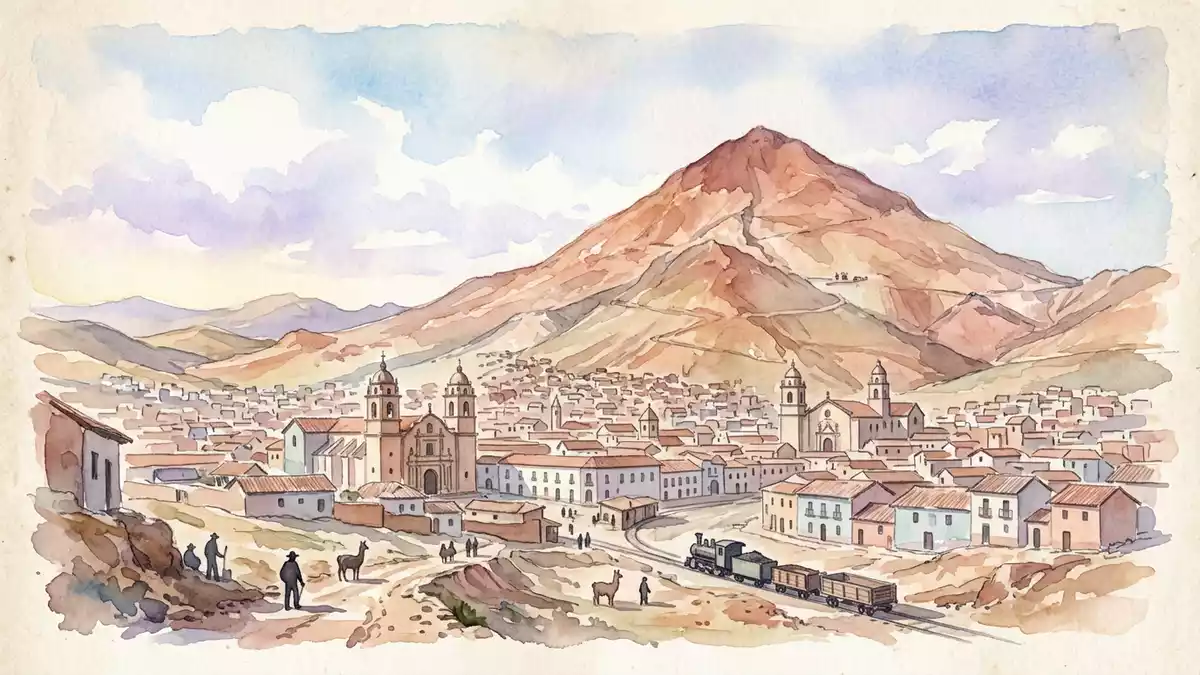
Cerro Rico above Potosi in Bolivia is a high Andean mountain whose silver ore reshaped global history and still defines the landscape around it. Rising to an elevation of around 4,700 m (15,400 ft), it forms a prominent cone immediately south of the city and remains riddled with mine workings and spoil heaps from centuries of extraction.
A rich mountain of the Andes
Cerro Rico, Spanish for “Rich Mountain”, stands in Bolivia’s southern highlands as part of the eastern chain of the Andes overlooking the historic city of Potosi. The peak reaches an altitude given in several sources as around 4,700 to 4,782 m (15,400 to 15,689 ft), marking it as a substantial summit on the high plateau where the air is thin and the climate is harsh.Altitude figures around 4,782 m The mountain lies roughly 1 km south of the city centre, rising steeply from the urban edge into a distinct cone of mineralised rock that has been heavily altered by mining.Located approximately 1 km south of Potosi
Geologically, Cerro Rico is described as a volcanic dome composed of highly altered rock rich in metals such as silver, tin, zinc and other ores.Volcanic rock mined for silver and other metals The slopes carry the traces of almost five centuries of intensive exploitation: portals marking the entrances to underground workings, spoil tips of discarded rock and processing installations scattered around its flanks. From the city below, the mountain dominates the skyline, its conical form providing a constant visual reminder of the mineral wealth that drew colonial power to this corner of the Andes.
The mountain that financed an empire
Silver ore from Cerro Rico powered the growth of Potosi after the mid-sixteenth century and provided a major source of revenue for the Spanish Empire. The silver deposits associated with the mountain were discovered in 1545, and extraction developed into what has been described as one of the largest industrial complexes of its time, centred on the mines and processing works linked to the peak.Discovery in 1545 and colonial mining complex Potosi became a major urban centre of colonial Spanish America, shaped physically and economically by the flow of silver extracted from the slopes and interior of Cerro Rico.Silver from Cerro Rico and growth of Potosi
Today, Cerro Rico forms part of the wider historic landscape of Potosi that has been recognised on the World Heritage List, with industrial monuments on and around the mountain linked to hydraulic mills, aqueducts and artificial lakes that served the ore extraction and processing chain.Industrial monuments of Cerro Rico and Potosi The historical record refers to immense quantities of silver removed from the mountain, and accounts highlight the human cost of the colonial labour systems that sustained production, including indigenous workers conscripted under the mita and later labour brought in to operate the mines. The phrase “the mountain that eats men”, used in several narratives, reflects the dangers associated with working deep inside Cerro Rico’s extensive tunnel network.The mountain that eats men
Cerro Rico as a landscape of mining
Cerro Rico’s present form is closely linked to continuing extraction and the legacy of past workings, giving the mountain a distinctive mining landscape that is visible from many points in and around Potosi. Multiple mine entrances dot the slopes, connecting to a vast system of underground galleries driven through the mineralised volcanic rock. Modern descriptions refer to hundreds of interconnected mines and thousands of tunnels, many of which remain in use and some of which are accessible on guided visits organised from the city.Interconnected mines in the mountain Visitors report entering working levels where miners extract ore with hand tools and basic equipment, moving through narrow passages and chambers where seams of metal-bearing rock are followed.
Accounts from environmental and development organisations describe Cerro Rico as structurally affected by centuries of mining, with parts of the cone’s summit area altered and some sections at risk of subsidence due to the density of underground workings.Structural concerns linked to extensive mining At the same time, silver, zinc, tin and other metals continue to be removed from the mountain by cooperative miners, and waste rock and tailings have accumulated on its slopes. For travellers viewing Cerro Rico from Potosi’s streets and squares, the mountain appears less as a remote peak and more as an extension of the city’s working environment, where extraction has long shaped both the skyline and the surrounding terrain.
Visiting Cerro Rico: what travellers from Western Europe should know
- Cerro Rico rises just south of Potosi in southern Bolivia and is reached from the city by road, with access tracks and streets leading up towards the mine areas on its lower slopes.
- The mountain stands at high altitude above 4,700 m (15,400 ft), and approaches on foot involve gradients on unpaved surfaces and paths that may cross areas of loose rock and mine debris.
- Cerro Rico is part of the historic mining landscape of Potosi, and guided visits into selected mine galleries are organised locally through tour operators and miners’ cooperatives based in the city.
- The official language is Spanish and the currency is the Bolivian boliviano.
- Entry requirements depend on your nationality; UK travellers can check the FCDO travel advice at gov.uk/foreign-travel-advice, Irish travellers the Department of Foreign Affairs at ireland.ie.
Searching for Cerro Rico on social platforms
These links open searches for Cerro Rico on each platform.Frequently asked questions about Cerro Rico
Where is Cerro Rico located?
Cerro Rico is a high Andean mountain immediately south of the city of Potosi in southern Bolivia, forming part of the eastern cordillera of the Andes.
What can travellers expect when visiting Cerro Rico?
Travellers encounter a working mining landscape with roads, mine entrances and spoil heaps on the mountain’s slopes, and locally organised tours can lead into selected underground galleries.
What makes Cerro Rico distinctive compared with other Andean peaks?
Cerro Rico is distinguished by its long history as a centre of silver mining, its extensive tunnel network and its role in shaping the colonial and industrial development of Potosi and the wider region.


