
Cerro Rico, the mountain that built Potosi’s silver city
Published on 09/04/2026 at 08:59 | Editorial responsibility: Rafael Müller, Editor-in-Chief AD HOC NEWS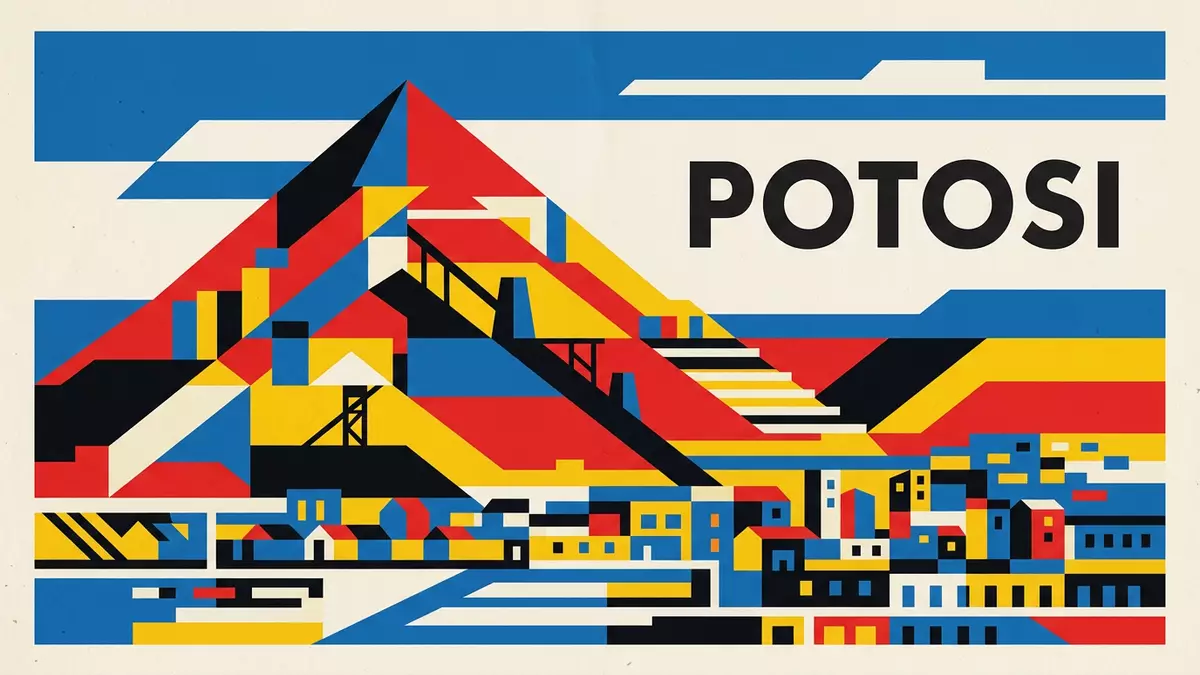
Cerro Rico rises above Potosi in southern Bolivia as a mineral mountain that has shaped the city’s form and fortunes for centuries. High in the central Andes, this “rich hill” became one of the most productive silver deposits in the world in the sixteenth century and still carries galleries and spoil heaps across its slopes.
A mountain of silver above a colonial city
Cerro Rico stands immediately south of Potosi, forming the backdrop to streets, churches and plazas built during the era of Spanish colonial rule. The peak lies in the Bolivian highlands at an elevation that places both mountain and city among the highest permanently inhabited mining centres in South America.the Cerro de Potosí south of the city The city of Potosi is inscribed as a UNESCO World Heritage Site, and Cerro Rico forms part of that cultural landscape through its industrial monuments and hydraulic works.industrial monuments of the Cerro Rico
The mountain’s silver ores attracted attention in the mid-sixteenth century and led to the rapid growth of Potosi as a mining and administrative centre. In 1545 the rich silver deposit of Cerro Rico was reported by the Indigenous prospector Diego Huallpa, and the Spanish authorities founded the city of Potosi at the mountain’s base soon afterwards.Diego Huallpa discovered the richest silver deposit Through the later sixteenth century and into the seventeenth century, ore from Cerro Rico fed smelters and refineries that supplied silver for coinage in Seville and other parts of the Spanish Empire.major colonial-era supplier of silver for Spain
Five centuries of mining on Cerro Rico
Extraction on Cerro Rico has continued in various forms for nearly five hundred years, leaving a dense network of tunnels and chambers within the mountain. Early colonial operations concentrated on high-grade silver veins, and historical studies estimate that a substantial part of the silver produced in the central Andes during that period was taken from this single deposit.vast quantities of silver to the Spanish Empire In the nineteenth and twentieth centuries attention shifted to tin-bearing ores, followed by complex sulphide ores containing zinc, lead and remaining silver in the late twentieth century.three principal stages of mining history
Geological and economic studies describe Cerro Rico as one of the largest silver deposits known, with mining documented from the sixteenth century onwards for silver and later for tin and zinc.world's largest silver deposit Research into lake sediments and stratigraphy suggests that mineral exploitation on the mountain was already taking place before the arrival of the Spanish, with evidence of pre-colonial extraction dating back many centuries.mining and smelting began around 1000 A.D. The long sequence of activity gives Cerro Rico a layered mining landscape, in which colonial galleries, republican-era shafts and cooperative workings coexist within the same massif.
Industrial heritage: reservoirs, mills and the silver city
Potosi’s World Heritage status reflects the combined heritage of Cerro Rico and the urban fabric below, where ore processing and trade shaped streets and architecture. On the slopes and adjacent high plateau, historic hydraulic infrastructure survives in the form of reservoirs and channels built to drive ore-crushing mills. At the height of colonial silver production, a system of around twenty-two reservoirs supplied water to more than one hundred mills that powered grinding and amalgamation works.22 lagunas and 140 ingenios These installations formed what has been described as a large industrial complex based around Cerro Rico and its ores.world’s largest industrial complex
Within Potosi, many churches, civic buildings and residential districts date from the period when silver from Cerro Rico funded construction and decoration. The Casa de la Moneda, built as a mint, and the ornate Church of San Lorenzo stand among structures connected to the mining economy, while workers’ quarters known as barrios mitayos mark the social geography of labour tied to the mountain.Casa de la Moneda and barrios mitayos The Spanish expression “vale un Potosí” entered the language during this era, indicating the perceived value associated with Cerro Rico’s silver and the city that grew beneath it.“vale un Potosí” meaning priceless
Visiting Cerro Rico: what travellers from Western Europe should know
- Cerro Rico rises directly south of Potosi in Bolivia’s central highlands, and access to viewpoints and mine entrances is reached from the city by road and tracks on the mountain’s slopes.
- The terrain on Cerro Rico consists of steep, high-altitude slopes with loose rock, mine tailings and networks of tracks, and any visit to the mining areas involves uneven ground and galleries cut inside the mountain.
- Potosi lies in the Bolivian Andes at over 4,000 m (13,123 ft) above sea level, so Cerro Rico and the surrounding landscape share thin air and cooler temperatures than many lowland destinations.
- The official language is Spanish and the currency is the Bolivian boliviano; entry requirements depend on your nationality, UK travellers can check the FCDO travel advice at gov.uk/foreign-travel-advice, Irish travellers the Department of Foreign Affairs at ireland.ie.
Searching for Cerro Rico on social platforms
These links open searches for Cerro Rico on each platform.
Frequently asked questions about Cerro Rico
Where is Cerro Rico located?
Cerro Rico stands just south of the city of Potosi in southern Bolivia, in the central Andes, forming the dominant mountain above the historic urban area.
What should visitors expect on a visit to Cerro Rico?
A visit to Cerro Rico involves high-altitude conditions, steep slopes and access routes linked to mine workings, together with views over Potosi and its colonial churches and streets.
What makes Cerro Rico distinctive among mining landscapes?
Cerro Rico is distinctive as a long-exploited silver and tin deposit whose industrial heritage, hydraulic infrastructure and colonial city below are recognised together as a World Heritage landscape.


