
Cerro Fitz Roy and the granite spire above El Chalten
Published on 08/27/2026 at 20:17 | Editorial responsibility: Rafael Müller, Editor-in-Chief AD HOC NEWS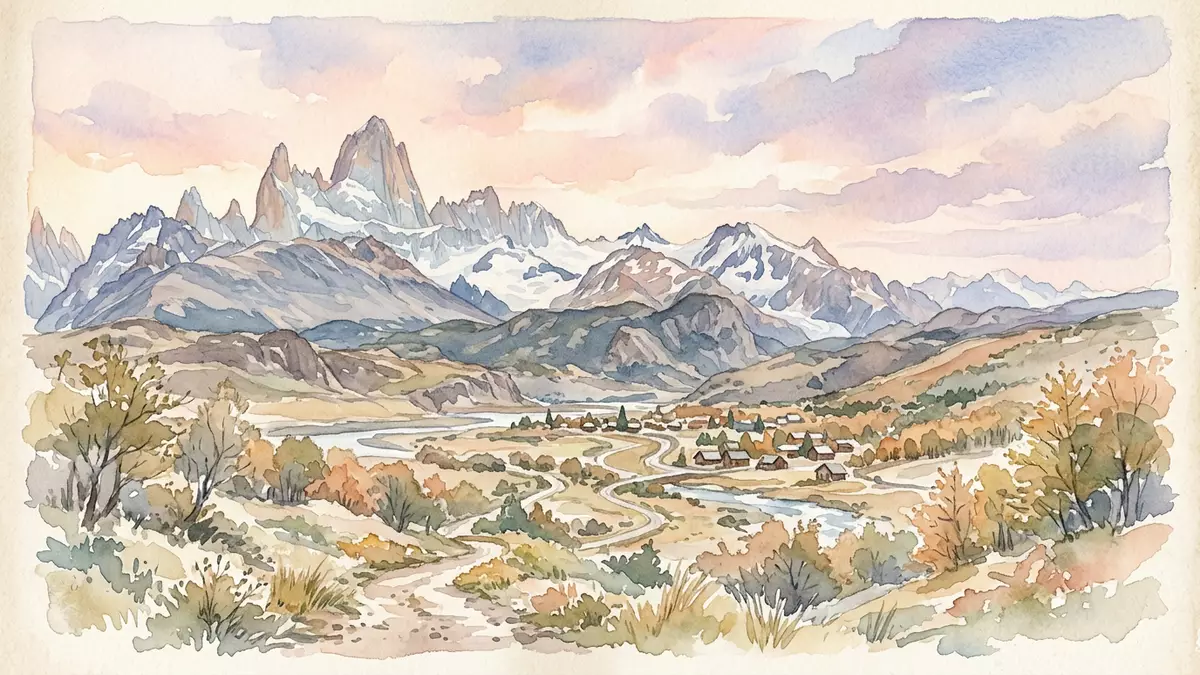
Cerro Fitz Roy rises above El Chalten as a sharp granite peak on the Argentine-Chilean border. The mountain is also known as Cerro Chaltén, and its profile is one of Patagonia’s most recognisable forms.
The granite summit above the valley
The mountain reaches 3,405 m (11,171 ft), a height that gives it a strong vertical presence above the surrounding valleys. Its slopes mix bare rock, ice and steep ridges, and the summit line is irregular rather than rounded.
That profile has long made Cerro Fitz Roy a reference point in southern Patagonia. The peak sits in the Los Glaciares area near El Chalten, where the mountains stand close to the valley floor and the rock faces read clearly against the sky.
Mount Fitz Roy and the nearby village share a tight visual relationship, with the mountain dominating views from the valley side. The border position adds another layer to its identity, since the peak belongs to both Argentina and Chile.
Cerro Chaltén and the naming of the peak
The name Cerro Chaltén is tied to the mountain’s indigenous history, while Fitz Roy reflects a later Spanish-era naming tradition. Both names have remained in use, and together they show how the peak sits at the meeting point of local and European maps.
The mountain is part of the Southern Patagonian Ice Field region, where rock and glacier systems meet in a narrow band of severe relief. In this setting, Cerro Fitz Roy reads as a freestanding massif rather than a softened range-top.
Captain of the HMS Beagle is the historical figure behind the Fitz Roy name, a link that places the mountain within wider nineteenth-century exploration of Patagonia. The older name and the later one remain part of the mountain’s identity in travel writing and map labels.
Rock, ice and the skyline of El Chalten
The mountain’s steep granite walls give it a different appearance from the lower, broader masses around it. Its summit point is narrow and jagged, and the surrounding ice and snow fields emphasise the hard edge of the rock.
El Chalten lies close enough that the peak becomes part of the town’s daily horizon, especially when the weather clears. From that side, Cerro Fitz Roy is less a distant mountain than a fixed landmark at the edge of the settlement.
near El Chalten is the simplest way to place it in relation to the town, and that proximity explains why the peak anchors so much local scenery. The mountain is also part of a wider ridge-and-ice landscape that continues across the border.
Visiting Cerro Fitz Roy: what travellers from Western Europe should know
- The mountain is reached from El Chalten in Argentine Patagonia. The approaches run through the Los Glaciares area and into mountain terrain rather than through an urban setting.
- The ground is steep, rocky and exposed at altitude. The peak itself is a climbing objective, while the valley views of it come from established walking routes.
- The border setting places the mountain in two countries at once. Cerro Fitz Roy is part of the Argentine-Chilean Patagonian landscape, with the summit line close to the frontier.
- The name Cerro Chaltén remains part of local usage. That older name sits beside the Fitz Roy name in maps and guide material.
Searching for Cerro Fitz Roy on social platforms
These links open searches for Cerro Fitz Roy on each platform.
Frequently asked questions about Cerro Fitz Roy
Where is Cerro Fitz Roy?
Cerro Fitz Roy stands near El Chalten in Argentine Patagonia, on the border with Chile. It belongs to the mountain and ice landscape of Los Glaciares.
What does a visit involve?
Visits centre on the mountain’s setting, views and mountain routes rather than on a built visitor monument. The terrain is steep and rocky, and the summit is part of serious alpine ground.
What makes Cerro Fitz Roy distinctive?
The mountain is distinctive for its steep granite form and sharp skyline. Its dual naming, border position and proximity to El Chalten add to its geographic character.


