
Centrul Istoric Sibiu and its ensemble of medieval squares
Published on 09/12/2026 at 20:05 | Editorial responsibility: Rafael Müller, Editor-in-Chief AD HOC NEWS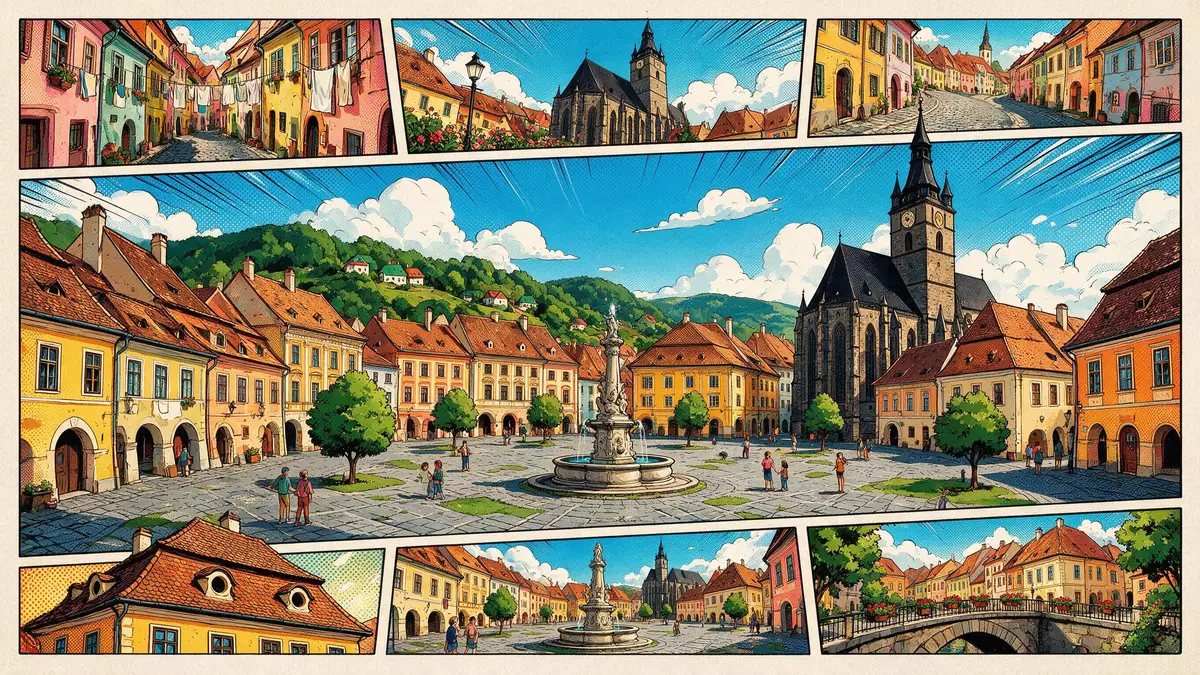
Centrul Istoric Sibiu is the historic core of Sibiu in central Romania, a medieval urban ensemble structured around a series of interconnected market squares and narrow streets in the Upper Town. The old centre preserves a townscape shaped between the thirteenth century and the modern era, with its form concentrated around the three major squares of Pia?a Mare, Pia?a Mic? and Huet Square.Centrul istoric al Sibiului
Medieval squares at the heart of Centrul Istoric Sibiu
The most striking feature of Centrul Istoric Sibiu is its chain of medieval squares, each with its own character yet linked by passages and streets that turn the Upper Town into a single walkable space. Pia?a Mare, the Large Square, serves as the main civic space of the historic centre and has existed since 1366, when Sibiu’s third fortification belt was completed.The square exists since 1366 It is one of the largest public squares in the Transylvanian town landscape, with a maximum length of around 142 m (466 ft) and a maximum width of about 93 m (305 ft).Lungimea maxim? de 142 m
Beyond Pia?a Mare, the historic centre continues into Pia?a Mic? and Huet Square, which together form a compact sequence of spaces that concentrate much of Sibiu’s old town life.Centrul istoric din Sibiu Pia?a Mic? bends around the upper edge of the Large Square, while Huet Square gathers ecclesiastical and civic buildings on a slightly higher terrace. Seen together, the three squares define the core geometry of Centrul Istoric Sibiu and frame views across roofs, towers and façades that step down towards the Lower Town.
A historic centre shaped between fortifications and civic life
Centrul Istoric Sibiu developed within a system of medieval fortifications that once wrapped around the Upper Town, giving the historic centre its compact form and clear edges.Zona este clasat? ca monument istoric Pia?a Mare emerged as a central space once Sibiu secured the right to organise regular markets in the thirteenth century, and documentation from 1408 records the square as a cereal market linked to merchants such as Mathias Baldi.pia?? de cereale Through the fifteenth and sixteenth centuries, it became the civic stage of the town, hosting public gatherings and markets that anchored daily life.
The political role of Pia?a Mare intensified after Sibiu became the seat of the Habsburg governor of Transylvania in 1692, turning the square into a ceremonial centre of imperial authority where decrees from Vienna were proclaimed in front of the townhouses and arcades.ceremonial centre of imperial authority In 1703 Johann Zabanius Sachs von Harteneck, one of the city’s leading figures, was publicly executed here, underlining the square’s role as a place for capital punishment as well as civic ceremony.beheaded Committees Zabanius Johann Between 1724 and 1757, a “lunatics’ cage” stood in the square, used to exhibit those who disturbed the night-time peace, a small but telling detail of how authority and spectacle intersected in the historic centre.the lunatic cage
Townscape, façades and the layout of the old centre
Walking through Centrul Istoric Sibiu reveals a layered townscape of guild houses, arcaded frontages and defensive remains that mirror the city’s long urban history. Along the northern side of Pia?a Mare, the first major construction belonged to the Guild of Tailors, erected in 1466, with one wing looking towards Pia?a Mic? and other buildings completing the urban wall of the square.Guild of Tailors erected in 1466 Later townhouses, many rebuilt or refronted in the eighteenth and nineteenth centuries, form a continuous line around Pia?a Mare, enclosing the space while leaving views towards towers that rise above the roofs.
The broader historic centre stretches from Pia?a Unirii and Bulevardul Corneliu Coposu in the south-east to Strada Dârstelor and the road to Alba Iulia in the west, bounded in the north by streets such as Nicolae Teclu and Pulber?riei and in the north-west by Pia?a Cibinului.Adresa SE Pia?a Unirii Within these limits, Centrul Istoric Sibiu concentrates medieval streets, small inner courtyards, churches and city walls that together define the character of Sibiu’s old town and give the historic centre its compact, walkable scale.
Visiting Centrul Istoric Sibiu: what travellers from Western Europe should know
- Centrul Istoric Sibiu occupies the central area of Sibiu, a city in central Romania, and is concentrated around the Upper Town squares of Pia?a Mare, Pia?a Mic? and Huet Square. It can be reached on foot from Sibiu railway station by following streets that lead towards the old town.
- The historic centre is built on a gentle hill, with streets that rise towards the Upper Town squares and drop towards the Lower Town. Visitors move between levels by stairways and sloping streets, some of which are paved with stone.
- The area around Centrul Istoric Sibiu includes the Cibin market to the north-west and modern boulevards such as Bulevardul Corneliu Coposu to the south-east, making it possible to combine time in the old centre with walks along the river and main roads.
- The official language in Sibiu and the rest of Romania is Romanian and the currency is the Romanian leu.
Searching for Centrul Istoric Sibiu on social platforms
These links open searches for Centrul Istoric Sibiu on each platform.
Frequently asked questions about Centrul Istoric Sibiu
Where is Centrul Istoric Sibiu located?
Centrul Istoric Sibiu occupies the central area of Sibiu in central Romania, extending between Pia?a Unirii and Bulevardul Corneliu Coposu in the south-east and streets such as Dârstelor and the Alba Iulia road in the west.Adresa SE Pia?a Unirii
What can visitors expect on a visit to Centrul Istoric Sibiu?
Visitors encounter a compact historic centre structured around Pia?a Mare, Pia?a Mic? and Huet Square, with medieval streets, townhouses and remaining fortifications arranged on a gentle hill above the Lower Town.ensemble of medieval squares
What makes Centrul Istoric Sibiu distinctive among Romanian historic centres?
Centrul Istoric Sibiu is distinguished by the way its three Upper Town squares form a single, continuous ensemble, framed by townhouses, guild buildings and defensive walls that preserve the medieval structure of a Transylvanian city.str?du?e medievale întortocheate


