
Centrul Istoric Sibiu and its ensemble of medieval squares
Published on 09/10/2026 at 12:25 | Editorial responsibility: Rafael Müller, Editor-in-Chief AD HOC NEWS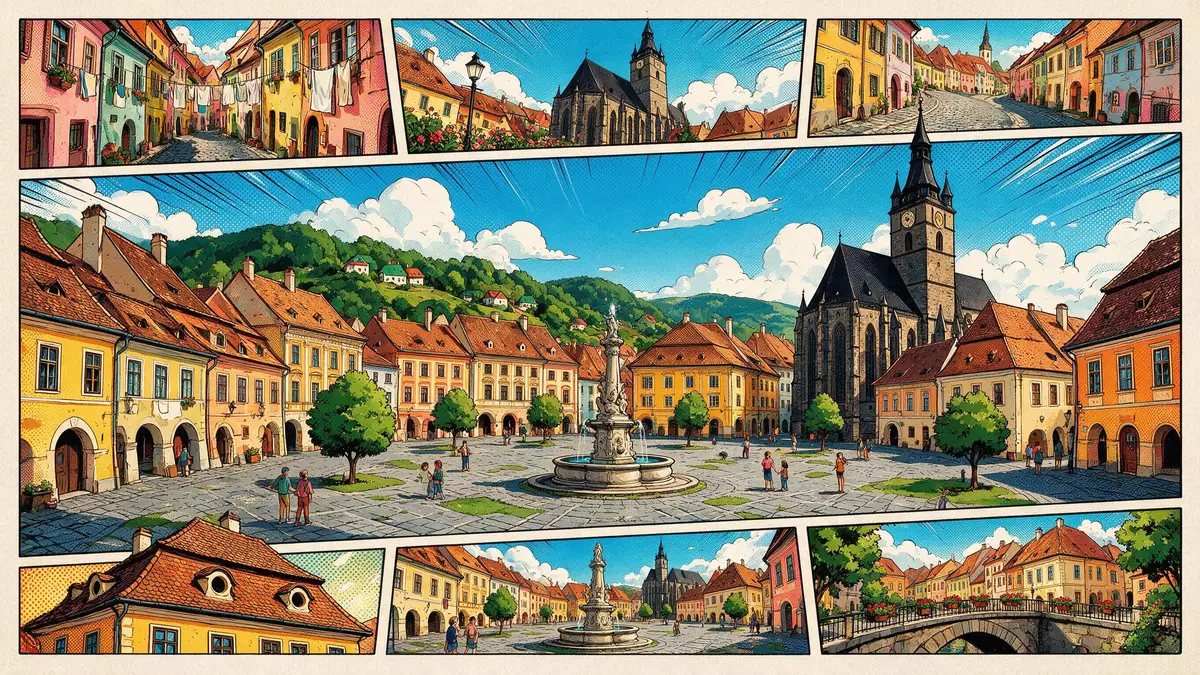
Centrul Istoric Sibiu is the historic centre of Sibiu in central Romania, a compact medieval core structured around an ensemble of squares and streets that grew with the city’s fortifications. Rooted in the late medieval period, this district concentrates Sibiu’s historic fabric around Pia?a Mare, Pia?a Mic? and Huet Square, where the plans of merchants, administrators and guilds left a dense urban landscape of houses, towers and churches.
Squares that organise the historic centre
The historic centre of Sibiu is concentrated around the three main squares of the Upper Town: Pia?a Mare, Pia?a Mic? and Huet Square, which together form a continuous civic space framed by historic buildings.Upper Town squares The ensemble is formally recognised as a monument, with the historic centre listed as a protected zone that preserves the medieval street pattern and building fronts.zona clasat? ca monument istoric
Pia?a Mare, the Large Square, developed as Sibiu’s principal civic space in the fourteenth and fifteenth centuries, after the completion of the city’s third belt of fortifications in 1366.square exists since 1366 Records from 1408 and 1411 mention stone houses and refer to the space as a cereal market, indicating its role as a trading hub for grain and goods brought into the city.document as a cereal market Huet Square and Pia?a Mic? extend this ensemble, connecting church fronts, guild houses and passages into a network that links the three main squares through arcades and slopes.
Pia?a Mare: a historic stage in stone
Pia?a Mare is the largest public square within Centrul Istoric Sibiu and has dimensions of around 142 m in length and 93 m in width, forming an open rectangle enclosed by historic facades.maximum length of 142 m During the Middle Ages it served as the setting for key aspects of urban life, with markets, public gatherings and judicial executions taking place in the same space that framed everyday trade and movement.stage for major civic events
From the seventeenth century onwards, Pia?a Mare took on a pronounced political function as imperial authority in Transylvania was expressed in the square. After Sibiu became the seat of the Habsburg governor in 1692, imperial decrees were proclaimed in this space, and military processions and inspections assembled there.ceremonial centre of imperial authority The history of the square includes the execution of Johann Zabanius Sachs von Harteneck in 1703 and the presence, between 1724 and 1757, of a cage for those who disturbed the night-time peace, an element that underlined the square’s role in public discipline.beheaded Johann Zabanius Sachs von Harteneck
Fortifications, streets and the wider historic ensemble
The historic centre of Sibiu is shaped by successive fortification belts, particularly the first two defensive rings, which influenced the geometry of the three main squares and the surrounding streets.rolul ordonator al primelor dou? incinte The area defined as Centrul Istoric Sibiu stretches from Pia?a Unirii and Bulevardul Corneliu Coposu on one side to Pia?a Cibinului and Aleea Filosofilor on the other, enclosing a core that carries walls, bastions and terraced streets over the remains of the fortifications.address boundaries around squares
The ensemble of squares and streets, including Pia?a Huet, Pia?a Mic? and Pia?a Mare, forms part of a World Heritage tentative listing submitted in 2004 under cultural criteria that highlight the historic centre and its squares.Historic Centre of Sibiu and its Ensemble of Squares Within this area, passages such as the General’s Hall, widened in 1775, link the Large Square to neighbouring spaces, while a network of streets carries views of towers, church spires and facades that reflect the evolution of Sibiu from a medieval Saxon city to an administrative centre in the Habsburg period.passageway widened in 1775
Visiting Centrul Istoric Sibiu: what travellers from Western Europe should know
- Centrul Istoric Sibiu occupies the central area of Sibiu in central Romania, concentrated around Pia?a Mare, Pia?a Mic? and Huet Square, and can be reached on foot from Sibiu railway station via streets leading into the old town.
- The terrain of the historic centre includes sloping streets between the Upper Town and Lower Town, cobbled surfaces and stairways linking levels around the squares and fortification remains.
- Sibiu lies in Romania, where the official language is Romanian and the currency is the leu.
- Entry requirements depend on your nationality; UK travellers can check the FCDO travel advice at gov.uk/foreign-travel-advice, Irish travellers the Department of Foreign Affairs at ireland.ie.
Searching for Centrul Istoric Sibiu on social platforms
These links open searches for Centrul Istoric Sibiu on each platform.
Frequently asked questions about Centrul Istoric Sibiu
Where is Centrul Istoric Sibiu located?
Centrul Istoric Sibiu is in the central part of Sibiu in central Romania, around the ensemble of squares that includes Pia?a Mare, Pia?a Mic? and Huet Square.
What should visitors expect when walking through the historic centre?
Visitors encounter linked squares, terraced streets, remains of fortifications and historic houses that reflect Sibiu’s development from a medieval Saxon town to a Habsburg administrative centre.
What makes Centrul Istoric Sibiu distinctive among European historic centres?
The concentration of three major medieval squares, the layered fortification belts and the World Heritage tentative listing for the historic ensemble give Sibiu’s centre a defined historic character.


